
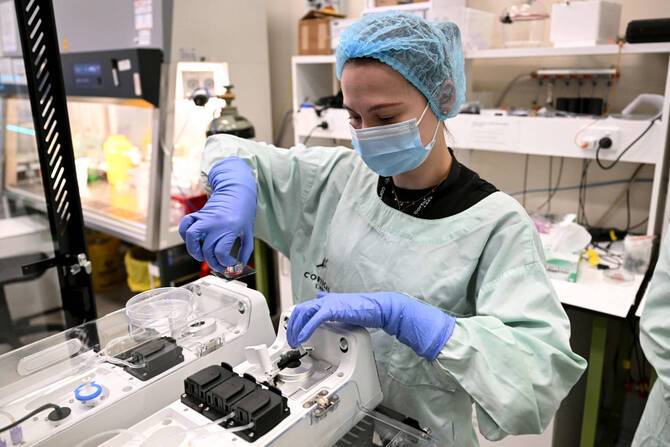
Australian Scientists Train Human Neurons to Play Doom Game
Biological Computer Learns Doom Through Real-Time Training

ISLAMABAD: (Web Desk) – Australian researchers have successfully trained lab-grown human brain cells mounted on a silicon chip to play the classic 1990s video game Doom, marking another significant step forward in biological computing technology.
The breakthrough comes from biotech company Cortical Labs, which has developed a system that combines living human neurons with computer hardware to create what it describes as a biological computer.
Each device contains approximately 200,000 living brain cells cultivated from stem cells derived from donated human blood. After previously learning to play the simple arcade game Pong, the neurons were challenged with the far more complex and fast-paced environment of Doom.
KP Athletes Receive Cash Awards After National Games
According to senior application scientist Alon Loeffler, the neurons initially behaved much like a first-time gamer, frequently walking into walls, firing in random directions and struggling to identify targets.
Over time, however, the neural cultures began adapting to the game’s environment. Researchers observed that the neurons increasingly recognized enemies and responded more effectively, demonstrating the ability to learn from experience and adjust their behavior in real time.
To achieve this, scientists translated elements of the game’s digital world into electrical signals that the neurons could interpret. When enemies appeared on screen, electrodes stimulated the cells, prompting reactions that controlled movements, aiming and firing actions within the game.
The neurons are housed on a specialized chip known as the CL1, which allows researchers to monitor and influence their activity through thousands of electrical connections. By analyzing these signals, scientists can train the neural network to improve its performance over time.
Researchers say the experiment highlights the potential of biological computing far beyond gaming. The technology could eventually support applications in robotics, machine learning, disease modeling, drug discovery and personalized medicine.
Chief scientific and operations officer Brett Kagan said the company is only beginning to understand the capabilities of these neural systems, describing the current achievements as an early glimpse of what biological computers may eventually accomplish.
Unlike traditional artificial intelligence systems, biological computers operate using living neurons, which consume significantly less energy. Scientists estimate the human brain functions on roughly 20 watts of power, a level of efficiency that modern AI systems and conventional computing hardware have yet to match.
While the technology is not intended to replace artificial intelligence, researchers believe it could complement existing systems by providing new forms of learning and computation that are currently impossible with silicon-based processors alone.
The neurons currently have a lifespan of around six months and do not yet produce fully consistent or programmable results. However, industry experts see promise in the technology’s potential to deliver more energy-efficient computing solutions.
William Keating, chief executive of semiconductor research firm Ingenuity, described the project as legitimate scientific progress that could help address growing concerns over the power demands of advanced computing systems.
Comments are closed, but trackbacks and pingbacks are open.