
Dialogue, Not Division: A Way Forward for Azad Kashmir
Pakistan invokes JAAC anti-terrorism act AJK amid growing diaspora pressure and unresolved demands

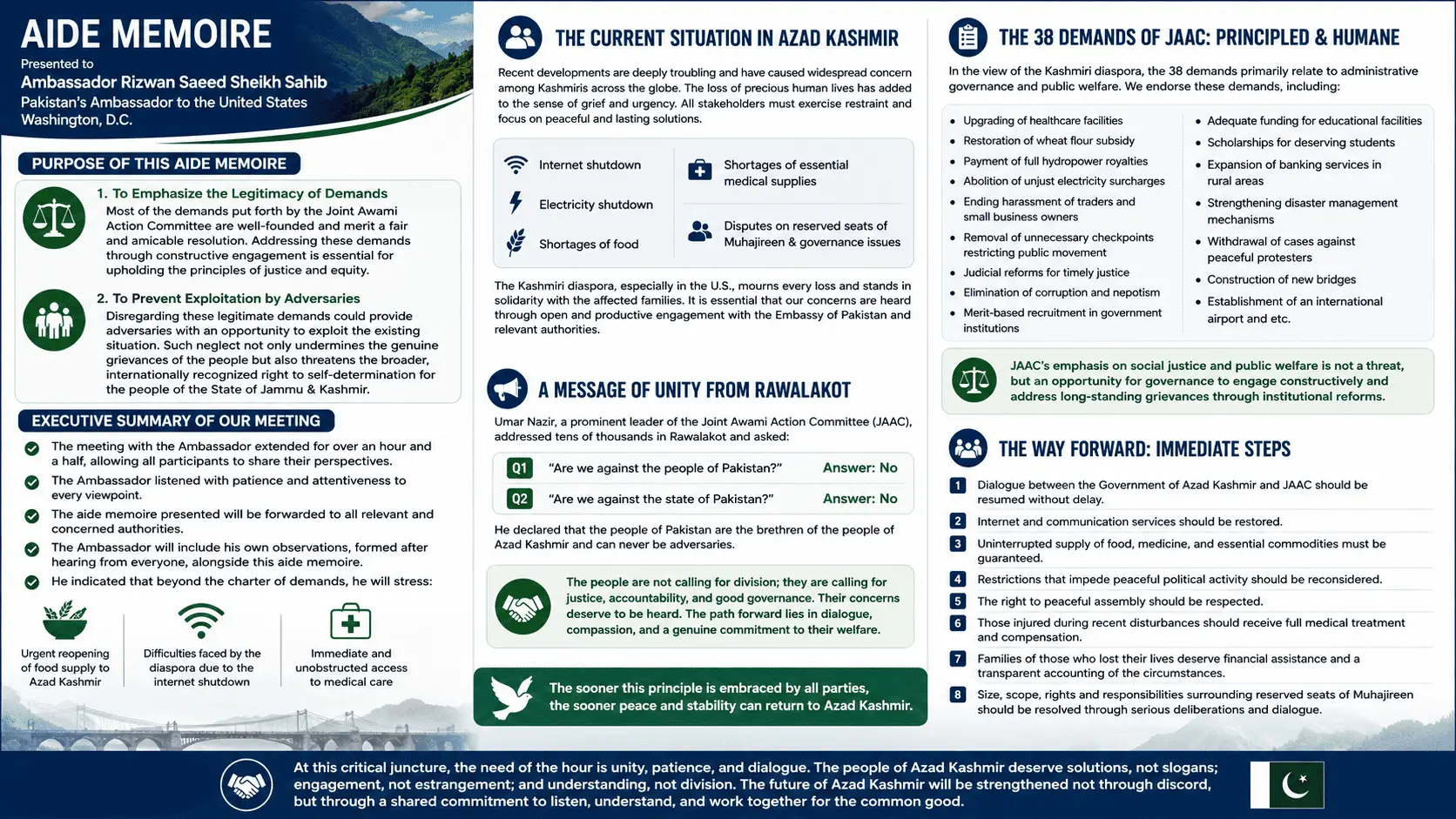
The following aide memoire was given to Ambassador Rizwan Saeed Sheikh Sahib, Pakistan’s Ambassador to the United States in Washington, D.C. in person.
The submission of this memorandum is guided by two primary objectives.
First, it seeks to emphasize that most of the demands put forth by the Joint Awami Action Committee are well-founded and merit a fair and amicable resolution. Addressing these demands through constructive engagement is essential for upholding the principles of justice and equity.
Second, it is imperative to recognize that disregarding these legitimate demands could provide adversaries with an opportunity to exploit the existing situation. Such neglect not only undermines the genuine grievances of the people but also threatens the broader, internationally recognized right to self-determination for the people of the State of Jammu & Kashmir.
The meeting with the Ambassador extended for over an hour and a half, providing ample time for all participants to share their perspectives.
Throughout the discussion, the Ambassador demonstrated patience and attentiveness, carefully listening to each viewpoint expressed by the attendees.
During the conversation, the Ambassador assured the group that the aide memoire presented would be forwarded to all relevant and concerned authorities. He further stated that he would include his own observations, formed after hearing from everyone present, alongside the aide memoire.
Of particular importance, the Ambassador indicated that beyond the charter of demands outlined in the aide memoire, he would stress the urgent need to reopen the food supply to Azad Kashmir without further delay.
He also committed to communicating the difficulties faced by the diaspora, especially those resulting from the ongoing internet shutdown. Additionally, the Ambassador emphasized the necessity of ensuring immediate access to medical care without any obstacles.
The recent developments in Azad Kashmir are deeply troubling and have caused widespread concern among Kashmiris across the globe.
The loss of precious human lives has added to the sense of grief and urgency. At a time when emotions are running high, it is imperative that all stakeholders exercise restraint and focus on finding peaceful and lasting solutions to the issues confronting the people of Azad Kashmir.
The Kashmiri diaspora, particularly in the United States, has been closely monitoring the situation. Like Kashmiris elsewhere, we mourn the loss of every life and express solidarity with the families affected by the ongoing unrest.
The challenges faced by the people of Azad Kashmir are real and cannot be ignored. Concerns regarding internet shutdown, electricity shutdown, shortages of food, and essential medical supplies deserve immediate attention. Likewise, disputes surrounding the reserved seats of Muhajireen and other governance-related issues require serious deliberations and consideration.
For this reason, it is essential that communication channels between the Kashmiri diaspora and Pakistani diplomatic missions remain open and productive. Constructive engagement with the Embassy of Pakistan and other diplomatic representatives can help ensure that the concerns of the Kashmiri American community are heard and conveyed effectively to the relevant authorities.
It is worth mentioning here that Umar Nazir, one of the prominent leaders of the Joint Awami Action Committee (JAAC), delivered a significant address to tens of thousands of people gathered in Rawalakot.
Speaking before the massive crowd, he stated that he wished to convey an important message to the people and the nation of Pakistan. To emphasize his point, he posed three questions to the attendees and requested their response.
First, he asked, “Are we against the people of Pakistan?” The crowd responded with a resounding “No.”
Second, he asked, “Are we against the state of Pakistan?” Once again, the response was an emphatic “No.”
He then declared that the people of Pakistan are the brethren of the people of Azad Kashmir and that they could never be considered adversaries.
Umar Nazir’s pronouncement clearly demonstrates that the relationship between Pakistan and Azad Kashmir has historically been founded upon shared values, mutual respect, and common aspirations.
While disagreements and grievances may arise from time to time, they should be addressed through constructive dialogue and peaceful engagement rather than confrontation.
The message from Rawalakot was unmistakable. The people are not calling for division; they are calling for justice, accountability, and good governance.
Their concerns deserve to be heard, and their grievances deserve to be addressed. The path forward lies not in confrontation, but in dialogue, compassion, and a genuine commitment to the welfare of the people. The sooner that principle is embraced by all parties, the sooner peace and stability can return to Azad Kashmir.
Mohtaram Ambassador Rizwan Sheikh Sahib, we would like to emphasize that, in the view of the Kashmiri diaspora, the 38 demands put forward by the Joint Awami Action Committee are primarily related to administrative governance and public welfare.
Many of these demands are principled and humane and reflect the everyday concerns of ordinary citizens of Azad Kashmir.
These include among others: the upgrading of healthcare facilities; restoration of the wheat flour subsidy; payment of full hydropower royalties; abolition of unjust electricity surcharges; ending the harassment of traders and small business owners; removal of unnecessary checkpoints restricting public movement; judicial reforms to ensure timely justice; elimination of corruption and nepotism; merit-based recruitment in government institutions; adequate funding for educational facilities; scholarships for deserving students; expansion of banking services in rural areas; strengthening disaster management mechanisms; withdrawal of cases against peaceful protesters; construction of new bridges; the establishment of an international airport and etc.
We as Kashmiri American diaspora endorse all these demands put forth by JAAC.
Let us also clarify one important point here that the JAAC’s emphasis on social justice and public welfare should not be viewed as a threat.
Rather, it should be seen as an opportunity for governments to engage constructively with citizens and address long-standing grievances through institutional reforms.
History teaches us that unresolved grievances rarely disappear on their own. When legitimate concerns are left unanswered, frustration accumulates, and social tensions intensify.
Conversely, when governments engage sincerely with citizens, even the most difficult disputes can be resolved peacefully.
The challenge today is not the existence of demands but the widening trust deficit between the government and the people of Azad Kashmir.
That deficit deepened after the October 2025 agreement reached between representatives of the Government of Pakistan and the Joint Awami Action Committee.
At the time, the agreement generated optimism because it included commitments to investigate the deaths of protesters, compensate victims and their families, withdraw cases against JAAC members, and undertake governance reforms.
However, many within JAAC believe that implementation has been slow and that several commitments remain unfulfilled.
The current situation in Azad Kashmir, therefore, calls for statesmanship rather than confrontation. Neither punitive measures nor restrictions can provide a lasting solution.
Peace and stability are achieved when people feel heard, respected, and treated fairly.
Several immediate steps could help de-escalate tensions and restore public confidence.
- Dialogue between the Government of Azad Kashmir and the Joint Awami Action Committee should be resumed without delay.
- Internet and communication services should be restored to ensure transparency and normalcy.
- The uninterrupted supply of food, medicine, and essential commodities must be guaranteed.
- Any restrictions that impede peaceful political activity should be reconsidered.
- The right to peaceful assembly should be respected.
- Those injured during the recent disturbances should receive full medical treatment and compensation.
- The families of those who lost their lives deserve both financial assistance and a transparent accounting of the circumstances surrounding these tragic deaths.
- Size, scope, rights and responsibilities surrounding reserved seats of Muhajireen should be resolved through serious deliberations and dialogue.
At this critical juncture, the need of the hour is unity, patience, and dialogue.
The people of Azad Kashmir deserve solutions, not slogans; engagement, not estrangement; and understanding, not division.
By choosing the path of respectful communication and constructive dialogue, all parties can contribute to stability, justice, and the well-being of the people they seek to serve.
The future of Azad Kashmir will be strengthened not through discord, but through a shared commitment to listen, understand, and work together for the common good.
Yours sincerely,
DMV Kashmiri American Community

For more information, please contact:
Raja Liaqat Kayani: (301) 674-9291
Khalid Faheem: (301) 237-0255
Abid Khan: (240) 643-0892
Zarif Khan: 202-714-5100
Shoaib Irshad: (571) 243-0452
Aftab Roshan: (571) 201-5849
Comments are closed, but trackbacks and pingbacks are open.