
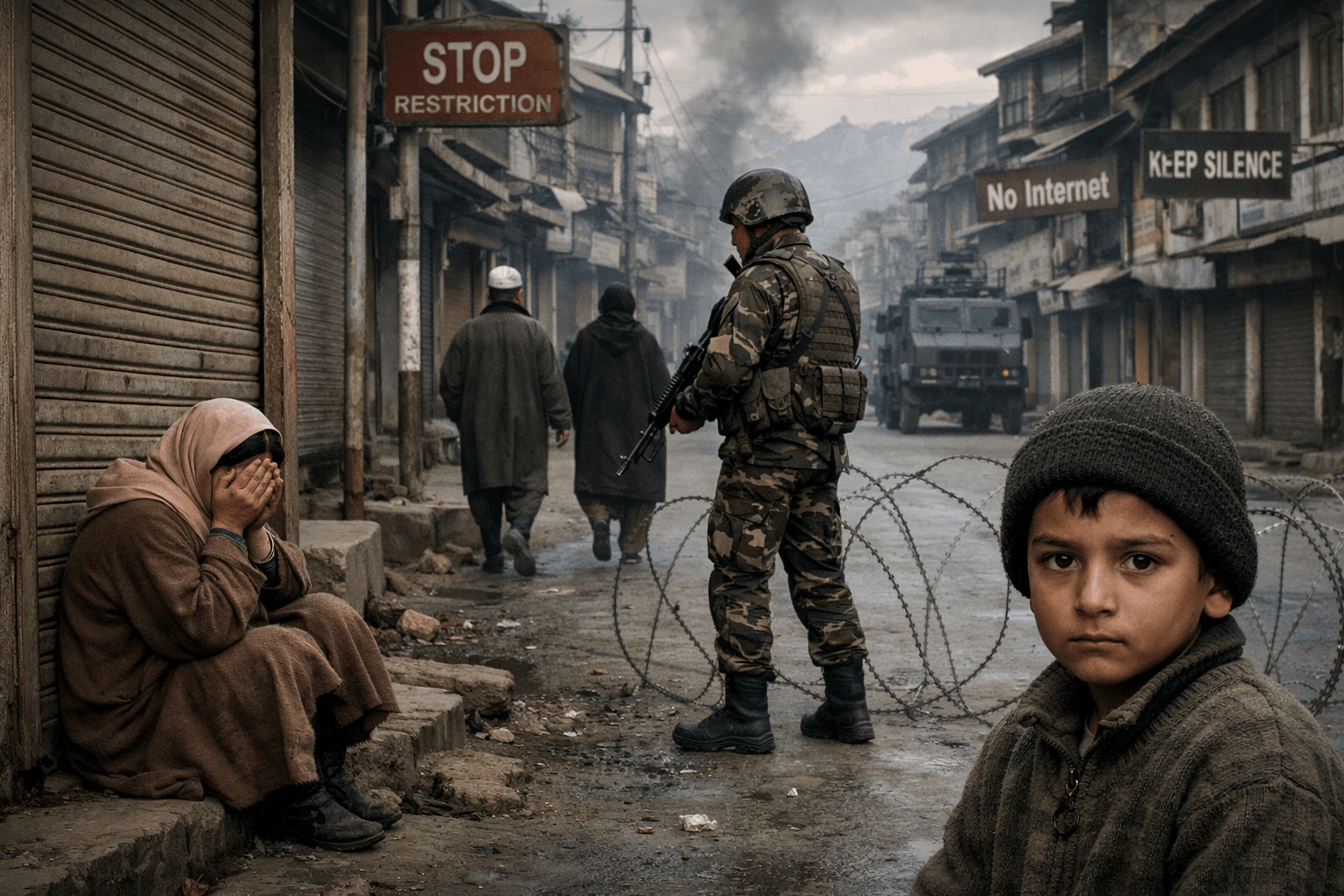

Youm-e-Istehsal (Day of Exploitation) is observed every year on 5 August in Pakistan to express solidarity with the people of Jammu and Kashmir. The day marks the constitutional changes introduced by the Government of India on 5 August 2019, which altered the special constitutional status of Jammu and Kashmir. Since 2020, Pakistan has officially observed this day through national ceremonies, seminars, media broadcasts, public rallies, and awareness campaigns.
The observance provides an opportunity for Pakistan to reaffirm its official position on the Kashmir dispute and to highlight its humanitarian, political, and legal dimensions. Government institutions, educational organizations, civil society, and media outlets participate in various activities to express support for the people of Kashmir and to promote awareness of the issue.
Why Is Kashmir Important?
Kashmir is one of the world’s most strategically important regions because of its geographical location, natural resources, and political significance. It shares borders with Pakistan, India, and China, making it highly important from both security and geopolitical perspectives.
The region is also the source of several major rivers, including the Indus, Jhelum, and Chenab, which play a vital role in agriculture, irrigation, and water resources, particularly for Pakistan. Besides its strategic importance, Kashmir possesses rich historical, cultural, and religious significance for the people living there. These factors make the Kashmir issue one of the most complex political disputes in South Asia.
Historical Background (1846–1947)
The modern history of Jammu and Kashmir began in 1846 with the signing of the Treaty of Amritsar between the British East India Company and Gulab Singh, the Dogra ruler of Jammu. Under this treaty, Gulab Singh acquired Kashmir and established the Dogra dynasty, which ruled the region for almost one hundred years.
During Dogra rule, the majority of the population was Muslim, while the ruling family was Hindu. This difference in demographics later became an important factor in the political developments of the region. Dogra rule continued until the partition of British India in 1947.
How Did the Kashmir Dispute Begin?
In August 1947, British India was divided into two independent states: Pakistan and India. The rulers of the princely states were given the option to join either country.
The ruler of Jammu and Kashmir, Maharaja Hari Singh, initially delayed his decision. In October 1947, tribal fighters entered Kashmir from areas bordering Pakistan, after which the Maharaja requested military assistance from India.
According to the Government of India, the Maharaja signed the Instrument of Accession before Indian troops entered Kashmir. Pakistan disputes this sequence of events and presents a different interpretation of the accession process. These opposing views remain at the centre of the Kashmir dispute. The deployment of Indian forces resulted in the First Indo-Pak War (1947–48).
The Role of the United Nations
In 1948, India referred the Kashmir issue to the United Nations Security Council (UNSC). The United Nations called for a ceasefire, which came into effect on 1 January 1949.
The Security Council later adopted several resolutions proposing that the people of Jammu and Kashmir should determine their future through a plebiscite. However, these proposals were never implemented because Pakistan and India disagreed over the conditions required for holding such a process.
As a result, Jammu and Kashmir has remained a disputed territory, with both countries continuing to maintain different legal, political, and diplomatic positions.
Major Historical Developments
Several major events have shaped the Kashmir dispute over the decades. The First Indo-Pak War (1947–48) ended with a UN-sponsored ceasefire, dividing the region between areas administered by Pakistan and India.
The Second Indo-Pak War (1965) also centred on Kashmir but ended without a permanent political settlement. Following the 1971 Indo-Pak War, the Simla Agreement (1972) established the Line of Control (LoC) as the de facto boundary separating the territories administered by both countries.
From 1989 onwards, the region witnessed increasing insurgency, militancy, and security challenges. Pakistan and India have continued to accuse each other of contributing to instability. Consequently, Jammu and Kashmir has remained one of the most heavily militarized regions in the world and continues to be a major issue in regional and international politics.
When the Day of Exploitation Is Observed
Youm-e-Istehsal is observed every year on 5 August across Pakistan. The date marks the constitutional and administrative changes introduced by the Government of India in Jammu and Kashmir on 5 August 2019. Pakistan officially began observing the day in 2020, and it has since become an important event on the national calendar.
Each year, the President, Prime Minister, Parliament, and other state institutions issue official messages reaffirming Pakistan’s support for the people of Kashmir. Educational institutions, media organizations, civil society groups, and political parties also organize seminars, conferences, discussions, and awareness programmes to mark the occasion.
Why and Where It Is Observed
According to Pakistan’s official position, the constitutional changes of 5 August 2019 were a unilateral alteration of the status of Jammu and Kashmir, which Pakistan considers a disputed territory under the relevant United Nations Security Council resolutions.
The day is observed to express solidarity with the people of Kashmir, raise awareness of the Kashmir dispute, and reaffirm Pakistan’s commitment to a peaceful resolution through dialogue and international law.
Youm-e-Istehsal is observed throughout Pakistan, including Islamabad, Lahore, Karachi, Peshawar, Quetta, Azad Jammu and Kashmir, and Gilgit-Baltistan. Activities include public rallies, seminars, conferences, newspaper articles, television and radio programmes, documentaries, educational events, and public discussions.
Effects of the Constitutional Changes of 5 August 2019
The constitutional and administrative changes introduced on 5 August 2019 brought significant political, legal, economic, and social changes in Jammu and Kashmir. These developments continue to be interpreted differently by Pakistan and India.
Immediately after the announcement, additional security forces were deployed across the region. Restrictions were placed on public movement, while telephone and internet services were suspended in many areas for extended periods. These measures affected education, business activities, healthcare, communication, and the daily lives of residents.
Several political leaders, including former Chief Ministers and members of mainstream political parties, were detained or placed under house arrest during the initial period. Public gatherings were also restricted as part of the security measures.
Under the Jammu and Kashmir Reorganisation Act, 2019, the former State of Jammu and Kashmir was divided into two Union Territories. Jammu and Kashmir retained a Legislative Assembly, while Ladakh became a separate Union Territory under the direct administration of the Central Government. At the same time, the constitutional provisions that had granted the region special status were removed, allowing Indian laws to apply directly.
The Government of India states that these reforms were intended to strengthen national integration, improve governance, encourage investment, promote economic growth, extend welfare programmes, and provide equal constitutional rights to all citizens. Indian authorities also cite infrastructure development, welfare schemes, local government elections, and legislative elections as evidence of progress.
In contrast, Pakistan and several Kashmiri political leaders argue that these constitutional changes reduced the region’s political autonomy, altered its legal status, raised concerns about demographic changes, and affected the identity of the local population. They have also expressed concerns regarding civil liberties, prolonged security restrictions, and human rights.
Independent observers and international organizations have presented differing assessments of these developments. Despite these differing views, it is widely acknowledged that the constitutional and administrative structure of Jammu and Kashmir changed significantly after 5 August 2019, with long-term effects on governance and the lives of its residents.
Key Personalities Associated with the 5 August 2019 Decision
Several political leaders played important roles in the constitutional changes announced on 5 August 2019.
On the Indian side, Prime Minister Narendra Modi supported the decision as part of his government’s long-standing political agenda. Union Home Minister Amit Shah introduced the necessary resolutions and legislation in the Indian Parliament and defended the government’s legal and political position. The constitutional orders were issued during the presidency of Ram Nath Kovind on the advice of the Council of Ministers.
Within India, the decision was opposed by several political leaders and parties. Omar Abdullah, a senior leader of the National Conference, and Mehbooba Mufti, leader of the People’s Democratic Party, publicly criticized the constitutional changes. Leaders of the Indian National Congress and several other opposition parties also expressed reservations. Some regional political leaders were detained for varying periods following the announcement.
From Pakistan’s perspective, the response was led by the then Prime Minister Imran Khan, who raised the Kashmir issue at international forums and called for greater global attention. Subsequent governments, including that of Prime Minister Shehbaz Sharif, have maintained Pakistan’s official position. Pakistan’s Parliament, the Parliamentary Committee on Kashmir, political parties, and civil society organizations continue to observe Youm-e-Istehsal every year to express solidarity with the people of Kashmir.
Constitutional and Legal Changes: Article 370 and Article 35A
The constitutional developments of 5 August 2019 marked one of the most significant changes in the history of Jammu and Kashmir. On that day, the Government of India revoked most provisions of Article 370 of the Constitution of India, which had granted the region a special constitutional status since 1949.
Before these changes, Jammu and Kashmir had its own Constitution, a separate state flag, and the authority to make laws on many subjects. The Parliament of India had limited legislative powers over the region, mainly in matters such as defence, foreign affairs, finance, and communications.
At the same time, Article 35A became inoperative. This provision had allowed the Jammu and Kashmir Legislature to define permanent residents and grant them exclusive rights related to land ownership, government employment, scholarships, and other benefits. After its removal, these special rights ceased to exist under Indian law.
The Jammu and Kashmir Reorganisation Act, 2019 divided the former State of Jammu and Kashmir into two Union Territories. Jammu and Kashmir was established with a Legislative Assembly, while Ladakh became a separate Union Territory under the direct administration of the Central Government.
Following these reforms, all provisions of the Constitution of India became fully applicable to Jammu and Kashmir, and many central laws were extended to the region.
According to the Government of India, these reforms were introduced to strengthen national integration, improve governance, encourage investment, create employment opportunities, and accelerate economic development.
Pakistan, however, rejects these constitutional changes, maintaining that Jammu and Kashmir is an internationally recognized disputed territory whose final status should be determined in accordance with the relevant United Nations Security Council resolutions and the aspirations of the Kashmiri people. These differing interpretations continue to shape regional diplomacy and international discussions on the Kashmir issue.
Youm-e-Istehsal is observed every year on 5 August as Pakistan’s official expression of solidarity with the people of Jammu and Kashmir. The day commemorates the constitutional developments of 2019 and highlights Pakistan’s position on the Kashmir dispute through peaceful and diplomatic means.
The constitutional changes introduced by India remain among the most significant political developments in South Asia in recent decades. While the Government of India views these reforms as measures to promote national integration, development, and equal constitutional rights, Pakistan considers them a unilateral change to the status of a disputed territory. These differing perspectives continue to influence regional politics, diplomatic relations, and international debate.
Every year, government institutions, educational organizations, media outlets, and civil society in Pakistan observe Youm-e-Istehsal through seminars, conferences, documentaries, special broadcasts, and awareness programmes. The observance emphasizes dialogue, respect for international law, and efforts aimed at achieving a peaceful resolution of the Kashmir dispute.
Rabia Malik Bs English ICG F6/2
Comments are closed, but trackbacks and pingbacks are open.