

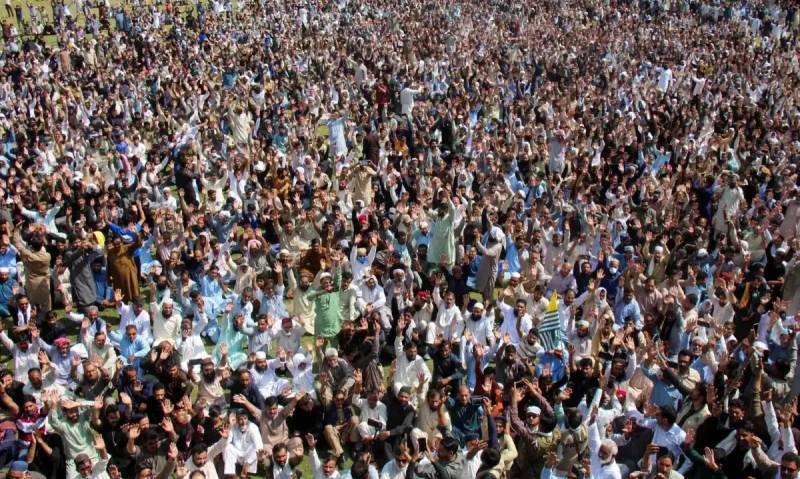

The movement being carried out in the name of public rights in Azad Kashmir now appears to be encouraging the people of Azad Kashmir toward rebellion, which is extremely regrettable.
The people of Azad Jammu and Kashmir have repeatedly expressed their deep affection for Pakistan and remain committed to the ideology of accession to Pakistan. However, the banned Joint Action Committee in Azad Kashmir seems to be losing its direction under the guise of advocating basic rights.
Speeches delivered from the stage of the ongoing sit-in in Rawlakot by leaders of the banned Joint Action Committee reportedly contained anti-state rhetoric and calls for Kashmiri personnel serving in the military to rebel. As a result, the movement now appears to be losing momentum and moving into reverse.
On one hand, the banned Joint Action Committee remains adamant about getting its demands accepted, while on the other hand, the government has repeatedly invited its leaders to resolve issues through negotiations.
A very large movement of the Joint Action Committee seems to be focused on a relatively small objective. At present, the dispute has become centered on the twelve legislative seats reserved for refugees residing in Jammu and Kashmir.
These twelve refugee seats are a constitutional matter that can only be resolved politically through the legislative assembly, with the participation and consent of all stakeholders. It is not a matter that can be settled simply through protests, shutdowns, or by expecting a notification from the Prime Minister’s House the next day abolishing the seats. The issue is far more complex than that.
The Action Committee argues that the twelve refugee seats are a burden on the people of the state and are used to make or break governments. This is certainly a matter open to debate. However, if we examine the historical background of these seats, they have held significant importance in relation to the Kashmir cause.
Since 1947, refugee representation has existed in various forms according to the political systems of different periods. Administrative shortcomings may exist, but abolishing these seats is not the solution.
Would the people of the state gain any benefit from the elimination of these seats? The answer is no.
Are the people of the state suffering any harm because these seats exist? The answer is also no.
If the members of the banned Joint Action Committee genuinely wish to protect public rights, they should move beyond the issue of these twelve seats and instead demand that future elections in Azad Kashmir be free from rigging, conducted transparently, and that the government be formed by whoever genuinely wins. No interference should be tolerated.
If these refugee seats are abolished today due to the Action Committee’s protests, has anyone asked the refugees residing in Pakistan whether they want these twelve seats to be eliminated? If the seats are removed, refugees living in Pakistan may begin protesting tomorrow, arguing that their identity has been undermined.
This issue could further deepen divisions among the people of the state.

After meetings with several senior figures and repeatedly hearing the government’s position, it can be inferred that the state is not inclined to show the same level of flexibility this time as it did in the past.
Previously, protests were held outside Indian embassies in Europe; now similar protests are being held outside Pakistani embassies. This seemingly indicates that India is succeeding in its objectives.
At present, India appears eager to exploit the situation through its proxies and push matters further toward instability, as India has never wanted peace in Pakistan. On social media, India is allegedly spreading hostility against Pakistani institutions through fake accounts, and several local individuals, knowingly or unknowingly, appear to be facilitating this agenda.
Various claims have also been made by the federal government regarding the implementation of the Charter of Demands, and additional time was reportedly requested from the Action Committee. However, the banned Action Committee remained committed to its June 9 call for protest.
For several days now, Azad Kashmir has experienced a blackout and internet service disruptions. Market closures and the partial suspension of transportation to various areas have caused considerable difficulties for citizens.
Despite this, the deadlock between the government and the protesters continues.
The members of the banned Joint Action Committee should set aside stubbornness and ego and adopt a path of reconciliation, while the Azad Kashmir government should also demonstrate greater flexibility and work toward a final resolution of the issue.
.
Comments are closed, but trackbacks and pingbacks are open.