

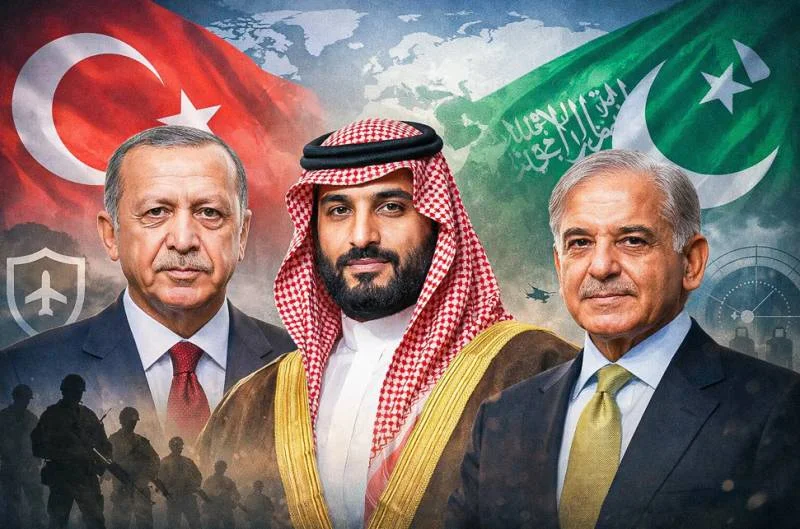

In a move that could reshape the strategic balance of power in the Middle East, Pakistan, Saudi Arabia and Türkiye have signed the Makkah Joint Defense Agreement, a landmark security pact that commits the three nations to collective defense against external aggression. The agreement, signed in the holy city of Makkah by PM Shehbaz Sharif, Prince bin Salman and Tayyip Erdoğan, is more than a military arrangement-it is a geopolitical statement that signals the emergence of a new strategic axis in the Muslim world.
At its core, the agreement stipulates that an armed attack against any one of the three countries will be treated as an attack against all, establishing an unprecedented trilateral security framework among three of the Islamic world’s most influential powers. While collective defense agreements are not uncommon in global politics, this is the first time Pakistan, Saudi Arabia and Türkiye have formally institutionalized such a commitment, reflecting a growing convergence of their strategic interests amid an increasingly volatile regional environment.
The timing of the agreement is particularly significant. The Middle East is undergoing rapid geopolitical transformation, driven by the Gaza conflict, tensions surrounding Iran, shifting alliances and intensifying competition among regional and global powers. Against this backdrop, the three countries appear determined to strengthen their own security architecture through deeper military coordination rather than relying solely on existing international partnerships.
Each member brings distinct strengths to the alliance. Pakistan contributes military experience and remains the only nuclear-armed Muslim-majority nation. Saudi Arabia offers economic power and political influence across the Arab and Islamic worlds, while Türkiye has emerged as a leading defense manufacturer with advanced drone technology, missile systems and a rapidly expanding defense industry. Together, these capabilities give the agreement considerable strategic weight.
Although the full text of the pact has not yet been released, Pakistan’s Foreign Office says it aims to strengthen collective deterrence, expand defense cooperation, promote intelligence sharing and deepen collaboration in military training and defense production. Officials have described the agreement as a reflection of the three countries’ shared determination to promote peace, security and stability while safeguarding their national interests.

The agreement is the culmination of months of diplomatic engagement. Turkish FM Hakan Fidan first disclosed in January that negotiations were underway, saying President Erdoğan envisioned a broader strategic platform linking the three countries. Pakistan later confirmed that the draft had been finalized after nearly a year of consultations, indicating that the pact was the product of careful planning rather than a response to any single regional crisis.
President Erdoğan has stressed that the agreement is “not against any country,” seeking to portray it as a defensive initiative aimed at preserving regional stability. Nevertheless, analysts believe the formation of a formal security framework linking Pakistan, Saudi Arabia and Türkiye will inevitably attract close attention from regional powers, particularly as new alliances continue to emerge across the Middle East.
Whether the Makkah Joint Defense Agreement develops into a NATO-style alliance or remains a framework for enhanced military cooperation will depend on the political will of its signatories and the mechanisms they establish in the months ahead. Yet its significance cannot be measured solely by its military provisions. The agreement signals a broader strategic shift toward greater self-reliance, coordinated security and regional leadership among three of the Muslim world’s most influential nations. In an era defined by geopolitical uncertainty, evolving conflicts and shifting alliances, the Makkah Joint Defense Agreement is more than a defense pact-it is a declaration that Pakistan, Saudi Arabia and Türkiye intend to play a more decisive role in shaping the future security architecture of the Middle East and the wider Islamic world.
The writer based in Rawalpindi, he is Journalist and Columnist.
Email:khawar.syed14@gmail.com
Comments are closed, but trackbacks and pingbacks are open.