

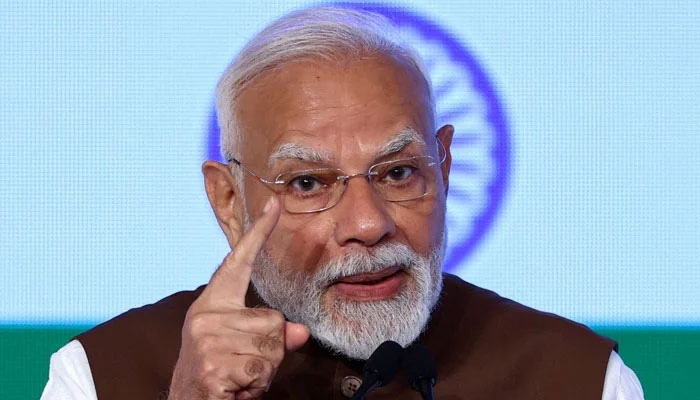
Modi’s Diplomacy: A Hand with Iran, a Hand with Israel
By: Professor Imran Ismail

International politics occasionally produces scenes that appear ordinary at first glance but reveal an entire diplomatic strategy when examined closely. New Delhi is witnessing precisely such scenes today. On one side, Indian Prime Minister Narendra Modi reiterates India’s commitment to Israel; on the other, he warmly shakes hands with Iranian President Masoud Pezeshkian. Israel remains a close strategic partner, while Iran remains important for India’s regional connectivity ambitions, particularly through Chabahar.
The question is not simply whom India is befriending.
The real question is: why is India trying to keep a foothold in so many different geopolitical camps at the same time?
The answer lies in the central principle of Indian foreign policy:
Where there is an interest, there is a relationship.
Modi has publicly reaffirmed India’s strong support for Israel. In his address to the Israeli Knesset, he also referred to Israel as the “fatherland” and India as the “motherland” of Israelis of Indian Jewish origin.
Yet Iran remains important to New Delhi as well.
The Chabahar port project has long been part of India’s strategy to reach Afghanistan and Central Asia while bypassing Pakistan. India’s 2026 budget did not allocate funds for Chabahar, raising questions about the impact of American pressure and sanctions, although Indian officials later indicated that New Delhi still wanted to find a sustainable way to remain involved in the project.
This is the interesting side of Indian diplomacy.
Keep Washington satisfied. Keep Israel close. Maintain relations with Tehran. Preserve old ties with Moscow. Sit with China and Russia in BRICS. Maintain economic links with the Arab world. And, at the same time, continue efforts to contain Pakistan diplomatically and strategically.
But there is one fundamental reality that New Delhi should not overlook:
Pakistan is not a country that can easily be pressured through diplomatic manoeuvring.
Pakistan has faced Indian attempts at diplomatic isolation before. It has faced efforts to shape the Kashmir narrative in India’s favour. It has faced the idea of Indian regional supremacy. Yet Pakistan has remained standing, defending its sovereignty and national interests.
And it will continue to do so, Insha’Allah.
India may have a large population, a growing economy and an increasingly active diplomatic presence. But economic size alone does not automatically translate into regional supremacy.
True national power also depends upon strategic resolve, geography, defence capability, national resilience and the ability to withstand pressure.
Pakistan has demonstrated that resilience repeatedly.
The recent BRICS gathering in New Delhi provides another revealing picture. Modi meets Pezeshkian, the two leaders exchange handshakes and smiles, and both sides discuss bilateral and regional issues. Yet beyond the diplomatic photographs lies a region experiencing serious tensions involving Iran, Israel, the Arab world and major international powers.
The activities of the Houthis, instability around the Red Sea, attacks affecting Arab countries, continuing turmoil in Lebanon and the broader Iran-Israel confrontation all demonstrate how fragile the regional balance has become.
In such circumstances, India is extending its hand in every direction.
But does reaching out to everyone automatically guarantee success everywhere?
Not necessarily.
Closer relations with Iran can create friction with Washington. Strong alignment with Israel can raise questions across the Muslim world. Continued ties with Russia can clash with Western preferences. Engagement with China through BRICS exists alongside India’s own strategic rivalry with Beijing.
Thus, beneath the appearance of diplomatic confidence, Indian foreign policy contains significant contradictions.
And Pakistan?
Pakistan has no reason to be intimidated by India’s diplomatic manoeuvring.
Pakistan does not claim that it can dictate terms to every country in the world. Its position is far simpler: we want peace, but with dignity and sovereignty; we want dialogue, but on the basis of equality; we want regional stability, but we will not accept anyone’s domination.
That is the difference.
If India believes that developing relationships with major global powers will enable it to impose its will upon Pakistan, history has already provided an answer—and it will provide one again.
Attempts have been made to pressure Pakistan before.
Attempts have been made to isolate Pakistan diplomatically.
Dreams of strategically surrounding Pakistan have also been entertained.
Yet Pakistan did not surrender then, and it will not surrender in the future, Insha’Allah.
India may continue playing its diplomatic game, but Pakistan is not a pawn.
Perhaps this is the first reality New Delhi needs to understand.
The real test of national power is not how many hands a country can shake. The real test is how firmly it can stand when its national interests are challenged.
Modi may have one hand extended towards Iran and another towards Israel.
Pakistan, meanwhile, stands firmly with both hands on its sovereignty and national interests.
That is its real strength.
India’s diplomatic manoeuvres will continue; Pakistan’s resolve will continue as well.
The difference is simple: India may have to calculate its next move after every diplomatic manoeuvre. Pakistan only needs to remain steadfast in defending its national interests.
And, Insha’Allah, Pakistan has neither bowed under pressure before, nor will it do so in the future.
Comments are closed, but trackbacks and pingbacks are open.