
The Himalayan Fury: From Nepal To Kashmir, A Warning We Can No Longer Ignore
Melting glaciers, sudden floods and the growing danger facing communities beneath the world’s highest mountains

By Muhammad Akeel Anjum
International Agriculture & Climate Journalist
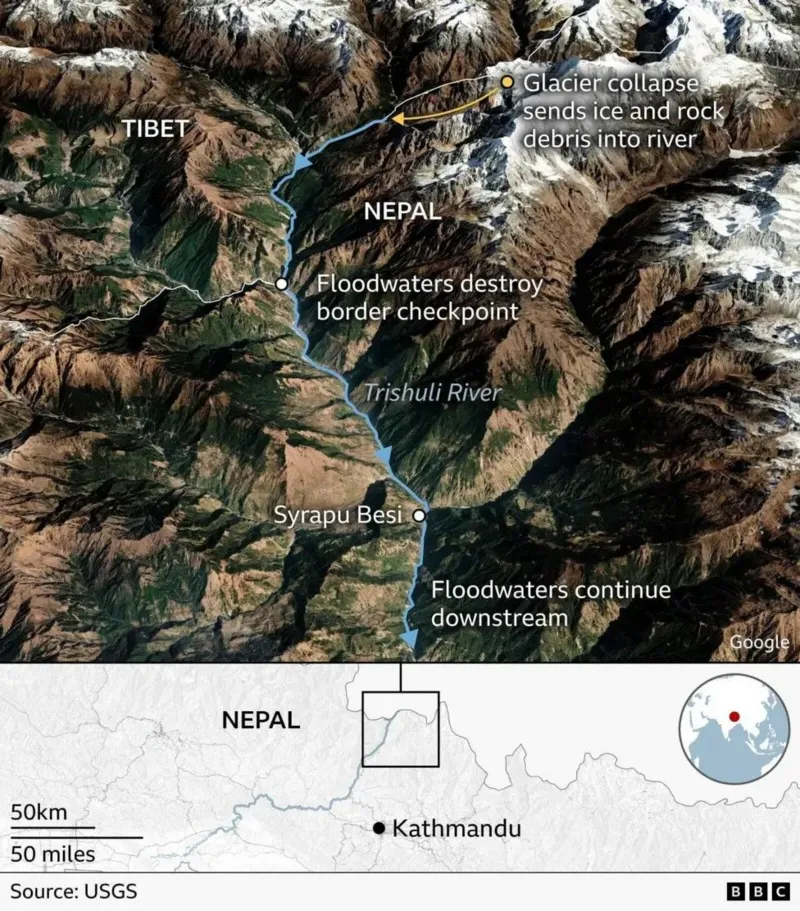
On August 26, 2026, the Himalayas sent a terrifying message from the Nepal-Tibet border. A huge mass of water, ice, rock, mud and debris suddenly came rushing down through mountain valleys in Nepal’s Rasuwa district.
Within minutes, roads disappeared, bridges were swept away, buildings collapsed and vehicles were carried downstream.
The images were shocking. But the disaster should not be dismissed as just another flash flood.
What happened in northern Nepal appears to have been a complex chain of hazards involving a major collapse of ice and rock at high altitude, the sudden obstruction and release of water, and a powerful debris-laden flood that tore through settlements downstream.
The disaster also struck the Chinese side of the border in Tibet, particularly around Gyirong, disrupting roads, infrastructure and a major cross-border route.
As rescue operations continue, the death toll has risen sharply. The latest reports put the number of confirmed deaths in Nepal at nearly 500, with hundreds more still missing.
On August 28, Reuters reported 489 deaths in Nepal and five in Tibet, with nearly 1,000 people still missing. The figures remain fluid as rescue teams reach areas that were cut off by the disaster. (Reuters)
The tragedy has also involved people from many countries.
Nepal’s Ministry of Foreign Affairs said on August 27 that 596 foreign nationals from 33 countries were still missing.
The official list included 167 Indian nationals, 66 Americans, 53 Ukrainians, 51 Malaysians, 35 Australians, 33 Britons, 25 Canadians and citizens of a range of European and Asian countries.
The list also included nationals of France, Germany, Italy, the Netherlands, New Zealand, Japan, South Korea, Spain, Sweden, South Africa, Russia, Singapore and others. (Ministry Of Foreign Affairs)
These are not merely numbers.
Behind every missing person is a family waiting for news.
And behind this tragedy lies a much bigger question:
If the glaciers, snowfields, lakes and mountain slopes above us are becoming increasingly unstable, how prepared are the millions of people living below them?
That question is no longer only about Nepal.
It is a question for the entire Himalayan region — including Pakistan and Azad Jammu and Kashmir.
Where did the water come from?
The exact sequence of events is still being investigated.
Initial reports created confusion about the cause. An earthquake was detected in Tibet around the same time as the disaster, while questions were also raised about rainfall and a possible glacial lake outburst.
But subsequent assessments increasingly pointed towards a major ice and rock collapse in the high mountains near the Nepal-Tibet border.
According to preliminary assessments reported by Nepali scientists and disaster authorities, an avalanche appears to have fallen into and blocked the Lhende River.
Water then accumulated behind the obstruction before the blockage gave way, sending a sudden surge downstream into the Bhote Koshi river system.
Scientists have also been investigating whether a glacial lake outburst may have been involved. (Kathmandu Post)
That distinction matters.
This was not necessarily a conventional rain-fed flood.
A large mass of ice, rock and debris can temporarily block a mountain river. Water builds up behind the blockage. Once the natural barrier fails, the accumulated water can burst downstream with enormous force.
And what comes down is not just water.
It can carry boulders, mud, ice, sediment and pieces of the mountain itself.
That combination can transform a relatively narrow mountain river into a moving wall of destruction.
Did heavy rainfall cause the disaster?
This is one of the most important questions.
A catastrophic mountain flood does not necessarily require torrential rain at the exact location where the destruction occurs.
Mountain hydrology is very different from what we see in the plains.
The Nepali Department of Hydrology and Meteorology reported that there had been no heavy rainfall in the Rasuwa area immediately before the disaster.
Preliminary assessments therefore focused on an upstream sudden release of water rather than a conventional rainfall-driven flood. (Kathmandu Post)
That does not mean rainfall is irrelevant.
Rainfall can weaken slopes, increase runoff and add pressure to an already unstable mountain system.
But it means that monitoring rainfall alone is not enough.
We need to know what is happening above the river.
We need to monitor glaciers, snow cover, glacial lakes, unstable slopes, landslide-prone areas, river levels and rainfall together.
Is climate change responsible?
This question requires scientific caution.
It would be wrong to claim that one particular flood was caused entirely by climate change without a specific attribution study.
But it would be equally wrong to ignore the much larger changes taking place across the Hindu Kush Himalaya.
Glaciers across the region are losing ice at an accelerating rate.
A major ICIMOD assessment found that Hindu Kush Himalayan glaciers disappeared 65 percent faster during 2011–2020 than during the previous decade.
A newer ICIMOD assessment released in 2026 says that glacier ice loss across the Hindu Kush Himalaya has continued to accelerate, with rates of ice loss doubling since 2000. (ICIMOD)
These numbers matter.
Glacier retreat is not simply a story about disappearing ice.
As glaciers retreat, water can accumulate in new or expanding glacial lakes.
Mountain slopes can become destabilised.
Rock and debris can accumulate in valleys.
Permafrost and frozen ground at high altitude can weaken as temperatures rise.
And when heavy rainfall, an avalanche, rockfall or landslide occurs, several hazards can interact.
That is when a local mountain event can suddenly become a regional disaster.
Recent scientific assessments of the Nepal disaster have also pointed to a collapse beneath a glacier and the resulting cascade of ice, rock and debris.
Scientists have stressed that a direct climate attribution cannot yet be established, but warming conditions can increase the instability of high-altitude slopes and glaciers. (AP News)
Glacier melt does not mean only more water
- There is another side to the glacier story that is often ignored.
- In the short term, accelerated melting can increase water availability and raise the risk of flooding.
- But if glaciers continue to shrink, their contribution to rivers during dry periods can eventually decline.
- In other words, the region can face two apparently opposite problems:
- Too much water today — and too little water tomorrow.
- That has enormous implications for Pakistan.
- Agriculture, hydropower, drinking water and the livelihoods of millions of people depend on river systems originating in the mountains.
- The Himalayan cryosphere is therefore not simply an environmental issue.
- It is a food-security issue.
- It is a water-security issue.
- It is an energy-security issue.
- And increasingly, it is a human-security issue.
Where is the global media?
- Every major climate disaster produces dramatic images.
- For several days, international media reports the death toll, shows aerial footage and interviews survivors.
- Then another crisis appears.
- The attention moves elsewhere.
- But investigative journalism should go beyond the immediate disaster.
- It should ask:
- Was the risk known?
- Were people warned?
- Were evacuation plans in place?
- Were natural waterways protected?
- Were high-risk settlements mapped?
- Were construction rules enforced?
- Was scientific information available?
- And if the information was available, why were people still exposed?
- These questions matter as much as the number of people killed.
The real danger is not one hazard
- The greatest danger is not simply glacier melt.
- It is not simply cloudbursts.
- It is not simply landslides.
- The real danger emerges when several natural and human vulnerabilities meet.
- Heavy rain falls on a fragile mountain slope.
- A landslide blocks a stream.
- Water accumulates.
- A temporary barrier collapses.
- The flood enters a settlement.
- The natural drainage channel is blocked by construction.
- A bridge fails.
- People receive no warning.
- And a natural event becomes a human catastrophe.
-
This is the chain we need to break.
A research agenda for Azad Jammu and Kashmir
The region now needs a comprehensive public-interest investigation:
“Natural Waterways, Encroachment and Climate Risk in Azad Jammu and Kashmir: 2000–2026”
The investigation should examine the region district by district and, where possible, stream by stream.
It should combine:
- Historical maps
- Satellite imagery
- Flood records
- Rainfall data
- River-flow data
- Government construction records
- Environmental regulations
- Disaster-management reports
- Local government records
- Interviews with residents
- Interviews with scientists and engineers
- Documentation of cloudburst and flash-flood events
- Identification of settlements and infrastructure exposed to flood pathways
The objective should be simple:
Identify the risks before they become disasters.
This cannot be done by journalists alone.
Climate scientists, hydrologists, geologists, urban planners, environmental experts, disaster-management authorities and local communities all need to be part of the process.
The final warning
- On August 26, a mountain above Nepal released a deadly combination of ice, rock, mud and water.
- The world watched the videos.
- People were shocked.
- Families began searching for missing relatives.
- Rescue teams began working through debris.
- But we should not watch those images merely as scenes from a disaster in a distant country.
- We should look at them as a warning.
- In those images, we can see Nepal.
- We can see Tibet.
- We can see Gilgit-Baltistan.
- We can see Chitral.
- We can see Neelum Valley.
- We can see Muzaffarabad.
- We can see Kishtwar.
- And we can see millions of people living beneath the Himalayan and Hindu Kush mountains.
- We cannot stop climate change overnight.
- We cannot command a glacier not to melt.
- We cannot tell a cloudburst where to fall.
- But we can reduce the human cost.
- We can protect natural waterways.
- We can stop new construction in high-risk flood channels.
- We can monitor glaciers and glacial lakes.
- We can monitor rainfall and river levels.
- We can strengthen early-warning systems.
- We can prepare evacuation routes.
- We can make mountain communities part of disaster planning.
- And above all, we can stop believing that a disaster happening today in Nepal is too far away to concern us.
- The Himalayas are one interconnected natural system.
- What happens high in the mountains does not necessarily stay there.
- The crisis begins in the mountains — but the water always comes down.
Comments are closed, but trackbacks and pingbacks are open.