
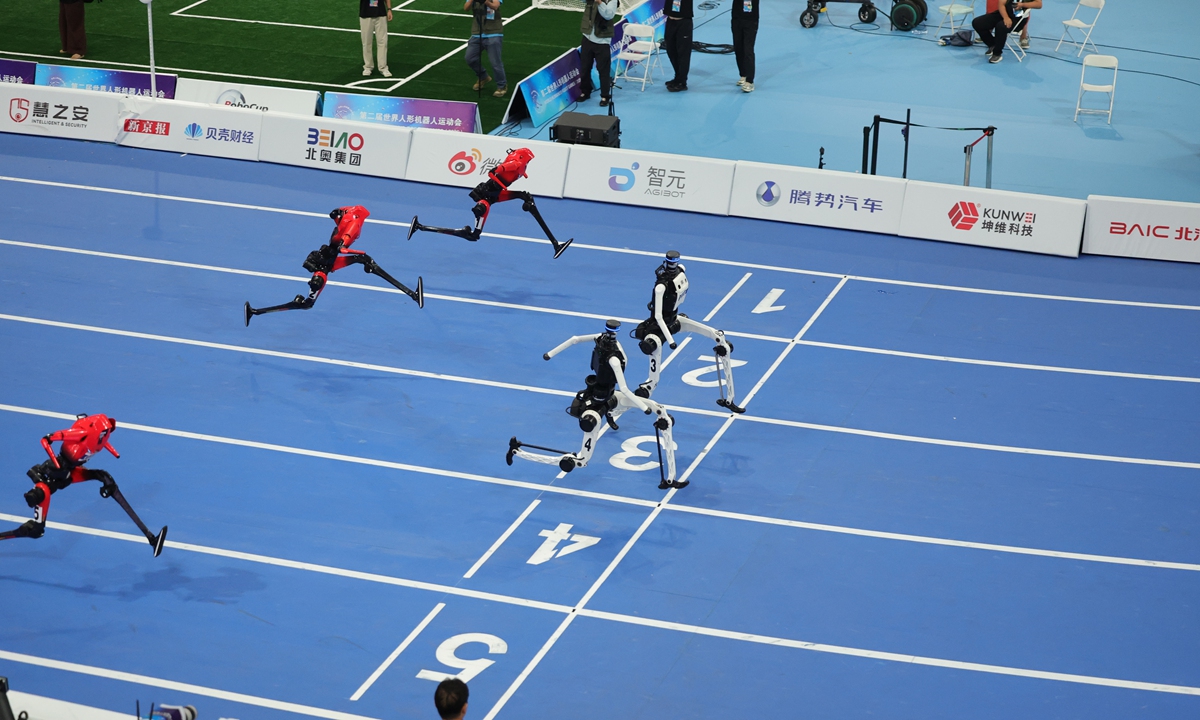
Tiangong Ultra Sets New 100m Record as Beijing Robot Games Close
Humanoid robot outruns the fastest man alive, but still can't think like one

China – (Special Correpondent/Web Desk) – A humanoid robot from China has just made history. The Tiangong Ultra 100m record now stands at 8.64 seconds, faster than Usain Bolt’s famous human record of 9.58 seconds. This win shows how far robot technology has come, but experts say the robot didn’t win by running like a person.
The record run happened in Beijing this week. Tiangong Ultra reached a top speed of nearly 42 kilometers per hour. That is much faster than any human sprinter has ever run.
Jung Moon-hyun, a sports science professor in South Korea, called it a huge step forward. He said it is rare to see a robot keep its balance while running this fast. No human can match that speed right now.
Still, the robot’s start was rough. Bolt reacted to the starting gun in just 0.146 seconds during his 2009 world record run in Berlin. Tiangong, on the other hand, stood in a stiff, upright pose. In an earlier run, it even waited almost a full second before it started moving, because it missed the starting signal.
Experts believe the robot could go even faster with real starting blocks. Iain Hunter, a sport scientist in the United States, said blocks would help the robot push off harder at the start. He guessed Bolt would already be five meters ahead before Tiangong even got moving.
Watch how, in less than 3 years, China’s humanoid robots🤖 have gone from stumbling steps to breaking human running records🏆 pic.twitter.com/1bw9Szq42u
— China Xinhua News (@XHNews) August 26, 2026
But once it starts running, the robot has clear advantages. Its makers redesigned the torso and waist to make it lighter. This change made it easier for the robot to move quickly. Engineers also upgraded its motors and control software to help it run more smoothly.
One big difference is the robot’s steps. Bolt finished his famous race in just 41 strides. Tiangong needed more than 50 steps to finish, but each step came much faster than a human stride. Experts say this quick, short-step style helps the robot stay balanced while running at top speed.
Robots and humans also get their power in very different ways. Human legs use muscles and joints that bend and stretch with every step. Robots use electric motors that simply spin at the joint, without needing to stretch like a muscle does.
This gives robots one big edge: they don’t get tired. Human sprinters slow down near the finish line because their muscles start to tire. Tiangong showed no signs of slowing down, even in the final stretch of the race.
That strength came with a downside, though. After hitting its top speed, the robot crashed into a padded wall at the end of the track. It could not slow itself down in time.
Experts say this is where robots still fall behind humans. Sports scientist Parunchaya Jamkrajang said real progress will come when robots can turn, react, and make quick decisions, not just run in a straight line. Right now, robots still can’t judge when to slow down or change direction on their own.
Even so, the Tiangong Ultra 100m record marks a major turning point. It shows robots can now beat human speed limits, even if they still have a long way to go before they can think and react like a person.
[…] (News Desk) – Philippine tennis star Alexandra Eala is already looking ahead to the Asian Games after her hard-fought exit from the US Open, saying she […]
[…] a letter to Ford CEO Jim Farley, published on the Department of Transportation’s website, Duffy said the company’s recent […]