
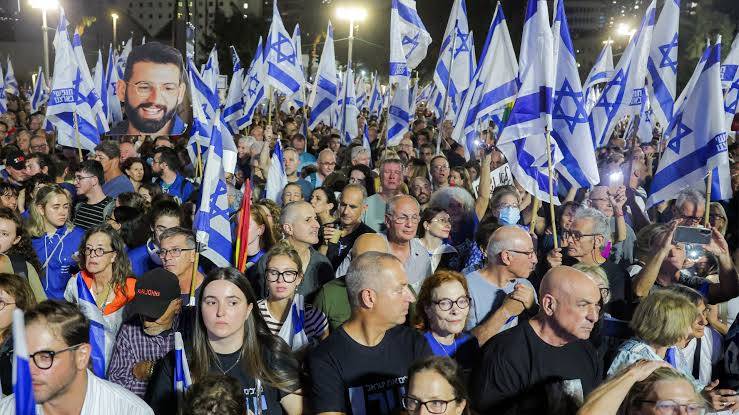
Tel Aviv Rally Demands Inquiry Into October 7 Failures
Thousands Rally Against Netanyahu Ahead of Israeli Election

TEL AVIV:(Web Desk) Thousands of people gathered in Tel Aviv on Saturday for a major anti-government rally, just three days before Israel’s general election, which has emerged as a crucial test of Prime Minister Benjamin Netanyahu’s political standing.
The demonstration was organised by the October Council, a group formed by families of victims and people taken hostage during the Hamas-led attack on October 7, 2023. The group is demanding accountability for the security failures that allowed the attack to take place and triggered the war in Gaza.
According to Israeli media reports, leaders of the four main opposition parties attended the rally. Among them was former military chief Gadi Eisenkot, whose political bloc is competing closely with Netanyahu’s camp. Eisenkot received a warm welcome from the crowd.
In a statement posted on X before the demonstration, the October Council said the gathering marked the culmination of three years of campaigning to uncover the truth, establish accountability and secure the creation of a state commission of inquiry into the October 7 failures.
Thousands of demonstrators marched from Rabin Square towards Hostages Square, a prominent site for previous protests calling for the release of hostages held in Gaza. The demonstration reflected continuing public anger over the government’s handling of security and its refusal to establish an independent inquiry.
Opinion polls published before a pre-election reporting blackout began on Friday night suggested that neither political bloc was on course to secure a parliamentary majority. A survey by Israeli public broadcaster KAN projected 52 seats for Eisenkot’s bloc and 50 for Netanyahu’s, with the remaining seats going to other parties, including Arab political groups. Israel’s parliament, the Knesset, has 120 seats.
Hadas Feuershtein, a 68-year-old demonstrator who spoke to AFP before the rally, criticised the government’s performance, saying Israel had never faced a situation like the current one.
Ahead of the gathering, the October Council warned law enforcement authorities about possible provocations by pro-government activists. Israeli police later announced that they had arrested a suspect accused of assaulting the security team of a public figure in Tel Aviv. Israeli media identified the individual as former prime minister and opposition leader Naftali Bennett.
The rally followed years of demands from opposition parties and civil society groups for an independent commission to investigate the security failures surrounding the October 7 attack. Netanyahu’s government has resisted calls for such a body and instead proposed a commission whose members would be divided between government and opposition appointees.
Opposition leaders have rejected that proposal, arguing that politicians should not control an investigation into the failures of their own government.
With the election campaign approaching its conclusion, Eisenkot and Bennett were expected to hold separate final meetings with supporters in Tel Aviv on Sunday evening.
The election campaign has also been marked by debate over Israel’s international standing and economic future after years of conflict in Gaza, Lebanon and Iran, alongside escalating violence in the occupied West Bank.
Naama Bitterman, an 18-year-old first-time voter attending Saturday’s rally, expressed confidence that the anti-Netanyahu bloc could prevail and improve Israel’s image internationally. She argued that a change in government could influence how the country is viewed around the world.
Britain and several other countries have imposed sanctions targeting goods from Israeli settlements in the occupied West Bank amid concerns over settler violence against Palestinians and settlement expansion approved by Netanyahu’s right-wing government.
Netanyahu said on Friday that Israel might need to develop an alternative digital economy to reduce its vulnerability to international isolation. He also warned that multibillion-dollar arms packages from the United States, Israel’s principal ally, could not be expected to continue indefinitely.
The remarks drew sharp criticism from opposition leaders. Eisenkot sarcastically dubbed the proposed alternative digital currency “bbCoin”, referring to Netanyahu by his familiar nickname, Bibi.
In a post on X, Eisenkot argued that Netanyahu’s proposal could risk disconnecting Israel from the global economy, discouraging investment in high technology and weakening national security.
Former prime minister and opposition leader Yair Lapid also criticised Netanyahu’s remarks, warning that another term under his leadership could expose Israel to further sanctions, jeopardise security cooperation with Washington and damage its economy.
The competing positions have made Israel’s international relationships, economic resilience and accountability for the October 7 security failures prominent issues in the final days of the election campaign.
Comments are closed, but trackbacks and pingbacks are open.