
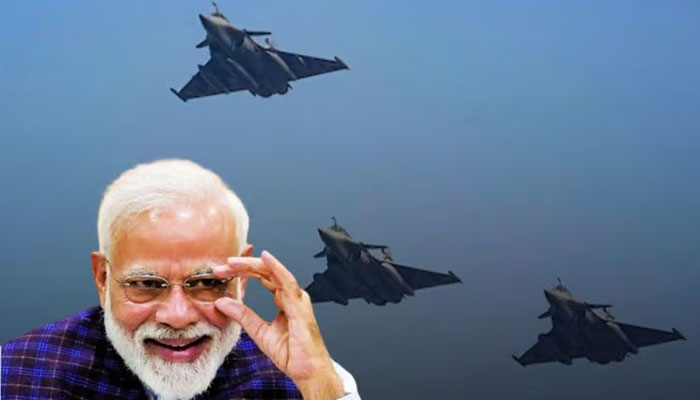

Peace and stability in South Asia remain hostage to India’s hegemonic ambitions, its pursuit of regional dominance, and its refusal to resolve the internationally recognized dispute of Jammu and Kashmir in accordance with international law. Instead of embracing dialogue, mutual respect, and peaceful coexistence, New Delhi’s policies have intensified regional polarization, undermined confidence-building efforts, and increased the risk of conflict between two nuclear armed neighbours.
The people of Indian Illegally Occupied Jammu and Kashmir (IIOJK) have welcomed Pakistan’s reaffirmation of its principled and consistent position on the Jammu and Kashmir dispute. They particularly appreciated the statement made by Pakistan’s Chief of Defence Staff and Field Marshal, Syed Asim Munir, during the Corps Commanders’ Conference in Rawalpindi. His assertion that lasting peace in South Asia is inseparable from the realization of the Kashmiri people’s right to self-determination under the relevant United Nations Security Council (UNSC) resolutions reflects a legal and moral position rooted in the Charter of the United Nations. It is a reminder that sustainable regional peace cannot be achieved by military superiority or coercive policies but only through justice and adherence to international law.
India’s regional conduct increasingly reflects a policy of hegemony and causing unrest in neighboring countries rather than cooperation. Statement by the governments of Canada and the United States regarding plots targeting Sikh activists on their territories, together with Pakistan’s repeated condemnation of Indian involvement in targeted killings within Pakistan have raised serious concerns about respect for state sovereignty and the principles of international law. Such controversies have contributed to diplomatic friction and reinforce the perception that unilateral approaches threaten regional and international peace.
India’s suspension of Indus waters and utter violation to the Indus Waters Treaty of 1960 has also generated significant concern. Pakistan has maintained that actions affecting the implementation of the treaty violate both its spirit and its legal obligations. Water should serve as a bridge for cooperation, not as an instrument of political pressure. Any departure from treaty obligations undermines regional confidence and weakens the rules based international order.
The continued occupation of Jammu and Kashmir had resulted in systematic and massive human rights abuses and the grim situation there remains at the heart of South Asia’s instability. Under Article 1(2) of the Charter of the United Nations, the principle of equal rights and self-determination of peoples is a fundamental purpose of the Organization. Article 25 further obliges Member States to accept and carry out the decisions of the Security Council. The relevant UNSC resolutions recognize that the final disposition of Jammu and Kashmir should be determined in accordance with the will of its people. A durable peace in South Asia therefore requires meaningful progress toward implementing these international commitments.
Equally troubling are persistent concerns regarding legal impunity and human rights. Laws such as the Armed Forces (Special Powers) Act (AFSPA), the Public Safety Act (PSA), and the Unlawful Activities (Prevention) Act (UAPA) have been criticized by international human rights bodies for enabling prolonged detention, limiting accountability, and restricting fundamental freedoms. Such measures have contributed to an environment where excessive use of force and arbitrary detention continue to attract international scrutiny.
India’s post-2019 policies in Indian occupied Jammu and Kashmir have also generated widespread concern regarding demographic transformation. Article 49 of the Fourth Geneva Convention prohibits an occupying power from transferring parts of its own civilian population into occupied territory. Critics contend that changes to domicile and land laws are inconsistent with this prohibition, while India disputes that characterization. Regardless of these legal disagreements, demographic engineering in a disputed territory risks further eroding trust and complicating prospects for a peaceful settlement.
Peace cannot be built upon occupation, coercion, demographic manipulation, or the suppression of fundamental rights. Nor can regional stability emerge where unresolved disputes are managed through force rather than dialogue. South Asia’s future depends on abandoning hegemonic ambitions in favour of respect for international law, sovereign equality, and peaceful dispute resolution. The Jammu and Kashmir dispute must be resolved in accordance with the UN Charter, the relevant Security Council resolutions, and the freely expressed wishes of the people of Jammu and Kashmir. Only then can the region move from confrontation to cooperation and secure the lasting peace and stability its people deserve.
The author is a legal expert and senior leader of APHC and can be reached at faiz.naqshbandi@gmail.com and WhatsApp: +92 333 5145415.
Comments are closed, but trackbacks and pingbacks are open.