
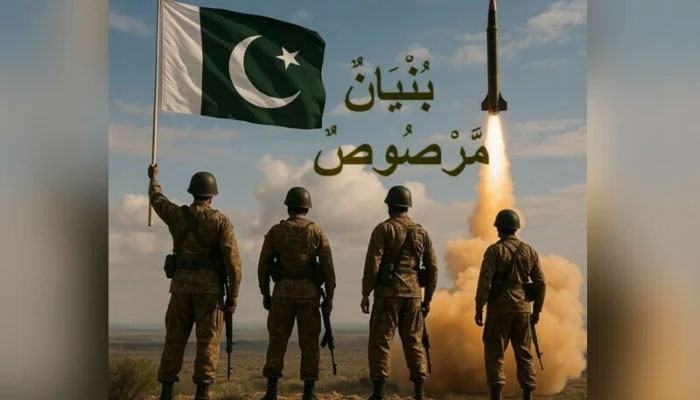

The May 2025 offensive by India on the mainland of Pakistan produced far-reaching strategic consequences for the future relations. India’s aggression under Operation Sindoor and Pakistan’s defensive response under Bunyān al-Marṣūṣ fundamentally altered the strategic psychology of the region. One of the clearest indicators of this makeover was India’s immediate shift to go underground and save military infrastructure after the ceasefire. The speed and urgency with which India reportedly moved critical military assets underground reflected not confidence, but strategic shock. Ironically, the state that entered the conflict seeking to project itself as a regional hegemon emerged confronting a new ground reality entirely different from what is being propagated by Indian media. In the age of Hi-Tech drones, precision-guided munitions, satellite surveillance, cyber warfare, and network-centric combat, visible military power has become increasingly vulnerable. The Pakistans capability demonstrated that expensive platforms alone cannot guarantee dominance when leadership acumen itself becomes the central battlefield variable. India initiated offensive strikes during the night of 7–8 May 2025, targeting mainland Pakistan and violating its sovereignty. Pakistan responded on 10 May under Operation Bunyān al-Marṣūṣ in broad daylight through a defensive but coordinated military framework. Regardless of competing political narratives, one strategic lesson became increasingly evident: centralised and exposed military infrastructure is highly vulnerable in modern precision warfare. The huge investment by India on rapid Indian turn toward going underground, therefore, represents far more than a technical military adjustment. It reflects a deeper doctrinal reassessment shaped by battlefield realities. Strategic studies literature helps explain this transformation. Defensive Realism, associated with Kenneth Waltz, argues that states ultimately seek survival and security under conditions of uncertainty. India’s move underground can thus be interpreted as a rational response to perceived vulnerability rather than merely an offensive restructuring. Similarly, Military Innovation Theory developed by scholars such as Barry Posen and Stephen Peter Rosen, explains how battlefield shocks compel militaries to reorganize doctrine, infrastructure, and operational thinking. The May 2025 conflict appears to have functioned precisely as such a combat-feedback mechanism. Several operational realities emerged during the confrontation. Precision-guided systems demonstrated deep-strike capability against strategic targets. Drone warfare eroded traditional defence depth. Satellite reconnaissance increased exposure of surface deployments, while centralised command structures became high-value vulnerabilities. Airbases, once symbols of strategic superiority, proved susceptible to runway-denial strikes and precision disruption. Modern warfare, therefore, increasingly punishes visibility and concentration while rewarding concealment, dispersion, redundancy, and resilience. Consequently, a new military logic is India establishing: Militarily Disperse – Conceal – Survive but keep the domestic media fully charged that they have managed the antagonists and bank on it during elections, is a hybrid but unique Indian approach, and she had succeeded to take devident of it in Delhi. Bihar and the West Bengal elections. Indian Airpower infrastructure also appears to have become a primary concern for Indian planners. Reports and strategic commentary in sections of the Indian press indicate growing emphasis on underground aircraft shelters, hardened runways, tunnel-based logistics systems, concealed fuel depots, and subterranean ammunition facilities. The fixed military infrastructure can remain openly vulnerable in high-intensity warfare environments so India is hiding it.The proliferation of low-cost drones and precision weapons has significantly altered the offense-defense balance. As military historian Lawrence Freedman argues, technological diffusion lowers the cost of strategic disruption. In contemporary warfare, even comparatively inexpensive systems can threaten billion-dollar military assets; hence to go underground is cheap to loss the costly weapon but this is not the solution. India’s emerging military response reportedly includes underground command-and-control centers, tunnel-based missile deployment systems, hardened UAV facilities, and concealed logistical corridors, particularly across mountainous terrain in Kashmir and Ladakh. This evolving structure resembles what may be described as a “Himalayan Fortress Doctrine,” where geography itself is militarised into a survivability shield. Yet, the most important lesson of the limited war was not technological—it was human. The confrontation demonstrated the leadership quality, organisational cohesion, strategic discipline, morale, and decision-making ability of Pakistan remain decisive even in an era dominated by advanced technology. India possessed sophisticated and expensive platforms, including Rafale fighter aircraft and advanced surveillance capabilities, yet Pakistan’s coordinated defensive posture under Bunyān al-Marṣūṣ highlighted that technological superiority alone does not guarantee strategic success.The short war reinforced a timeless military principle: human quality in leadership remains the ultimate force multiplier. Discipline, coordination, clarity of command, and operational confidence can offset material asymmetries. Pakistan’s defensive performance conveyed that conventional deterrence in South Asia is not shaped solely by military expenditure or high-tech acquisitions, but also by institutional preparedness, strategic coherence, and the ability to absorb and respond under pressure.This reality carries a critical strategic implication. The assumption that military coercion or muscular escalation can compel political outcomes in Kashmir appears increasingly unsustainable. The conflict instead demonstrated that Pakistan retains the conventional capability, strategic resilience, and defensive depth necessary to respond to escalation. Consequently, continued military posturing risks perpetuating instability rather than establishing dominance, which is the bitter lesson Indian extreme Manchu rightist regime shall understand.The more rational lesson emerging from the crisis is therefore political rather than military. If future recurrence is to be prevented, India must move beyond coercive signaling and engage seriously in conflict resolution instead of the decades-old mantra of conflict management keeping the Kashmir issue at bay. The Kashmir dispute, unresolved for more than seven decades, remains the core structural driver of instability in South Asia. The post–5 August 2019 developments neither silenced the Kashmir dispute nor removed Pakistan as a central stakeholder in the conflict.
From a realist perspective, unresolved lingering disputes continuously reproduce security dilemmas and compel arms competition, military adaptation, and recurring crises. India’s underground turn is therefore not simply infrastructure modernisation; it symbolises the arrival of a new era of warfare in South Asia where survivability, resilience, endurance, and operational continuity and the leadership acumen of as Pakistan, as demonstrated increasingly on ground, define effectiveness. Ultimately, modern wars are no longer won by visibility, rhetoric, propaganda, or numerical scale alone. They are shaped by the ability to survive first contact, maintain cohesion under pressure, and preserve operational continuity in precision-threat environments. The strategic lessons of Bunyān al-Marṣūṣ suggest that military escalation cannot produce a durable peace in the region. The sustainable path lies not in conventional or nonconventional muscle-flexing by India, but in meaningful time-bound political engagement over Kashmir—the unresolved dispute which bled the Kashmiris and the region for more than seventy years is the actual cause, and others are all effects- address the cause and effect will go. The panacea is not go underground but to come in lime light and resolve the underlying issues.
Comments are closed, but trackbacks and pingbacks are open.