

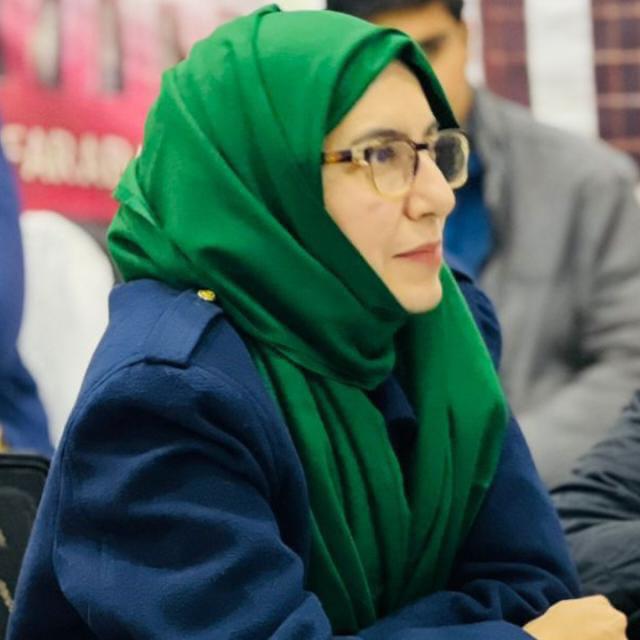
A Crown of Ashes: The Tragedy of Asiya Andrabi and the Theatre of Unending Kashmir
The story of Asiya Andrabi reflects conviction, conflict, and the long shadow of Kashmir’s unresolved history.

Sarah Rasul Taus Banihali
In the long and grievous theatre of Kashmir, where history does not proceed as a line but returns as a wound upon itself, certain lives emerge as though summoned by the storm. Among them stands Asiya Andrabi—a woman whose existence has been drawn into the austere collision of faith, law, and unrelenting political destiny.
She is not merely a figure before the court, nor simply a name inscribed in the contentious archives of state and dissent. She is, rather, a symbol shaped in the furnace of contradiction, where conviction and consequence are bound together like iron forged in fire. Around her gathers a manifold chorus of interpretation: to some she is defiance incarnate, to others unyielding certainty mistaken for truth, and to still others a dangerous clarity that refuses compromise. Yet beyond these disputations lies the quieter register of tragedy, where the human being is seen beneath the emblem.
Born in Srinagar in the early 1960s, Andrabi came of age in a valley already trembling with political uncertainty. Hers was a generation formed at the uneasy crossroads of education and unrest, where the pursuit of learning was never untouched by the tremor of identity. At the University of Kashmir, she studied science and Arabic literature—disciplines that suggest both reason and reverence—yet her intellectual passage gradually gave way to a more turbulent calling, one shaped by the moral and political upheavals of her time.
In 1987, she founded Dukhtaran-e-Millat, a women’s organisation that began in modest reflection but soon expanded into the contested terrain of political expression. Like many movements born in lands of unresolved history, it became both vessel and voice—an attempt to articulate what is often rendered unspeakable in moments of conflict.
To speak of Asiya Andrabi is to speak of persistence under pressure. For decades, her life has moved within a repeating cycle of detention and release, as though time itself had ceased to be linear in her case, becoming instead an orbit of confinement. The legal instruments invoked against her—framed in the language of security and order—have, over time, ceased to appear episodic; they have become structural, shaping the very conditions of her existence.
Yet what distinguishes her figure in the public imagination is not only imprisonment, but endurance within it. Time, that impartial sculptor of all mortal things, appears in her story not as passage but as weight. Each year adds not distance but density, compressing life into an ever-narrowing architecture of waiting.
In recent years, culminating in judicial pronouncements reported in 2026, she and several associates have faced severe convictions under stringent security legislation. To the state, these verdicts represent the culmination of lawful process; to her supporters, they signify the tightening machinery of repression. Between these irreconcilable readings lies the familiar chasm of Kashmir’s political condition, where every judgement is also a narrative, and every sentence a continuation of an older, unresolved story.
Yet to confine her existence to the lexicon of courts would be to commit a subtler violence—that of reducing a human life to procedural abstraction. Beneath the scaffolding of law lies a deeper architecture: that of consequence, memory, and lived rupture.
For in Kashmir, lives are often shaped not by events but by absences. Fathers become names spoken across prison walls; mothers learn the grammar of endurance; children grow fluent in waiting long before they understand its meaning. In such a world, imprisonment is not only the deprivation of liberty—it becomes a shared language of interruption, inherited across generations.
Andrabi’s life is woven into this wider fabric. Her confinement is not solitary in effect; it radiates outward, touching kinship, memory, and identity. In this sense, she is both subject and source of a collective narrative defined by separation.
Her son, speaking of her sentence, does not speak in the measured cadence of jurisprudence but in the fractured rhythm of inheritance—where law is not abstraction but lived rupture. Here, the narrative leaves the courtroom and enters the domain of tragedy proper, where fate appears not as accident but as inevitability.
For what, indeed, is tragedy if not the collision between conviction and consequence? Between belief held with unyielding sincerity and a world that refuses to mirror it back? In Andrabi’s figure, this collision is rendered with stark clarity.

Her supporters see fidelity; her critics see obstinacy. Yet both, in their divergence, concede a singular truth: she does not yield. And in the political dramaturgy of such lives, refusal becomes both moral anchor and historical burden.
It is this unbending quality that renders her story persistently emblematic. For power, in all its forms, is often most unsettled not by opposition alone, but by that which refuses assimilation. Thus, the unyielding figure becomes a recurring site of confrontation, as though history itself cannot move forward without passing through her again.
Yet if one steps beyond the hardened grammar of power and resistance, another image emerges—quieter, more human, and more devastating in its simplicity. It is the image of time passing within confinement: years accumulating like dust upon a closed manuscript, life experienced not as continuity but as fragments of interrupted breath.
In such a condition, political narrative dissolves into human time. There are hearings, adjournments, sentences, appeals, and renewed sentences again. The stage resets, yet no one departs it. This repetition becomes its own kind of eternity.
Kashmir: A Chronicle of Broken Promises and Unfinished Justice
Across Kashmir, this rhythm is not singular. It echoes through generations, shaping a collective consciousness in which history does not conclude but persists—an unfinished sentence spoken into cold air, awaiting a reply that never fully arrives.
To write of Asiya Andrabi, then, is not merely to recount a biography but to confront an unresolved question: what becomes of conviction when the world refuses its form, and what becomes of justice when it is perpetually refracted through irreconcilable histories?
There are no final answers—only the slow unfolding of lives lived beneath the weight of meaning too vast to resolve.
And so she remains: a figure at the intersection of law and memory, of certainty and refusal, of state and story. Whether remembered as dissenter or devotee, she stands within a narrative larger than herself, where tragedy is not an event that concludes, but a condition that endures.
In that condition, even silence acquires the gravity of speech.
Sarah Rasul Taus Banihali is an author, analyst, and media presenter focusing on affairs related to Indian Illegally Occupied Jammu and Kashmir (IIOJK).She can be reached at
Gmail:rasulsara021@gmail.com, Twitter: @Rasul__Sarah
Comments are closed, but trackbacks and pingbacks are open.