
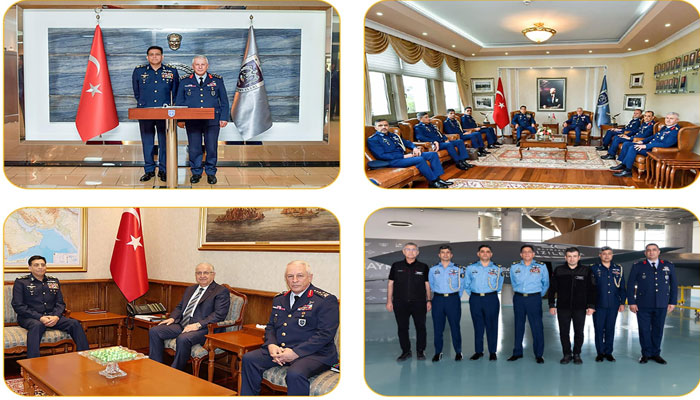

The strategic partnership between Pakistan and Turkiye has entered a decisive new chapter following the recent visit of Chief of the Air Staff, Air Chief Marshal Zaheer Ahmed Baber Sidhu, to Turkiye. Far more than a routine diplomatic engagement, the visit reflected the growing strategic alignment between the two brotherly nations at a time when the global security environment is rapidly evolving and modern warfare is being reshaped by technology, innovation and multi-domain operations. Over the past few years, Pakistan and Turkiye have steadily expanded cooperation across defence, aerospace and emerging technologies. The Air Chief’s high-level engagements in Ankara highlighted not only the depth of existing ties, but also the shared ambition of both countries to build a future-oriented strategic partnership capable of addressing tomorrow’s challenges together.
The visit began on a historic and symbolic note at the Turkish Air Force Headquarters, where Air Chief Marshal Zaheer Ahmed Baber Sidhu was received by General Ziya Cemal Kadıoglu, Commander Turkish Air Force. In a gesture reflecting the exceptional warmth and mutual respect shared between the two nations, a smartly turned-out contingent of the Turkish Air Force presented a Guard of Honour to the visiting Air Chief. While the ceremonial welcome carried strong symbolism, the real significance of the visit lay in the substance of the discussions that followed. Both Air Chiefs held extensive talks aimed at strengthening operational cooperation and enhancing interoperability between Pakistan Air Force and Turkish Air Force. Their discussions focused on expanding bilateral military exercises, professional exchange programmes, advanced training initiatives and collaborative operational frameworks to prepare both Air Forces for emerging combat realities. One particularly notable aspect of the interaction was the Turkish Air Chief’s appreciation for Pakistan Air Force’s longstanding support in the training of Turkish pilots. The acknowledgment underscored the professional standing and operational credibility that the PAF enjoys internationally, while also highlighting the deep institutional trust that now exists between the two Air Forces. Defence observers believe that this expanding military cooperation could eventually translate into greater joint operational capability in areas such as aerial warfare, electronic warfare, integrated air operations and network-centric combat systems. As both countries continue to modernize their forces, the emphasis is increasingly shifting from traditional defence cooperation towards integrated strategic coordination.
The strategic importance of the visit became even more evident during the Air Chief’s meeting with Turkiye’s Minister of National Defence. Discussions reportedly covered a wide spectrum of issues including defence collaboration, aerospace cooperation,
capacity building and future-oriented military partnerships. During the meeting, the Air Chief emphasized the historic relationship between Pakistan and Turkiye; a bond rooted in shared faith, mutual trust, common strategic interests and decades of unwavering support for one another. The Turkish leadership, in turn, appreciated the modernization and transformation initiatives undertaken by the Pakistan Air Force under its current leadership and expressed strong interest in expanding cooperation across multiple defence domains. Analysts are viewing these engagements as part of a broader strategic convergence between Islamabad and Ankara. Both nations are increasingly focused on strengthening indigenous defence capabilities, reducing reliance on external security frameworks and investing in technological self-reliance. This shared vision has brought the two countries closer than ever before in the fields of defence production, aerospace innovation and advanced military technologies.
Perhaps the most consequential engagement of the visit was the Air Chief’s meeting with Chief Technology Officer of Baykar Technologies; the company that has emerged as a global symbol of Turkiye’s rapid rise in unmanned aerial systems and drone warfare technologies. The meeting focused on next-generation aerospace innovation, unmanned combat systems and emerging technologies that are redefining the future battlefield. As drone warfare, artificial intelligence and autonomous systems become increasingly central to modern military strategy, cooperation in these areas carries immense significance for both countries. Turkiye’s remarkable success in developing indigenous drone technologies has already transformed its defence profile globally. Pakistan Air Force, meanwhile, is aggressively pursuing modernization and technological advancement under its current leadership within its own aerospace ecosystem. Defence experts believe that enhanced collaboration between the two sides could open new avenues for joint development, technology sharing and future cooperation in advanced unmanned systems. Such partnerships are expected to strengthen Pakistan’s future warfighting capabilities while accelerating the induction of cutting-edge technologies into the country’s defence architecture. More importantly, they signal a shift towards a more technologically integrated partnership between the two countries.
The broader significance of the Air Chief’s visit goes well beyond diplomacy or ceremonial military engagements. It reflects the emergence of a more mature, resilient and future-focused Pakistan–Turkiye strategic partnership built on shared geopolitical outlooks, operational trust and expanding technological collaboration. At a time when nations around the world are reassessing their security priorities in response to hybrid threats and rapidly changing combat paradigms, Pakistan and Turkiye appear determined to move forward together as dependable strategic partners. The historic welcome accorded to the Chief of the Air Staff in Turkiye was not simply a ceremonial gesture. It symbolized the strength of a relationship that has evolved into a robust
strategic partnership with immense long-term potential. As defence, aerospace and technological cooperation between the two nations continues to grow, the outcomes of this landmark visit are likely to translate into enhanced military preparedness, stronger indigenous capabilities and deeper strategic coordination for Pakistan in the years ahead. For Pakistan and Turkiye, the message emerging from this visit is both clear and consequential: the future of their strategic partnership will not only be defined by shared history and brotherhood, but also by a common vision for the future of regional security and technological advancement together.
Comments are closed, but trackbacks and pingbacks are open.