

Dr. Ghulam Nabi Fai
Chairman
World Forum for Peace & Justice
Kuala Lumpur, Malaysia
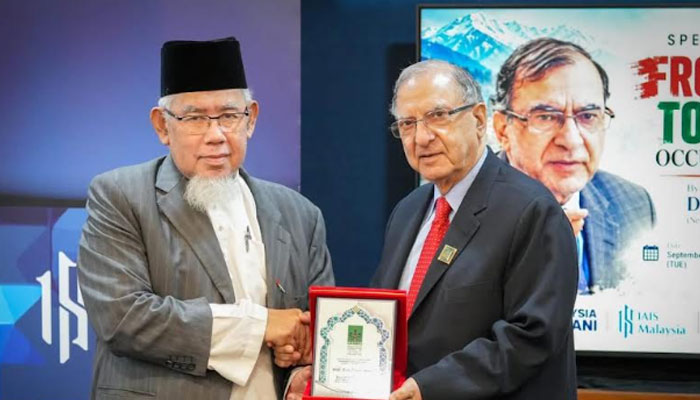
The International Institute of Advanced Islamic Studies (IAIS) Malaysia, in collaboration with the Malaysian Consultative Council of Islamic Organizations (MAPIM) and the Peace, Dialogue and Xenophobia Studies Centre (PEDIXS), IIUM, hosted a Special Lecture on September 29, 2026 at the IAIS Boardroom featuring Dr. Ghulam Nabi Fai, Chairman of the World Forum for Peace and Justice.
Mr. Arief Arman research fellow at FEDIXM-IIUM was the master of ceremony who greeted the guests and welcomed them to the conference.
YB Dr. Maszlee Malik, Chairman IAIS as the host also welcomed the guests and said that people in Malysia have always been concerned with both Palestine and Kashmir conflicts. Although, Palestine has generated lot of interest, particularly within the past one year but Malaysian also know the situation in Kashmir, although not extensively. So, today’s conference provides us an opportunity to listen to our guest speaker who is the expert on the subject.
Mohd Azmi Abdul Hamid, Prescient, Malaysia Consultative Council of Islamic Organizations (MAPIM) said wherever people are denied their freedom, dignity and right to determine their own future, the international community must not remain indifferent. Kashmir and Palestine are different historical and political context. They cannot be reduced to identical situations. But they share a fundamental human question: can there be a genuine peace when the right and aspirations of an entire people remain unresolved?
Prescient MAPIM added that our message is simple but profound. Let the people live with dignity. Let children grow up without fear. Let families live without displacement. Our message is for justice. Our message is for freedom. Our message is for the peaceful resolution of Palestine and Kashmir through international law, dialogue and respect for the right of people.
The representative of PEDIXS-IIUM said that both Palestine and Kashmir have posed greater threat to the international peace and security. As Muslim we should be concerned with any situation of pain and suffering irrespective of whether the victims or Muslims, Jews, Christians, Hindus or else.
Addressing a highly engaged audience of academics, advocates, officials from various embassies and members of civil society, Dr. Fai examined the historical and contemporary dimensions of the conflicts in Kashmir and Palestine, emphasizing that their unresolved status continues to have consequences not only for the people directly affected but also for regional and international peace and security.
Dr. Fai noted that the United Nations Security Council has been seized of both questions since 1948. In April 1948, the Council adopted a series of resolutions concerning Palestine, including Resolutions 43, 46 and 48, while Resolution 47, adopted on April 21, 1948, addressed the India-Pakistan question and called for measures including the restoration of peace and order and a plebiscite in Jammu and Kashmir. The UN Security Council’s official records confirm that both questions were before the Council during the same historic period.
Dr. Fai argued that the continuing inability to achieve durable political settlements in both Kashmir and Palestine demonstrates the serious consequences of leaving long-standing international disputes unresolved. He stressed that the people of the affected territories have endured decades of conflict, uncertainty and human suffering, while the wider regions remain exposed to recurring tensions and instability.
He emphasized that the credibility of the international system depends upon the consistent application of international law and the principles of the United Nations Charter. “International law cannot be meaningful if it is applied selectively,” he said, urging the international community to work toward peaceful and just solutions acceptable to all parties concerned.

Dr. Fai also drew attention to demographic and settlement-related developments in both Kashmir and the occupied Palestinian territory. With regard to Palestine, United Nations reporting has documented the continuing expansion of Israeli settlements in the occupied West Bank, including East Jerusalem. A 2025 UN Secretary-General report recorded more than 737,000 Israeli settlers in the West Bank and East Jerusalem during the reporting period.
Turning to Kashmir, Dr. Fai discussed changes to domicile and land-related rules following the 2019 constitutional changes in Jammu and Kashmir. He explained that the earlier state-subject framework had restricted the acquisition of land and permanent settlement by persons who did not possess the requisite status, while subsequent changes introduced domicile provisions under which eligibility can be acquired through specified periods of residence or education. He argued that these developments deserve careful international scrutiny because of their potential implications for the demographic character and political future of the territory.
Dr. Fai emphasized that his comparison was not intended to minimize the distinctive historical, political and legal circumstances of either conflict. Rather, he said, the comparison illustrates a broader challenge: when prolonged conflicts remain unresolved and international legal obligations are not effectively implemented, the consequences can extend far beyond the immediate parties.
He expressed appreciation for the willingness of NATO countries and other international actors to invoke the protections of the Fourth Geneva Convention in addressing situations involving armed conflict and occupation, including the protection of civilians in Ukraine. He asked why comparable attention should not be given wherever civilians are exposed to serious violations of international humanitarian law.
Dr. Fai referred to testimony by Dr. Gregory Stanton, founder of Genocide Watch, before the United States Congress, in which Stanton expressed concern about what he described as “the trappings of genocide” in Kashmir. Dr. Fai stressed that such allegations should be addressed through credible, independent international scrutiny and verification rather than ignored.
“The international community has mechanisms, institutions and legal instruments designed to prevent human suffering and preserve international peace,” Dr. Fai said. “The question is whether the international community will summon the political will to use them consistently and effectively.”
The Special Lecture subsequently developed into a dynamic scholarly dialogue, with participants exchanging views on the moral and legal responsibilities of states, international organizations, academics and civil society in addressing protracted conflicts.
In his concluding remarks, Dr. Fai issued a broader appeal to the major powers and the international community to become more actively engaged in seeking peaceful resolutions to both the Kashmir and Palestine questions.
He stressed that world powers have a particular responsibility to help prevent these conflicts from becoming sources of wider regional confrontation and international instability. The objective, he said, should not be to assign victory or defeat to one side, but to create conditions in which justice, human dignity, international law and the legitimate rights of all affected peoples can be addressed through peaceful political processes.
Dr. Fai urged the international community to move beyond periodic expressions of concern and toward sustained diplomacy, meaningful dialogue, impartial fact-finding and effective implementation of applicable international law.
He concluded that the longer Kashmir and Palestine remain unresolved, the greater the risk that instability and insecurity will continue to affect their respective regions and, potentially, the wider international community.
“Peace in these regions is not merely a regional aspiration,” Dr. Fai said. “It is an investment in the peace and security of the world.”
Dr. Ghulam Nabi Fai can be reached at:
WhatsApp: 1-202-607-6435
gnfai2003@yahoo.com
Comments are closed, but trackbacks and pingbacks are open.