
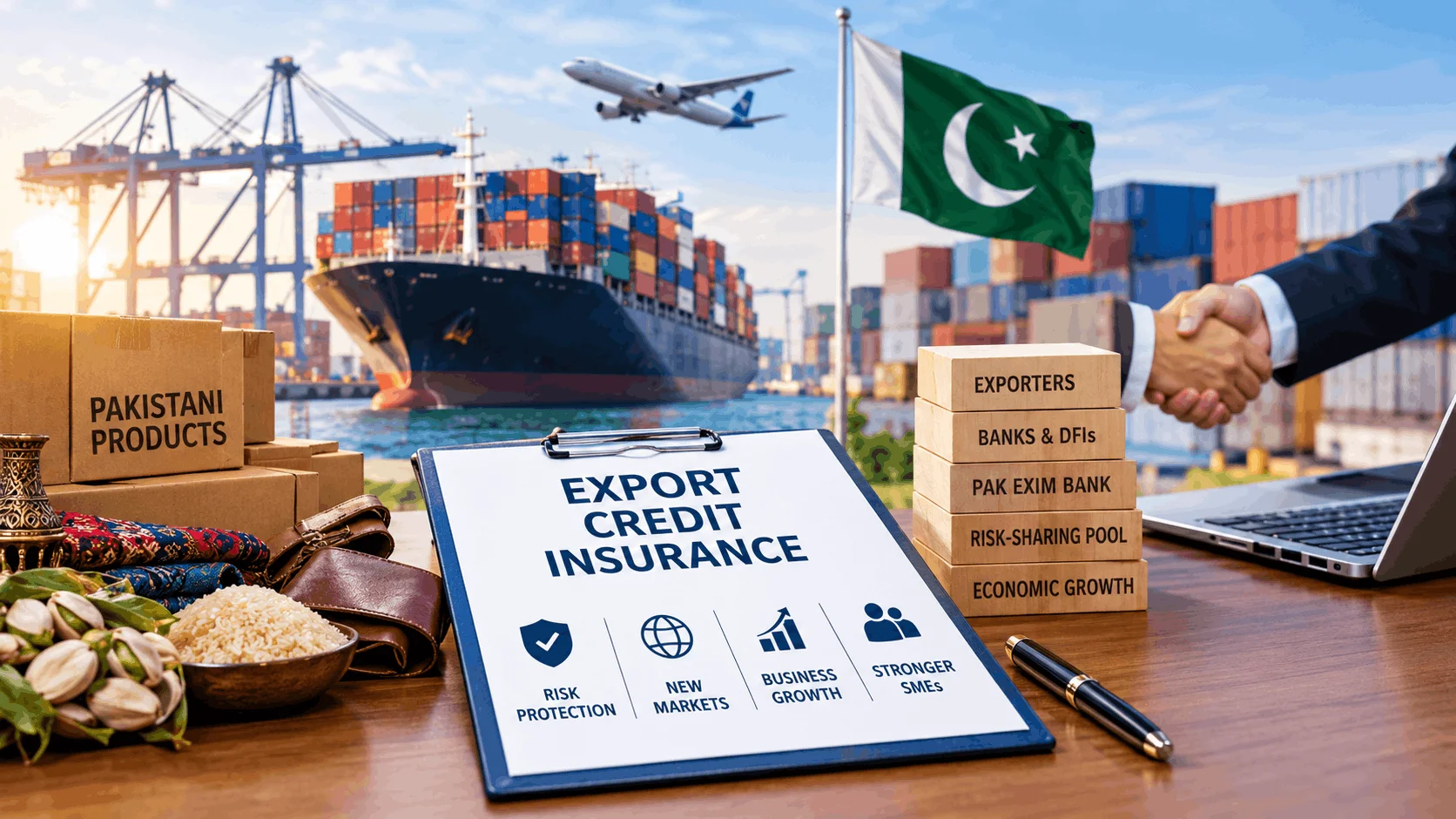
A Significant Step Toward Export Promotion: Export Credit Insurance Gives Pakistani SMEs New Strength
How Pak EXIM Bank's Risk-Sharing Pool helps small exporters trade with new foreign buyers without fear of non-payment

By: Syed Mujtaba Rizwan
Exports have always held fundamental importance in Pakistan’s economy. For any country, selling goods and services in international markets generates foreign exchange. It also strengthens industrial development, employment opportunities, business activity, and overall economic stability.
Alongside large companies, small and medium-sized enterprises (SMEs) can play a significant role in Pakistan’s export economy. However, these businesses face a number of risks when entering international markets, some of which can affect their entire business strategy.
One of the most important risks is that a foreign buyer may fail to make payment. This is where Export Credit Insurance in Pakistan can emerge as an effective protection mechanism for exporters.
What Is Export Credit Insurance?
The basic objective of Export Credit Insurance is to protect an exporter against the risk of non-payment by a foreign buyer after goods or services have been supplied. Subject to the terms and conditions of the policy, Pak EXIM Bank may provide compensation for the loss.
The most important aspect of this facility is that an exporter does not have to enter international trade entirely exposed to uncertainty. Instead, the exporter can expand business with the support of an institutional risk-protection mechanism.
Why SMEs Need Export Credit Insurance
A large number of SMEs in Pakistan have the potential to sell their products abroad. However, risks associated with new buyers, new markets, and international payments often compel them to remain cautious.
Many businesses limit themselves to buyers with whom they already have established relationships because of concerns about payment risks. As a result, their export activities remain confined to a relatively narrow circle.
Export Credit Insurance can help change this situation. When an exporter has protection against non-payment, the business may feel more confident about establishing relationships with new buyers and entering new international markets.
This facility is particularly important for small and medium-sized exporters. Large companies can sometimes manage different risks through their financial resources, legal expertise, and international business experience. For a small business, however, non-payment of a large amount by a foreign buyer can create a serious financial crisis.
Export Credit Insurance seeks to reduce this risk and thereby expand the ability of SMEs to participate in international trade.
Supporting Open-Account Trade
Another important benefit is that exporters can move toward conducting business on an open-account basis. In international trade, open-account transactions mean that, in certain circumstances, goods are supplied to the buyer first and payment is made later.
Although this method can make business relationships easier and more competitive, it also exposes the exporter to the risk of non-payment. By providing protection against this risk, Export Credit Insurance can help Pakistani exporters adopt more flexible trade terms with international buyers.
Building Confidence in the Export Environment
Export Credit Insurance is not merely an insurance policy. It is a mechanism for creating confidence within the export environment.
In international trade, buyers seek suppliers who can provide products consistently, reliably, and on competitive terms. When a Pakistani exporter has institutional protection against non-payment, the exporter may be in a better position to offer more acceptable trade terms to buyers. This can create opportunities for increasing business volumes and establishing long-term commercial relationships.
The Pak EXIM and EDF Risk-Sharing Pool
The concept of a Risk-Sharing Pool provided through Pak EXIM Bank also has an important role in this framework. According to the available information, the Export Credit Insurance facility for SMEs under the Pak EXIM and EDF Risk-Sharing Pool is intended to make export credit insurance more accessible to small and medium-sized enterprises.
Under such a mechanism, the risk is managed institutionally rather than being placed entirely on one party. The objective is to enable SMEs, particularly businesses entering the export market for the first time, to manage the risks of international trade in a more structured manner.
Key Products: CSTP and Bank Master Policy
Two important products have been identified under this programme.
- Comprehensive Short-Term Policy (CSTP): an eligible SME exporter can directly obtain Export Credit Insurance.
- Bank Master Policy (BMP): participating banks and Development Finance Institutions (DFIs) can obtain Export Credit Insurance against the risk of non-payment for their funded SME exporters.
Both mechanisms have the potential to strengthen the relationship between SMEs and financial institutions.
Why the Bank Master Policy Matters
The importance of the Bank Master Policy needs to be understood in the context of Pakistan’s current business environment. Obtaining an export order is not enough for an SME. It also requires financial resources for working capital, production costs, raw materials, packaging, transportation, and other operational needs.
If a bank is providing financing to an SME for export-related business, non-payment by a foreign buyer also represents an important risk for the financial institution. Export Credit Insurance can assist in managing this risk. It may also create an additional avenue for banks and DFIs to provide export financing to SMEs.
Benefits for Banks and DFIs
The benefits of this system are not limited to exporters. Participating banks and DFIs can also benefit by offering Export Credit Insurance to their SME clients, thereby strengthening their relationship with exporters.
Building a larger and better-protected SME export portfolio can also be commercially significant for financial institutions. When a bank knows that institutional protection is available against specific export-related risks, it can engage with the export business of its SME clients in a more structured manner.
The Wider Economic Chain
This can create a broader economic chain. An SME obtains Export Credit Insurance, enters into business with a new foreign buyer, and receives an export order. It then obtains financing from a bank, increases production, creates additional employment, and delivers Pakistani products to international markets.
If this process expands across thousands of small and medium-sized enterprises, its cumulative impact on the national economy could be significant.
Export Potential Across Pakistani Sectors
The importance of SMEs in Pakistan is not limited to their existing business volume. These enterprises have export potential across sectors such as industry, agricultural value chains, textiles, leather, sports goods, surgical instruments, handicrafts, engineering, food processing, information technology, and various other fields.
Many Pakistani products have already established a presence in international markets. The challenge is that many small businesses are unable to fully benefit from the financial and commercial facilities required to manage the risks associated with international trade.
Reducing Risk and Expanding Business
Export Credit Insurance is one effort aimed at reducing this gap. If a businessperson believes that the entire risk of non-payment will fall on them when dealing with a new foreign buyer, they will naturally remain cautious.
However, if part of that risk is protected under an insurance policy, their approach to business expansion may become broader. They may search for buyers in new countries, explore new distribution channels, and accept orders that they might previously have considered too risky.
Improving Global Competitiveness
At the same time, Export Credit Insurance can support Pakistani exporters in international competition. In today’s global trade environment, producing quality goods alone is not enough. Buyers consider a range of factors, including price, quality, delivery time, payment terms, and supplier reliability.
If a Pakistani exporter becomes capable of offering more suitable commercial terms to a foreign buyer, the exporter’s competitiveness in the global market may improve.
Support for First-Time Exporters
The facility can also be particularly important for first-time exporters. Experienced exporters are generally more familiar with international trade procedures, buyer assessment, payment risks, and various commercial documents. For a first-time exporter, however, the entire process can be complicated.
If Export Credit Insurance, bank financing, and institutional guidance are made available through an integrated system, the barriers to entering international markets can be reduced.
Awareness and Cooperation Are Essential
Cooperation among the government, banks, DFIs, Pak EXIM Bank, and the private sector is therefore essential. Merely introducing an insurance policy will not be sufficient.
It will also be necessary to ensure that information about the facility reaches SMEs, the application process is simplified, and policy terms are clearly explained. The business community must also be properly informed about its benefits.
Many small businesses may not yet be fully familiar with the concept of Export Credit Insurance. Awareness and capacity-building can therefore become important components of the programme’s success.
Making Insurance Affordable for SMEs
Affordability is equally important for SMEs. If the cost of insurance is too high, small exporters may find it difficult to benefit from the facility.
This is why the concept of a Risk-Sharing Pool becomes important. Its purpose is to manage risk in a manner that can make Export Credit Insurance more accessible and relatively affordable for SMEs and first-time exporters.
Expanding and Diversifying Pakistan’s Export Base
For Pakistan, one of the greatest potential benefits is the expansion of the country’s export base. If more SMEs enter international markets, the export base can become broader. Instead of relying on a limited number of large companies, thousands of small and medium-sized enterprises can become part of the export economy.
This can also increase economic activity at the regional level, because SMEs are not confined only to major cities.
Growth in exports is also directly connected with foreign-exchange earnings. For a country like Pakistan, stable and diversified export revenues can play an important role in economic stability.
When new exporters enter international markets and existing exporters expand into new markets, the country’s overall export portfolio becomes more diversified. Such diversification can help reduce dependence on a single sector or a limited range of products.
Part of a Broader Export Strategy
It is also important to view Export Credit Insurance as part of a broader export strategy rather than as an isolated financial facility. Increasing exports also requires quality improvement, research, branding, packaging, logistics, certification, market intelligence, digital marketing, and compliance with international standards.
Export Credit Insurance cannot replace these elements. However, it can work alongside them as an important tool for managing the risks associated with export business.
Managing Payment Risk in Export Business
Success in international markets is not easy for Pakistani SMEs, but appropriate institutional support can make the process more structured and manageable.
For a small business, securing a new foreign buyer may represent the result of months or even years of effort. If the buyer fails to make payment, the exporter’s working capital, production cycle, and future orders can all be affected. Managing payment risk is therefore a fundamental component of any serious export strategy.
Export Credit Insurance seeks to address precisely this need. It can give exporters greater confidence that they do not have to ignore new buyers and business opportunities simply because of concerns about non-payment. This confidence can become an important driver of export expansion.
Pak EXIM Bank’s Role as Underwriter
The role of Pak EXIM Bank as an underwriter is also an important component of the system. The bank assesses the exporter and its buyers, providing the basis for understanding the risks involved and extending protection in accordance with the policy.
An SME exporter can apply for Export Credit Insurance directly through Pak EXIM Bank or through a Participating Bank or DFI. The exporter and its buyers are then assessed, after which the protection process proceeds according to the applicable policy terms.
This mechanism indicates that Export Credit Insurance is not simply a means of compensating losses after they occur. Rather, it is a structured financial system based on risk assessment. Better risk assessment can help exporters, banks, and insurers make more informed and organized decisions.
Export-Led Economic Growth and Global Supply Chains
For Pakistan, the broader objective of this entire concept is Export-Led Economic Growth. If the country is to increase its exports, SMEs must be given a more active role in international trade. This requires access to financing, insurance, markets, and business information, among other facilities. Export Credit Insurance can become an important link in this chain.
There is also a need to focus on integrating Pakistani SMEs into global supply chains instead of restricting them to local markets. A small business that provides employment to ten people locally today may, after gaining access to international markets, increase its production, employment, and investment several times over.
Similarly, a successful SME can create supply-chain opportunities for other businesses, thereby expanding the overall circle of economic activity.
Understanding Policy Terms and Limits
Risk cannot be eliminated from international trade; it can only be managed more effectively. This is why managing non-payment risk through Export Credit Insurance is so important.
No insurance policy automatically eliminates every possible cause of business loss. Protection is always subject to the terms, eligibility requirements, coverage limits, exclusions, and claim procedures specified in the policy. Exporters must therefore understand all policy conditions carefully before using the facility.
Conclusion: Building Confidence in Pakistan’s Export Economy
Ultimately, Export Credit Insurance can be viewed as a mechanism for building confidence in Pakistan’s export economy. If SMEs receive appropriate protection, their ability to approach new buyers can increase. Opportunities for SME export financing can expand for banks and DFIs, and confidence among businesses operating in international markets can improve. The foundation for expanding export activity can also become stronger.
If cooperation among Pak EXIM Bank, EDF, banks, DFIs, and the private sector progresses effectively, Export Credit Insurance could become an important financial protection mechanism for Pakistan’s small and medium-sized exporters.
Pakistan needs policies that do more than simply protect businesses from difficulties. It needs policies that prepare them to compete in global markets. Giving SMEs greater access to international markets, managing their financial risks, improving their access to bank financing, and creating confidence to trade with new buyers should all be part of a comprehensive export strategy.
Export Credit Insurance is a practical step in this direction. If implemented transparently, efficiently, and in an accessible manner, it can help open new doors for Pakistani businesses and contribute to strengthening the country’s Export-Led Economic Growth.
Comments are closed, but trackbacks and pingbacks are open.