
Constitution Before Emotion: Why the Twelve Refugee Seats in AJK Must Be Preserved
By: Ifra Noor

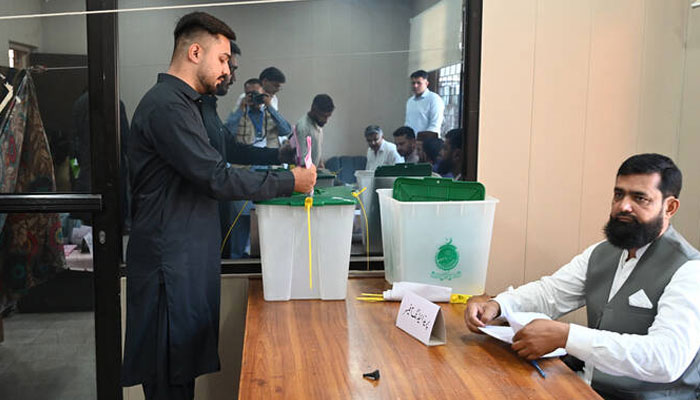
People can criticize government, demand reforms, and peacefully protest in all democracies. When Democracy turns into sentiment, however, constitutional issues are in danger. While the debate on the abolition of the twelve refugee seats in the AJK Leg Assembly may appear to be a political debate, it is actually also a constitutional issue, as it is based on history, representation and Pakistan’s decades long commitment to the Kashmir cause. Things like that should be debated in court, not by popular vote.
The 12 refugee seats were established to accommodate Kashmiris who lost their homes in Indian administered Kashmir during the partition and subsequent wars. These families sacrificed their home and livelihoods, opting for Pakistan. They are therefore not a political privilege but a constitutional recognition of their history and Kashmir dispute yet to be resolved. It will be unwise to remove these seats because it will not only weaken that historical recognition but also Pakistan’s consistent stance on Kashmir.
The advocates of the elimination of such seats say the members of AJK should elect their representatives. This is a concern that must be discussed, but the constitution cannot be amended by protest or public pressure. Supreme Court of AJK has ruled that the seats of refugees are protected under the Constitution. Any amendment (should it be made) must be made in accordance with the constitutional process, which would involve the debating of the amendment in the Legislative Assembly and obtaining the required majority for approval. In democracies, for reform to happen it should be done through Parliament, not through the streets.
This is a question that comes to mind during this debate: What is the meaning of loyalty to the state? Loyalty doesn’t equal silence or being a yes man for all government policies. Citizens are free to have their say, and Pakistan has a history of peaceful protests that have led to important changes. Many of the economic demands put forth by the AJK Action Committee were accepted, in fact. The federal government has announced a relief package worth about Rs23 billion, a sum that includes subsidies on wheat and electricity, and it has said 37 out of 38 demands have been tackled. The only ambiguity that remained was that of refugees seats, as it is constitutional and not administrative.
Democracy requires accountability. Violence, attacks on law enforcement officers, destruction of public property or illegal acts do not serve the same purpose as peaceful protest and violate the very democratic values protesters seek to protect. Protest and the rule of law go hand-in-hand. Confrontation is less effective in addressing constitutional issues than dialogue and parliamentary debate.
The other common claim is that since AJK has a significant contribution towards the generation of the hydroelectric power in Pakistan, the populace has the right to receive cheaper electricity. There is some truth in this concern and Pakistan has already been giving substantial subsidies to AJK for electricity and wheat. But each province gives to the federation differently. Punjab is called the backbone of Agriculture in Pakistan as it generates most of the wheat, rice, sugarcane, cotton, maize, fruits and vegetables of the country. Sindh’s contribution is through its ports and industries, and natural gas reserves, while Khyber Pakhtunkhwa and Balochistan contribute hydropower, minerals etc. and natural resources. All provinces, however, are still facing the same economic problems the country is facing. Therefore, national level policies should ensure regional contributions are also in sync with the overall financial ability of Pakistan.
Also, the strategic environment of Pakistan must be kept in consideration. The country has complex regional security issues and is also under threat from decades of terror and hybrid warfare, which make it vulnerable to disinformation and attempts to capitalize on political instability. In times of protest, misinformation can proliferate rapidly, leading to greater mistrust and escalating tensions. It is not to say that all protests are externalized but it is important to educate people to use verified information instead of unverifiable claims being spread on social media.
Finally, the refugee seats issue goes beyond just 12 seats in a legislature. It’s about upholding the constitutional rights of the displaced Kashmiri populace, the democratic institutions and the historic promise of Pakistan to the Kashmir cause. All democracies must enable criticism, promote discussion and listen to citizens. However, constitutional changes must be made in a constitutional way.
When people really think these seats should be scrapped, the right way is to create political support, get a constitutional amendment, and a parliamentary majority, not to use public pressure instead of constitutional means. The rule of law is strongest in Democracies when the Constitution is final. Kashmiri refugees, as well as the rule of law, can be protected and the history that this twelve refugee seats were established to honor can be preserved while adhering to democratic principles.
Ifra Noor is a Strategic Studies scholar and emerging writer with a strong interest in regional security, South Asian geopolitics, constitutional affairs, and national security. She writes on contemporary political and strategic issues, aiming to encourage informed discussion through research, historical context, and policy analysis
Comments are closed, but trackbacks and pingbacks are open.