
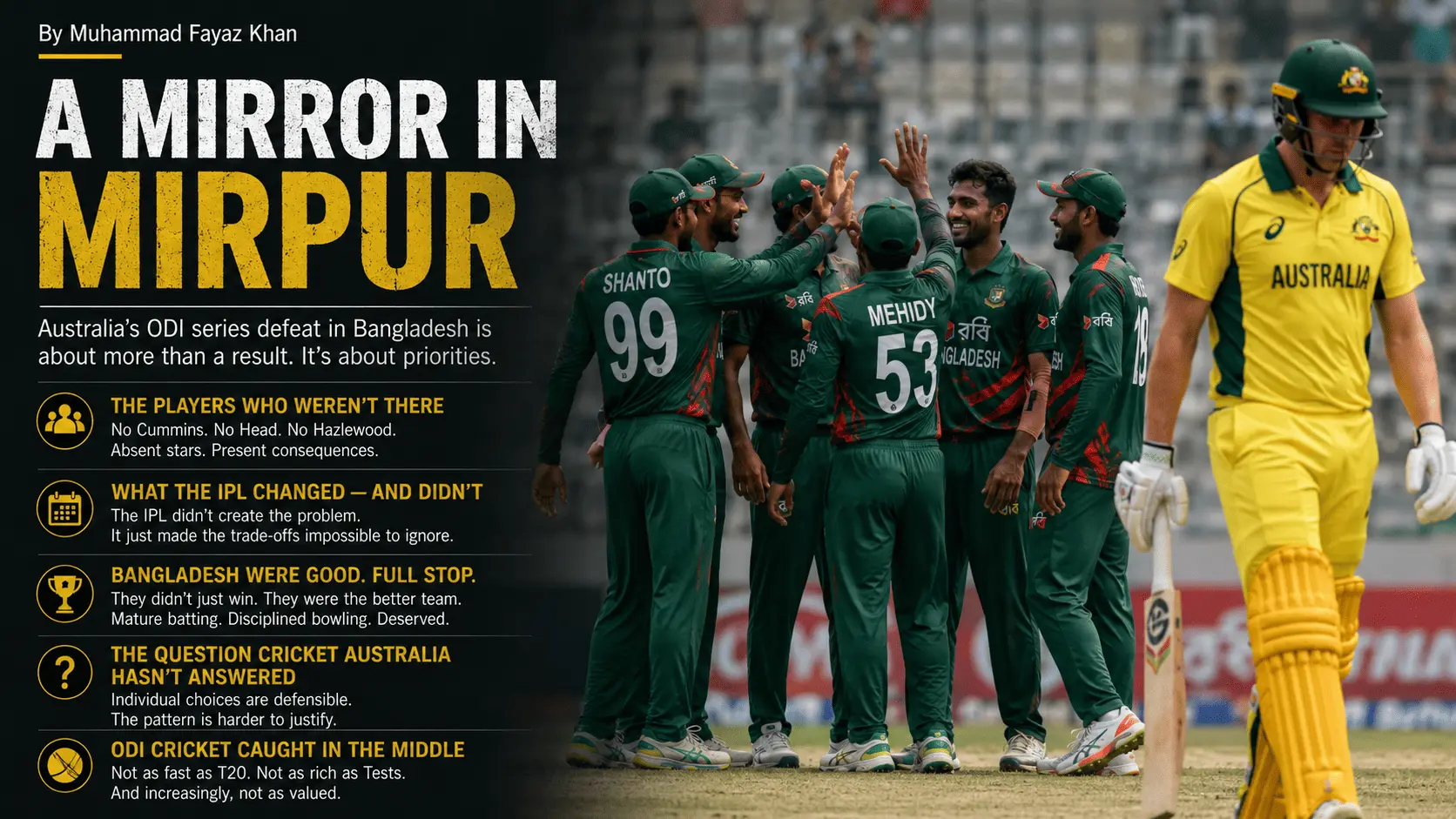
The Series Nobody Wanted to Talk About Is Now the Only Thing Worth Discussing
Australia's ODI losses to Pakistan and Bangladesh haven't just damaged a record. They've exposed a fault line running through the entire structure of international cricket.

By Muhammad Fayaz Khan
The call sheet for Australia’s ODI squad to tour Bangladesh did not read like a who’s who of their generation’s best cricketers. It read more like a what’s left.
No Pat Cummins. No Travis Head. No Josh Hazlewood.
Three players who, in any honest conversation about the current state of 50-over cricket, would be among the first names written on the team sheet. Three players who were, at that precise moment, otherwise engaged — their attention directed not toward a bilateral series in Mirpur but toward the demands of franchise cricket and the financial ecosystem that now orbits it.
What followed was not just a series defeat. It was a statement, though not the kind Cricket Australia would have chosen to make.
Bangladesh won. Convincingly. Historically. And in doing so, they held up a mirror to a sport that has been quietly avoiding its own reflection.
The Players Who Weren’t There
To understand what happened in Bangladesh, you have to start with the absences, because the absences are the story — or at least, they are half of it.
Cummins is Australia’s Test captain, their most important bowler across formats, and by any measure one of the three or four most influential cricketers on the planet. Head has evolved from a talented middle-order option into a match-winner of the highest order, the kind of player opposition coaches specifically build plans around. Hazlewood, at his best, is as reliable as seam bowling gets.
None of them were there.
The official framing was workload management, and there is genuine substance to that explanation. The demands on elite cricketers in the modern era are not trivial — the schedule is relentless, the formats are multiplying, and the physical and psychological toll of playing international cricket across all three forms of the game is something the sport has been slow to reckon with properly. Cummins himself has spoken thoughtfully about managing his body through long seasons. This is not invented reasoning.
But workload management and commercial prioritization occupy different places on the same spectrum, and the line between them is not always where administrators suggest it is.
The IPL did not create this problem. It accelerated it, clarified it, and made it impossible to look away from.
What the IPL Changed — and What It Didn’t
There is a version of this conversation that treats the IPL as a villain, and that version is both too simple and largely wrong.
The Indian Premier League is the most commercially successful cricket competition in history. It has made generational wealth available to players who, a decade earlier, would have retired comfortably but not lucratively. It has developed talent, created narratives, and — whatever its critics say — produced cricket of genuine quality at its best.
It has also, in a very short space of time, reorganized the sport’s priorities around itself.
The FTP, the ICC’s grand scheduling architecture, was built on the assumption that international cricket occupied the center of the cricketing universe. The IPL has not formally challenged that assumption. It has simply made it irrelevant in practice, one released player at a time.
“The calendar works on paper,” one county coach, speaking privately, said last year. “On paper, there’s always enough time for everything. In practice, every board is making the same calculation about which commitments they can afford to be flexible on. And international cricket, outside of the biggest events, keeps losing that argument.”
That calculation has consequences — and they showed up in Mirpur.
Bangladesh Were Good. That Needs Saying First.
There is a version of this piece that uses Bangladesh’s victory purely as a vehicle for talking about Australia, and that would be a disservice to what Najmul Hossain Shanto’s side actually achieved.
They were, across the series, the better team. Not the luckier team. Not the beneficiary team. The better team.
Their batting showed a maturity that has been quietly building for several years. When pressure arrived — and it did arrive, in the shape of lower-order Australian resistance and tightening run rates — they responded with the composure of a side that has learned, through hard experience, how to close out matches at the highest level.
Their bowling was disciplined in a way that exposed genuine flaws in Australia’s batting lineup. They were not simply filling in the gaps left by absent Australians. They were exploiting them with intelligence.
Bangladesh cricket has been on this trajectory for a while. The series win over Australia is not a surprise to anyone who has been paying attention. It is, rather, the moment the wider conversation was forced to catch up with a reality that existed already.
They deserved this. Fully.

But the Squad That Australia Sent — Let’s Be Honest About It
Deserved victories can also expose inconvenient truths in the teams they beat. This one did.
The players who represented Australia were not frauds or makeweights. Several of them will go on to have meaningful international careers, and one or two may develop into genuine match-winners. Potential was not in short supply.
What was in short supply was readiness. The particular, hard-won kind of readiness that only comes from playing high-pressure international cricket alongside experienced performers, in difficult conditions, when results genuinely matter.
Australia have prided themselves, historically, on an almost industrial capacity to produce international-ready cricketers. The Sheffield Shield, for all its diminished public profile, remains one of the best domestic competitions in the world precisely because it was built to prepare players for exactly this moment.
But preparation and deployment are different things. A player can be ready for international cricket and still need guidance that isn’t available when the senior players are elsewhere. The squad in Bangladesh was, in several positions, learning things on the job that ideally would have been learned alongside Cummins or Head or Hazlewood.
That is not a criticism of the players. It is an observation about a system.
The Question Cricket Australia Hasn’t Answered
Cricket Australia occupy an unenviable position in this argument, and it is worth acknowledging that before loading further criticism onto them.
They cannot unilaterally fix the international calendar. They cannot force the IPL to schedule around bilateral series. They cannot tell their players — high-earning professionals with finite careers and legitimate financial agency — that franchise cricket is not for them. The levers of power in this particular argument are not in Jolimont Street.
What they can do, and what they will eventually have to answer for, is the cumulative effect of the choices being made in aggregate. Individual decisions about workload and scheduling can each be defensible in isolation. The pattern they form, over time, is something else.
Two ODI series losses — to Pakistan, then to Bangladesh — do not constitute a crisis. Australian cricket has absorbed worse and rebuilt quickly. They will be competitive at the next major event. The talent is there.
But results have a way of forcing conversations that administrative convenience prefers to defer. And the conversation this series has opened is one that extends well beyond Australia’s win-loss record in 50-over cricket.
The Format Caught in the Middle
ODI cricket is, in many ways, the most vulnerable format in this argument.
Tests have history, tradition, and a devoted constituency that has proven remarkably resilient. T20 cricket has the IPL, the Big Bash, The Hundred, and a generation of players and fans for whom it is simply the natural mode of the game.
ODIs occupy an increasingly awkward middle ground. They are long enough to lack the explosive immediacy of T20 cricket, and short enough to lack the deep narrative architecture of a Test match. Their prestige rests almost entirely on the World Cup, which comes around every four years and — crucially — requires all available players.
Between World Cups, bilateral ODI series are precisely the kind of commitment that gets renegotiated when a more lucrative alternative presents itself. The incentive structure of modern cricket does not favor them. And without the best players consistently available, their credibility erodes in ways that are difficult to reverse.
That erosion is happening. This series, and the Pakistan series before it, are data points in a trend that predates both.
Where This Goes
Australia will be fine. That much is worth stating plainly, if only because the alternative narrative — that Australian cricket is in genuine long-term decline — is not supported by the evidence.
They have a core of world-class players, a domestic system that continues to produce talent, and a competitive culture that tends to respond to adversity with something resembling ferocity. The next time a full-strength Australian side takes the field, opponents will be reminded of all of this.
But being fine is not the same as having answered the question.
The question — about what international cricket is worth, who it is for, and how it sustains its own relevance in a landscape increasingly organized around franchise tournaments — will not be resolved by a strong Australian performance in the next series. It will not be resolved by a single ICC policy document or a renegotiated FTP.
It will be resolved slowly, or it won’t be resolved at all, through thousands of individual decisions made by players, boards, and administrators who are each responding to the incentives in front of them.
The series in Bangladesh is over. The debate it crystallized is just getting started.
Australia’s next ODI assignment is scheduled for later this year. Whether their best players will be available for it remains, as it increasingly does, a question worth asking in advance.
Comments are closed, but trackbacks and pingbacks are open.