
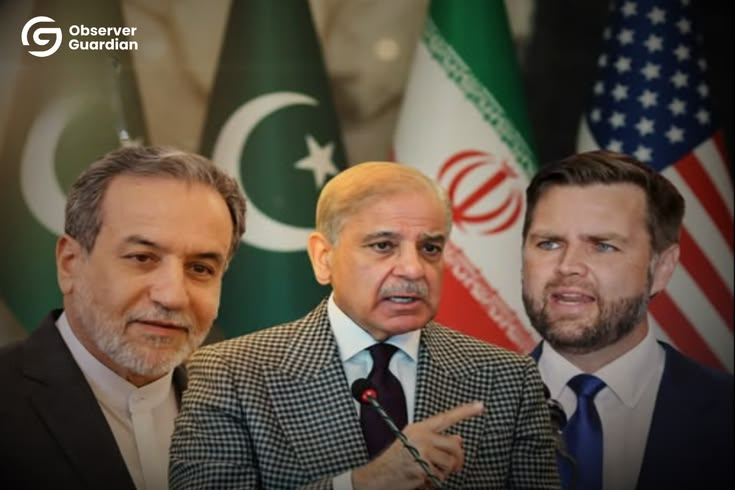
“Pakistan’s Role as a Peace Mediator Between Iran and the United States: Implications for Arms Control and Regional Stability”
By: Aliza Ali

The post-Cold War international order has increasingly relied on intermediary states to manage tensions between rival powers and regional adversaries. The long-standing confrontation between the United States and the Islamic Republic of Iran remains one of the most complex geopolitical rivalries, shaped by ideological mistrust, sanctions regimes, proxy conflicts, and nuclear proliferation concerns. The absence of sustained direct engagement between Washington and Tehran has repeatedly created space for third-party diplomatic facilitation by states capable of maintaining access to both sides.
Pakistan’s emergence as a potential mediator is strategically significant. As a nuclear-armed state located at the crossroads of South Asia and the Middle East, Pakistan maintains historical, cultural, and geographic proximity to Iran while also sustaining diplomatic and security engagement with the United States. This dual connectivity provides Islamabad with a rare diplomatic niche. As Kofi Annan noted, “Dialogue is not a sign of weakness; it is a sign of strength,” highlighting the importance of communication in preventing escalation. Pakistan’s potential role therefore reflects both strategic positioning and the broader need for mediation in a fragmented regional environment.
Theoretical Framework: Middle-Power Mediation and Arms Control
Pakistan’s mediating role can be understood through the lens of middle-power diplomacy, which emphasizes the ability of semi-peripheral states to influence international outcomes through negotiation and facilitation rather than coercive force. Middle powers often lack dominance but can still shape diplomatic processes by reducing mistrust and enabling structured communication between adversaries. In arms control theory, mediation is viewed as a stabilizing mechanism that reduces uncertainty and prevents escalation. During the Cold War, even hostile powers relied on communication channels, confidence-building measures (CBMs), and verification systems to avoid accidental conflict. These principles remain relevant in the Iranian nuclear issue today, where mistrust and strategic ambiguity dominate relations.
Henry Kissinger’s observation that “Trust is not essential for negotiation; clarity is” is particularly relevant here. Pakistan’s role is not to resolve ideological differences between the United States and Iran but to facilitate clarity, reduce misinterpretation, and create diplomatic pathways for controlled engagement. Within this framework, Pakistan’s mediation intersects with conflict prevention theory, nuclear non-proliferation regimes, regional security complex theory, and coercive diplomacy models.
Structural Drivers of Pakistan’s Mediating Role

Pakistan’s potential as a mediator is shaped by several structural factors. Its relationship with Iran is grounded in shared borders, energy cooperation potential, and long-standing cultural and religious linkages. These ties provide Islamabad with access and credibility in Tehran’s strategic thinking. Simultaneously, Pakistan maintains a complex but enduring relationship with the United States. Despite fluctuations in trust, both states have cooperated on counterterrorism, regional stability, and economic engagement. This dual access enables Pakistan to act as a communication bridge between two adversarial powers. Pakistan’s own security environment further reinforces its interest in preventing escalation. Regional instability in the Middle East has direct consequences for Pakistan’s energy security, internal stability, and western border management. As Imran Khan once emphasized, “No country can prosper in isolation when its neighborhood is burning.” This reflects Pakistan’s structural dependence on regional stability, making mediation a strategic necessity rather than a purely diplomatic choice.
Mediation Dynamics and Nuclear Arms Control Implications
The most important dimension of Pakistan’s mediation lies in its implications for nuclear arms control. The United States–Iran dispute centers on uranium enrichment, breakout capacity, and the possibility of nuclear weaponization. In such a high-risk environment, mediation plays a critical role in reducing misperception and preventing escalation. One key function of mediation is de-escalation of nuclear signaling. By enabling indirect communication, Pakistan can help reduce the risk of misinterpretation during crises involving military movements or sanctions pressure. Even limited communication channels can significantly lower the probability of unintended escalation in nuclearized conflicts. A second dimension is the revival of negotiated frameworks similar to the Joint Comprehensive Plan of Action (JCPOA). Although the JCPOA has faced major setbacks, it remains the most significant reference point for nuclear diplomacy with Iran. As Barack Obama stated, “The choice is not between diplomacy and war; it is between diplomacy and either war or a flawed agreement.” This underscores the importance of diplomatic engagement even in highly constrained environments. Third, Pakistan can facilitate confidence-building measures such as phased sanctions relief, inspection protocols, and enrichment limitations. These mechanisms are central to modern arms control practice and are essential for building gradual trust between adversarial states. Through such facilitation, Pakistan contributes to reducing nuclear risks without directly imposing solutions.
Regional Stability and Strategic Spillover Effects
Pakistan’s mediation efforts also carry broader implications for regional stability. The United States–Iran rivalry is deeply embedded in Middle Eastern geopolitics, particularly due to the strategic importance of maritime routes such as the Strait of Hormuz, through which a large share of global oil trade passes. A military escalation between the United States and Iran would likely disrupt global energy markets, intensify proxy conflicts in Iraq, Syria, and Yemen, and increase militarization across the Gulf region. These consequences would extend beyond the Middle East and directly affect neighboring regions, including Pakistan. For Pakistan, instability in Iran or the Gulf would create pressures along its western frontier, including refugee flows, security risks, and economic disruptions. As Ban Ki-moon once noted, “No region can be secure if its neighborhood is unstable.” This highlights the interconnected nature of modern security systems, where regional conflicts rapidly produce transnational consequences. Therefore, Pakistan’s mediation is not symbolic diplomacy but a practical mechanism for reducing systemic instability in a highly interconnected regional order.
Constraints and Limitations
Despite its strategic position, Pakistan’s mediating capacity faces significant structural constraints. The most important limitation is the absence of coercive power. Unlike global actors, Pakistan cannot enforce compliance between the United States and Iran, making its role strictly facilitative rather than decisive. Another major constraint is the deep mistrust between Washington and Tehran. Decades of hostility, sanctions, and ideological confrontation have hardened positions on both sides, limiting the flexibility required for meaningful compromise. In such conditions, even credible mediation efforts face limited room for maneuver. Pakistan’s internal challenges also restrict its diplomatic effectiveness. Economic instability, political volatility, and competing foreign policy priorities reduce its ability to sustain long-term mediation initiatives at the highest strategic level. Finally, maintaining neutrality remains a persistent challenge. Effective mediation requires sustained credibility with all parties, and even perceived alignment with one side can weaken Pakistan’s diplomatic usefulness.
Comments are closed, but trackbacks and pingbacks are open.