
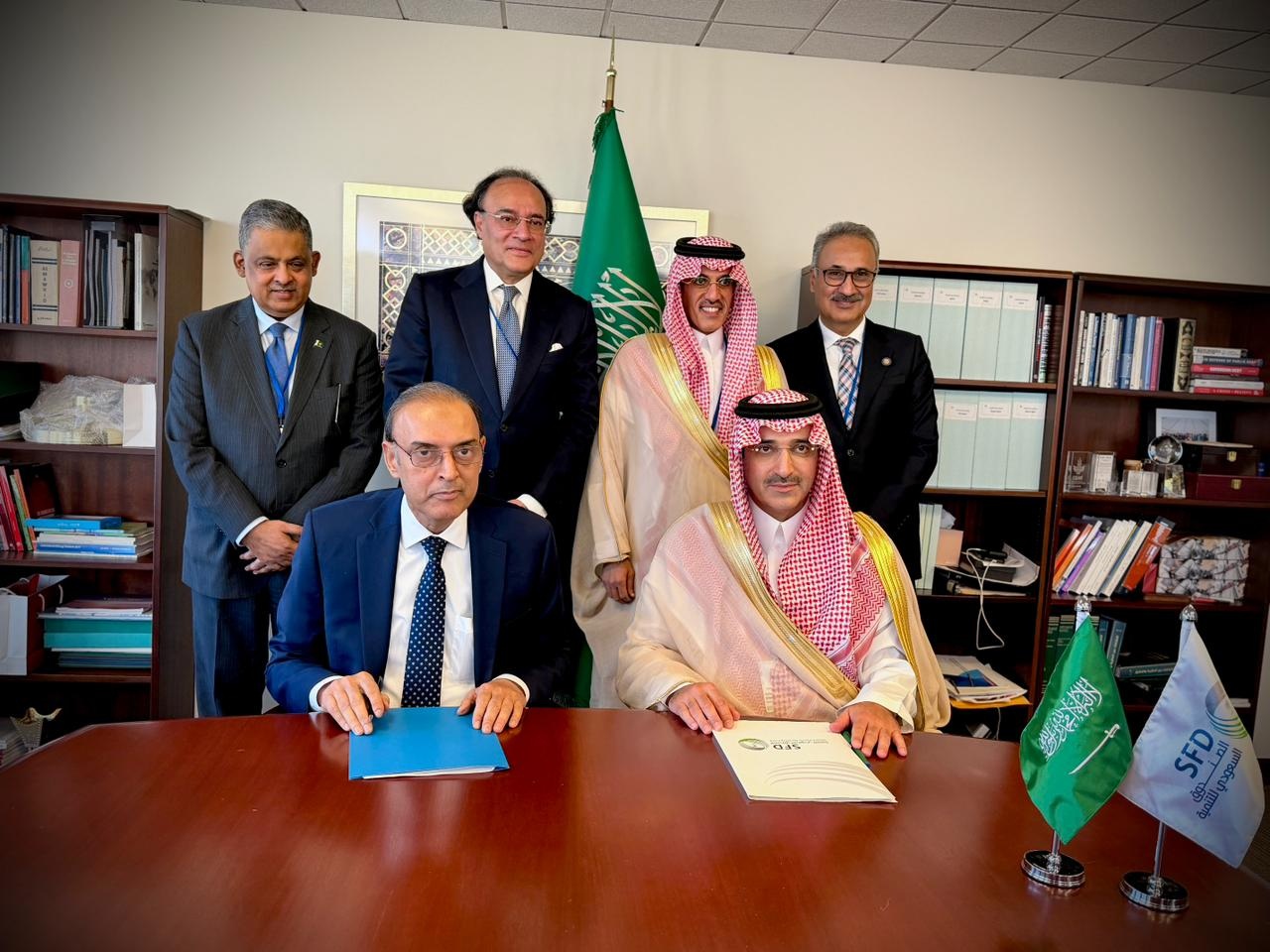
Pakistan and Saudi Arabia sign $3 billion deposit extension agreement
Pakistan Strengthens Global Financial Ties at World Bank-IMF Spring Meetings 2026

Pakistan & Saudi Arabia – (Web Desk) – Pakistan and Saudi Arabia have signed a key financial agreement. The signing took place in Washington, D.C. It happened during the World Bank-IMF Spring Meetings 2026.
Finance Minister Senator Muhammad Aurangzeb attended the ceremony. Pakistan’s Ambassador to the United States was also present. The event marked a significant moment in bilateral relations.
The agreement was signed between two major institutions. The Saudi Fund for Development (SFD) signed with the State Bank of Pakistan (SBP). It covers an extension of a $3 billion deposit.
Sultan bin Abdulrahman Al-Marshad signed on behalf of SFD. Jameel Ahmad, Governor of SBP, signed for Pakistan’s side. Both officials formally completed the agreement.
This deposit extension carries great importance for Pakistan. It reflects the deep economic ties between both nations. Saudi Arabia has long supported Pakistan financially.
The move will strengthen Pakistan’s external financial stability. It shows Saudi Arabia’s continued trust in Pakistan. Both countries are committed to long-term economic cooperation.
Finance Minister Witnesses Signing of Saudi Deposit Extension Agreement with State Bank of Pakistan
Federal Minister for Finance and Revenue, Senator Muhammad Aurangzeb, witnessed the signing of an important financial agreement in Washington, D.C., in the presence of the… pic.twitter.com/2BCoaWPhNL
— Ministry of Finance, Government of Pakistan (@Financegovpk) April 17, 2026
Federal Finance Minister Senator Muhammad Aurangzeb met a top Chinese official. He held talks with Dr Pan Gongsheng in Washington. Dr Pan is the President of the People’s Bank of China (PBOC).
The meeting was warm and productive. Aurangzeb thanked China for its strong support. He appreciated China’s backing of Pakistan at the IMF Executive Board.
Pakistan recently achieved a major milestone. It successfully completed a Staff-Level Agreement with the IMF. This covers the third review under the Extended Fund Facility (EFF).
The second review under the Resilience and Sustainability Facility (RSF) also concluded. IMF Executive Board approval is expected very soon. This is a big step for Pakistan’s economy.
The finance minister also raised the Panda Bond topic. Pakistan plans to issue its first-ever Panda Bond. He requested fast-track approval from NAFMII.
Pakistan records a current account surplus of $1.07bn in March
Aurangzeb shared more positive financial news. Pakistan has successfully repaid its Eurobond obligations. Saudi Arabia has also extended fresh financial support to Pakistan.
The minister highlighted the regional conflict’s economic impact. The government has launched targeted subsidies to help citizens. Demand management steps are also in place to reduce pressure.
The meeting ended on a positive note. Dr Pan personally invited Aurangzeb to visit Beijing. The visit is expected to take place in the near future.
Finance Minister Meets Governor of the People’s Bank of China, Discusses Financial Cooperation and Market Access
Federal Minister for Finance and Revenue, Senator Muhammad Aurangzeb, held a productive meeting with Dr. Pan Gongsheng, Governor of the People’s Bank of China (PBOC),… pic.twitter.com/mQCksJ4sD8
— Ministry of Finance, Government of Pakistan (@Financegovpk) April 17, 2026
Finance Minister Aurangzeb spoke at a high-profile investment seminar. The event was organized by JP Morgan in Washington. It was titled “Pakistan: Economic and Monetary Policy Outlook.”
The seminar was held on the sidelines of the World Bank-IMF Spring Meetings 2026. Top global institutional investors attended the session. State Bank Governor also joined the discussion.
Aurangzeb opened with major financial news. Pakistan has completed a Staff-Level Agreement with the IMF. This covers the third review under the Extended Fund Facility (EFF).
The second review under the Resilience and Sustainability Facility (RSF) also wrapped up. This reflects Pakistan’s strong commitment to economic reforms. It also boosts investor confidence in the country.
The minister expressed full confidence in Pakistan’s financial future. He assured investors that all external obligations will be met on time. Saudi Arabia’s financial support plays a key role in this stability.
Aurangzeb also updated investors on the Panda Bond plan. Pakistan is preparing its first-ever Panda Bond issuance. This is part of a broader strategy to diversify funding sources.
Japan commits $2 million in aid for Pakistan’s climate-affected communities
He also addressed the regional conflict’s energy impact. The government has introduced smart energy management steps. These include demand control and market timing adjustments.
Digital subsidies are being used to protect vulnerable citizens. Full price pass-through measures are also in place. These steps help reduce the economic burden on common people.
The session ended with a lively Q&A round. Investors asked about additional IMF financing options. Questions on privatization progress and Pakistan’s regional role were also raised.
Finance Minister Engages Global Investors at J.P. Morgan Seminar on Pakistan’s Economic Outlook
Federal Minister for Finance and Revenue, Senator Muhammad Aurangzeb, participated in the J.P. Morgan Investment Seminar titled “Pakistan: Economic and Monetary Policy Outlook”, where… pic.twitter.com/NHIez1rmuA
— Ministry of Finance, Government of Pakistan (@Financegovpk) April 17, 2026
Comments are closed, but trackbacks and pingbacks are open.