
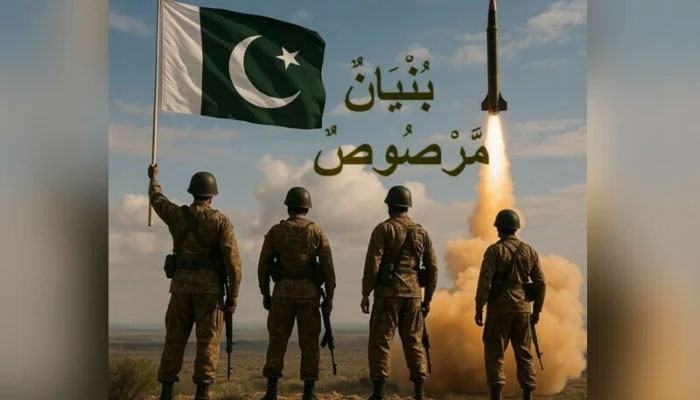
Operation Bunyan-ul-Marsoos and the Reassertion of Deterrence in a Nuclearized Region
By: Muhammad Waleed Akhtar

The unfortunate incident in Pahalgam on April 22, 2025, became the latest flashpoint in an already volatile region. Its immediate impact was borne by the people of Indian illegally occupied Jammu and Kashmir (IIOJK). Instead of a transparent investigation, a sweeping security crackdown followed. Reports highlighted mass detentions, raids and the demolition of civilian homes. Communities were placed under intense surveillance. Daily life was disrupted. Fear and uncertainty deepened. Such measures reinforced a pattern where entire populations are subjected to collective pressure rather than targeted accountability.
Within hours, India attributed responsibility to Pakistan without presenting publicly verifiable evidence. Diplomatic space narrowed rapidly. The suspension of the Indus Waters Treaty signalled a sharp shift from restraint to coercion. This escalation set the stage for a broader confrontation.
On May 7, 2025, India launched Operation Sindoor, projecting it as a counter-terrorism response. The strikes extended across multiple locations in Pakistan and Azad Jammu and Kashmir, raising serious concerns about proportionality and intent. Instead of stabilizing the situation, the operation intensified tensions and expanded the crisis.
Pakistan’s response came on May 10 through Operation Bunyan-un-Marsoos. It was calibrated, coordinated and decisive. Strategic military targets were engaged with precision. The response demonstrated operational readiness and technological capability. It challenged assumptions of unilateral escalation dominance. India’s posture was exposed. Its narrative of uncontested superiority faced a serious setback.
Operation Bunyan-un-Marsoos signalled more than retaliation. It reflected resolve, discipline and national cohesion. It conveyed that aggression would be met with proportionate response. In a nuclearized region, this balance between restraint and capability remains critical. The episode reaffirmed one reality: sustainable peace cannot emerge from force. It requires accountability, dialogue and a serious engagement with the unresolved dispute at the core of the conflict.
Since the abrogation of Article 370 in August 2019, New Delhi had constructed a layered argument: that Jammu and Kashmir was administratively normalised, democratically re-engaged through the 2024 assembly elections and economically reviving through recovered tourism. Indian authorities maintain that Operation Sindoor was a precisely calibrated counter-terrorism response, that its targets were non-state actors rather than Pakistani military assets and that the territory remains an internal matter. These claims form a coherent official position and they deserve to be engaged rather than dismissed.
What they cannot explain is the conduct that followed Pahalgam. States that have genuinely resolved the political conditions underlying instability do not respond to a single attack by suspending a treaty that survived two wars, demolishing civilian homes as collective punishment and detaining over a thousand residents without legal process. That pattern of response does not signal control. It signals that the conditions being managed are more volatile than the official narrative permits. As Al Jazeera reported on 23 April 2025, the Pahalgam attack punctured the balloon of the government’s New Kashmir story. The response that followed confirmed the puncture was structural, not incidental.
The Stimson Center’s post-crisis report, “Four Days in May,” described the May 2025 confrontation as the most significant South Asia crisis since 2019 and only the second time in recorded history that two nuclear-armed states exchanged airpower. Pakistani authorities reported that Indian strikes under Operation Sindoor killed at least 31 civilians including women and children. Along the Line of Control, shelling reached an intensity that residents of Poonch and Rajouri said they had not experienced in decades. Al Jazeera’s frontline reporting documented at least 11 civilian deaths in Poonch from Pakistani artillery strikes, including a seven-year-old child killed when shells struck a residential area.
The international response exposed a clear reality. UN Secretary-General António Guterres warned that the world could not afford a military confrontation between India and Pakistan. On 5 May 2025, the UN Security Council held closed consultations under the long-standing “India–Pakistan question.” US Secretary of State Marco Rubio engaged both sides. A ceasefire followed on 10 May, driven by pressure from the United States, China, Saudi Arabia, Turkey and the United Kingdom. It was not bilateral restraint. It was external intervention. When multiple powers are required to halt hostilities, calling the dispute “domestic” becomes untenable.
UN Security Council Resolution 47 (1948) recognised Jammu and Kashmir as disputed and called for a plebiscite. It remains valid. The right to self-determination, rooted in Article 1 of the UN Charter, does not expire through unilateral legislation.
A governance model built on detention, suppression and legal redefinition does not resolve disputes. It intensifies them. The April 2025 Baisaran Valley incident reflected that risk. The crisis reaffirmed one point: the dispute remains unresolved and demands sustained diplomatic engagement. The return of Kashmir to global attention in May 2025 was not engineered. It was inevitable. It was what happens when the gap between an official narrative and a political reality becomes too wide for a single event to bridge.
The author is a student of International Relations at the International Islamic University, Islamabad. Currently, he is serving as an intern at the Kashmir Institute of International Relations Islamabad.
Comments are closed, but trackbacks and pingbacks are open.