
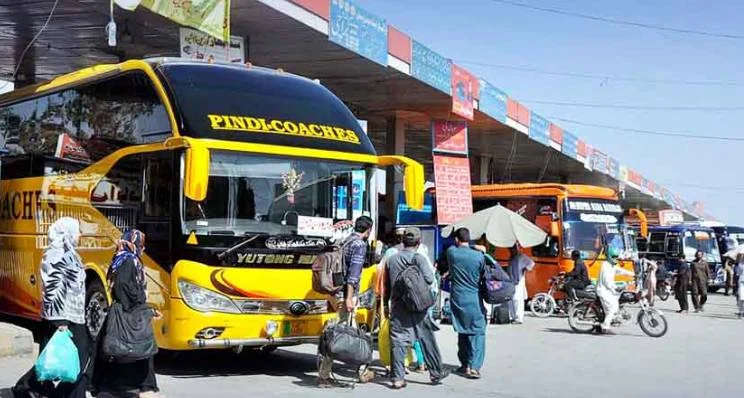
Pakistan’s Fuel Crisis Is Testing Pakistan’s Already Collapsed Public Transport System
By Syeda Aliha Bukhari, Samin Fatima & Suwaibah Irfan | May 2026

Rising petrol prices are not the root cause. They are a stress test and Pakistan’s public transport is failing it.
In early April 2026, the government increased the price of petrol by Rs 137.23 per litre, a 42.7 percent increase, bringing the price of high-speed diesel to Rs 520.35 and petrol to Rs 458.41 per litre. This announcement caused immediate panic across the nation. At petrol stations, long lines were formed. A day later, the petrol price dropped to Rs 378 as Prime Minister Shehbaz Sharif lowered the petroleum levy by Rs 80 per litre. It fell to Rs 366 per litre and diesel to Rs 385 within another 24 hours.
The numbers kept shifting.
By early May, the prices were somewhat settled. Petrol now sits at Rs 414.78 per litre, diesel at Rs 414.58, but damage had already been done. Millions of Pakistanis who depend on private vehicles to get to work, hospitals, and universities had to recalculate every trip for weeks. This crisis raised an uncomfortable question: was there another option?
The answer is complicated. Public transport exists but not everywhere. It runs, but not for everyone. It is cheaper but not always safe, not always accessible and not always worth the trouble.
At one point, Misbah’s daily commute revolved around petrol costs, traffic and stress. A student at SKANS Islamabad, who used to drive her own car to university. But as fuel prices started rising, every trip began to feel like a fuel cost analysis. “I was always mentally calculating how much each trip was costing me,” she says. “By the end of the week, the sum was a lot.”
On average, she was spending around Rs. 20,000 to 22,000 per month on fuel alone. This did not include parking or maintenance costs. Eventually, the amount became difficult to ignore.
Today, she takes the metrobus instead.
“Fuel prices were the biggest trigger,” she explains. “But after switching, I realized it’s not just about money anymore. The commute became more structured and less stressful.”
Her story shows a growing reality in Pakistan’s urban centers, where rising fuel prices are quietly reshaping the way people move. As fuel costs remain unstable, more commuters are shifting toward public transport systems like the Metrobus, Orange Line Train and electric bus networks.
But beneath this shift lies a larger question: Can Pakistan’s public transport systems realistically reduce fuel dependence, or are commuters simply adapting to an economic crisis?
A System that Works but Only in Parts
Pakistan has made significant investments in mass transit projects over the last decade, especially in cities like Lahore, Rawalpindi, Islamabad, Multan, and Karachi. The Orange Line Metro Train, Metrobus corridors, and more recent electric bus initiatives were created to ease traffic and offer an alternative for personal vehicles.
According to transportation engineer Rabbia Asad, these systems are already having some impact.
“As a transport engineer, I believe public transport can reduce fuel dependence, but only partially in the current situation,” she says.
She explains that on certain routes, commuters are already moving away from cars and motorcycles due to initiatives like the Orange Line Train and Lahore Metrobus. However, the larger problem is that these systems remain corridor based rather than citywide. “Coverage is still very small compared to the size of the city,” Rabbia says. “Most people still rely on motorbikes because they dominate fuel use and offer flexibility.”
For commuters like 34-year-old wholesale dealer Sarim Akhtar, the metro has become a practical alternative to rising fuel prices. Traveling daily from College Road to Saddar, he gradually stopped using his bike and shifted fully to the metrobus system.
“The increase in fuel prices significantly affected my commute,” he says. “After petrol became expensive, the metro became the more economical option.”
What works for him most is the dedicated metro route, which avoids traffic and saves time. “Previously, when I used my bike, I would get stuck in traffic for nearly an hour for routes that should only take 15 to 20 minutes,” he explains.
But even Sarim’s experience reflects the gaps that Rabbia pointed out.
“The metro is not directly accessible from my home,” he says. “I still have to cover some distance on my own.”
That “last mile problem” remains one of the biggest structural weaknesses in Pakistan’s public transport systems. According to Rabbia, many commuters can use the metro only after arranging separate transport for themselves, such as walking long distances, or relying on cab services to reach stations.
“The systems are not fully integrated,” she explains. “Metrobus, Orange Line and feeder routes are not connected in a seamless way.”
As a result, public transport works efficiently for certain corridors, but not for the entire journey.
“The systems are not fully integrated. Metrobus, Orange Line and feeder routes are not connected in a seamless way.” — Rabbia Asad, Transport Engineer
The Price of Convenience
Though public transport may be cheaper, but many commuters say it comes with compromises.
For Sarim, overcrowding remains one of the biggest frustrations. “During peak hours, there is constant pushing and very limited personal space,” he says. “I’m always worried about pickpocketing.” The experience becomes even more exhausting during summer rush hours. “I’m somewhat
claustrophobic,” he adds. “Traveling in overcrowded conditions becomes very stressful.”
This issue is not limited to working professionals.
Ameer Hamza, a Civil Engineering student at NUST, says rising fuel prices pushed him toward university transport services.
“Yes, I use university van more often now,” he says.
The switch helps him save money and reach classes on time, but it also limits his flexibility. “I can’t leave when I’m free or stay after 5 PM for projects because the vans leave at fixed times,” he explains.
The adjustment has affected his routine in small but meaningful ways. “I have to wake up earlier now,” he says. “I used to sleep 40 minutes more.”
Would he continue using university transport long-term?
“I would definitely try not to because of so many inconveniences.”
His response highlights a pattern repeated across multiple interviews: many people are not choosing public transport because it is ideal. They are choosing it because it is financially necessary.
When Safety Becomes Part of the Journey
For female commuters, the experience of using public transportation is completely different and carries another layer entirely.
Easha Fatima, who works at a real estate marketing agency, uses the metrobus regularly and walks around 10 to 15 minutes from the station to her workplace.
“I feel safe around 80 percent of the time,” she says. “The traveling itself feels relatively safe. The waiting does not.”
According to her, metro station entrances and waiting areas often feel uncomfortable for women due to unwanted attention from strangers. “Inside the bus, I generally feel safer,” she explains. “But outside the station, especially near stairs and entrances, there is always fear that someone may approach you and make you uncomfortable.”
Although she has not experienced direct harassment, she says her personal boundaries are frequently ignored in crowded spaces. “When I first started using public transport, I was softspoken and accommodating,” she says. “Over time, I realized you really have to be confident and protective of your own space.”
She considers women-only sections effective despite overcrowding. “Women generally look out for one another,” she says. “That sense of mutual care makes the compartment feel safer.”
However, overcrowding still creates serious discomfort. During one rush-hour commute, someone stepped on her so severely that the injury affected her for days. “There were no seats available, so I had to continue standing despite the pain,” she says.
Other female commuters shared similar concerns.
A 21-year-old student recalled repeated harassment while waiting for a bus at G-9 Chowk. According to her, men slowed down their vehicles, stared continuously and gestured for her to sit with them. “They even park and wait for women,” she says.
Another student described the walk from the NUST metro station to the university as “sketchy,” especially at night due to poor lighting and the absence of security personnel. “There are bikes passing by and lots of men and they do not hesitate to stare at you all the way to the station,” she says.
Because of this, she avoids staying late at university. “I end up missing events and opportunities because I don’t want to walk alone at night to the station.”
These incidents support one of the points Rabbia made in her interview: safety concerns continue to discourage many people, especially women, from relying fully on public transport.
A System Still Struggling to Connect
Despite the growing number of users, experts argue that Pakistan’s transport systems remain incomplete.
Rabbia points to several structural issues:
- Limited network coverage
- Weak feeder systems
- Poor pedestrian infrastructure
- Fragmented governance
- Lack of multimodal connectivity
“Only main roads are served,” she says. “Inner areas are often disconnected.” This disconnect is one reason some commuters eventually stop using public transport altogether.
Former NUML student Maleeha Hassan used public transport regularly between Committee Chowk and her university before eventually giving up. “The overall journey became too exhausting,” she says. Even after taking the bus, she still had to walk nearly 15 minutes to reach campus. The commute became unsustainable due to overcrowding and limited route flexibility.
“The system did not feel efficient,” she explains. “If your destination was even slightly out of the way, it became difficult to manage.”
For commuters like Maleeha, public transport covered only part of the journey while leaving the hardest portions unresolved.
Beyond Short-Term Solutions
In recent months, the government has implemented temporary relief measures, such as free metro bus services during certain periods to reduce financial pressure on commuters. But experts argue that short-term relief alone cannot solve Pakistan’s transportation challenges.
According to Rabbia, real impact would require a complete shift in planning philosophy. “Public transport needs to move from corridor-based systems to city-wide coverage,” she says. She also emphasizes the need for integrated ticketing systems, stronger feeder routes and transit-oriented development around stations. Instead of making commuters choose between private vehicles and public systems, she suggests that facilities like park-and-ride could help connect the two.
At the same time, public transport needs to be more dependable, accessible, and safe than private alternatives. Without it, commuters might only use vans and metros as short-term fixes for growing fuel costs rather than long-term lifestyle changes.
Conclusion
Pakistan’s fuel crisis is often discussed as an economic issue. But for millions of commuters, it is increasingly becoming a mobility issue.
The metrobus may save time for Sarim, but overcrowding still exhausts him. University transport may help Ameer reduce costs, but it also limits his freedom. Female commuters may appreciate women-only sections yet still feel unsafe outside stations. Former users like Maleeha eventually stop using the system altogether because the journey remains incomplete.
The problem is no longer simply whether public transport exists. The problem is whether it can truly support the realities of daily life in Pakistan. As of right now, the answer seems to be partial. The systems work. But only in pieces.
Comments are closed, but trackbacks and pingbacks are open.