

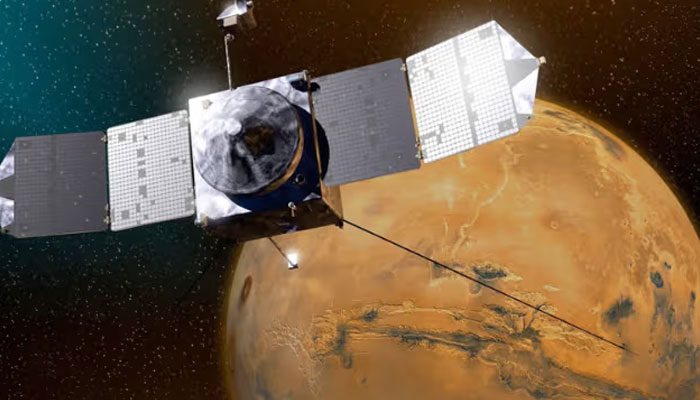
NASA Ends MAVEN Mars Mission After Contact Loss
NASA Declares MAVEN Mars Orbiter Unrecoverable After Failure

NEW YORK: (Web Desk) – NASA has officially concluded its review of the Mars Atmosphere and Volatile Evolution mission, following a six-month loss of contact with the spacecraft and an investigation that determined it was no longer recoverable.
The MAVEN mission stopped communicating on December 6 after passing behind Mars during a routine orbital phase. NASA later confirmed that no further transmissions were detected when it re-emerged, prompting extensive recovery attempts.
Communication efforts using NASA’s Deep Space Network and the Green Bank Observatory were unsuccessful, although engineers briefly recovered limited telemetry data from a radio science experiment shortly after the anomaly occurred.
According to mission officials, including project manager Mike Moreau, the recovered data indicated that the spacecraft had begun spinning at an unexpected rate of 2.7 revolutions per minute. This rotation likely disrupted its solar power generation, ultimately draining its batteries and rendering the spacecraft inoperable.

Scientists, including principal investigator Shannon Curry, noted that while the precise cause of the failure remains under investigation, MAVEN’s scientific legacy is substantial. Since entering Mars orbit in 2014 after its 2013 launch, the spacecraft has significantly advanced understanding of atmospheric escape on the Red Planet.
Blue Origin Rocket Explosion Deals Blow to NASA
Beyond its research role, MAVEN also served as a key communications relay for Mars missions, transmitting nearly one-fifth of all data from surface operations. Its loss places greater reliance on other orbiters operated jointly by NASA and the European Space Agency, which continue to support the Mars Relay Network.
NASA has acknowledged that data transmission speeds may be slightly affected, but the network remains operational and stable. The agency is now accelerating plans for the Mars Telecommunications Network, a dedicated relay system expected to launch by 2028 with funding of approximately $700 million.
Despite the mission’s end, MAVEN is expected to remain in Martian orbit for decades, gradually decaying over the next 50 to 100 years before eventually reentering the planet’s atmosphere.
Comments are closed, but trackbacks and pingbacks are open.