
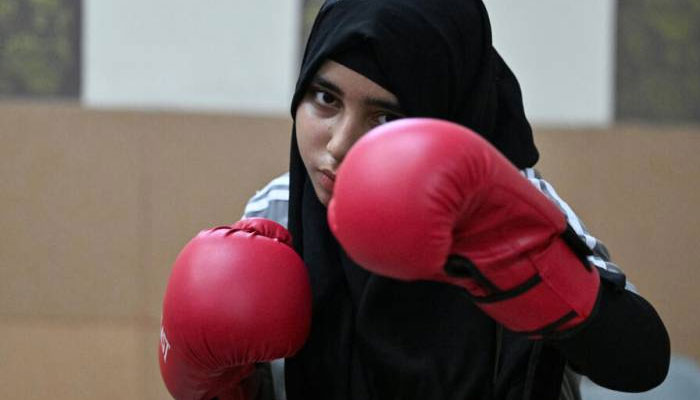
Lyari’s Young Girls Punch Through Barriers With Boxing
Pakistan’s Girl Boxers Defy Convention One Punch at a Time

ISLAMABAD: (Sports Desk) – Sweat running down her face, aspiring teenage boxer Hoorain Zahra repeatedly works through combinations, dreaming of following the path of her role model Aliya Soomro.
Soomro, 21, gained national attention last year after securing an international victory in Bangkok, a significant achievement for a young Pakistani woman pursuing a sport often viewed as unsuitable for girls because of conservative social and cultural expectations.
Female boxing has drawn further attention in Pakistan following Fatima Zahra’s achievement as the country’s first female Commonwealth Games boxing medallist. The 22-year-old claimed bronze in the 60kg category at the Commonwealth Games in Glasgow in late July.
Thirteen-year-old Hoorain, like Soomro, comes from Lyari, the sports-loving neighbourhood in Karachi that has endured years of poverty, violence and social challenges. Despite criticism from parts of society, she remains determined to pursue boxing.
Some people believe boxing is not appropriate for girls and that young women should not leave their homes because of safety concerns, Zahra said. But she argues that going outside is an unavoidable part of everyday life and that girls should have the opportunity to participate in sport.
Inside a modest boxing gym in a rundown Lyari building, other young girls prepare for training. They remain fully covered in scarves, long-sleeved tops and trousers as they get ready for their session.
The gym is run by Ustad Younis Qambrani, a 56-year-old coach who has trained generations of young fighters and opened his facility to girls more than a decade ago.
Qambrani said he considered women’s boxing important for girls and recalled that his own two daughters were among the first to take up the sport at his gym. He believes boxing gives the girls confidence, courage and the ability to face challenges without fear.
Breaking Barriers
The difficulties faced by girls seeking to participate in sport are closely linked to Lyari’s turbulent history. Once regarded as one of Karachi’s most dangerous neighbourhoods, the area was heavily affected by the spread of weapons and drugs during the Afghan war against the Soviet Union.
A major paramilitary operation against armed gangs began in 2013. Political and social changes followed, with conservative groups gaining influence in subsequent years and restrictions on girls’ activities increasing in some parts of the community.
Yet sport has remained an important part of Lyari’s identity. The neighbourhood has produced numerous athletes, while its young female boxers are increasingly challenging traditional expectations.
Support from families has also played a key role. Parents of girls such as Hoorain and Soomro have encouraged their daughters to pursue boxing despite social pressure.
Soomro, who hopes to build on her international success, believes girls deserve the same opportunities as boys in sport.
She argues that society often underestimates women and assumes they are too weak to succeed. Her experience in the ring, however, has strengthened her belief that girls can accomplish anything—and sometimes even outperform men.
[…] (News Desk) – A new study by Germany-based Anar Academy has found that many Afghan girls are turning to online education, private courses and self-study to […]