

Khawaja Asif Credits Field Marshal Asim Munir for Regional Peace Efforts, Makkah Joint Agreement
Khawaja Asif Defends Asim Munir’s Tehran Peace Mission

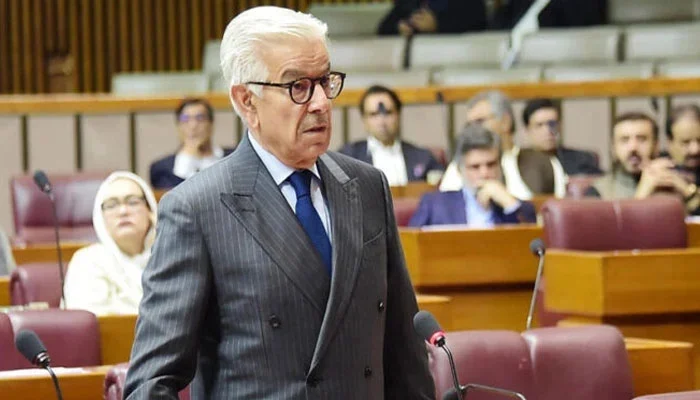
ISLAMABAD: (Staff Reporter) – Defence Minister Khawaja Asif has said his ministry was not responsible for the recent diplomatic engagement in Tehran, explaining that he did not attend because no defence agreement was being signed during the visit.
Addressing the National Assembly on Thursday, Khawaja Asif said Field Marshal Syed Asim Munir had travelled to Tehran with a message of peace and had made diplomatic efforts to ease regional tensions.
“The Field Marshal made diplomatic efforts for establishing peace in the region. Field Marshal’s diplomatic efforts led to the Makkah Joint Agreement and an agreement with Qatar,” the defence minister said.
Taking aim at Jamiat Ulema-e-Islam-Fazl (JUI-F) chief Maulana Fazlur Rehman, Khawaja Asif questioned his contribution to the Kashmir cause during his decade-long tenure as chairman of the Kashmir Committee.
“What did Maulana do for the Kashmir cause besides free rides?” he asked, alleging that JUI-F was the only political party making money in the name of religion.
Earlier, Maulana Fazlur Rehman had criticised the defence minister during his address to the House, using Khawaja Asif’s well-known phrase, “Koi sharam hoti hai, koi haya hoti hai” (There should be some shame and decency).
The JUI-F chief questioned why defence-related agreements were being discussed in Iran while the defence minister remained in Pakistan. He asked whether such matters also fell under the responsibility of the Interior Ministry.
Fazlur Rehman also urged Khawaja Asif to maintain his dignity and self-respect, turning the minister’s own previously used remarks against him.
Beyond the exchange, the JUI-F chief called on the government and opposition to engage in dialogue and develop a new “Charter of Democracy” to address Pakistan’s political challenges.
The National Assembly session witnessed a sharp exchange between the two leaders over regional diplomacy, defence responsibilities and the political role of religious parties.
Comments are closed, but trackbacks and pingbacks are open.