
Gaza Hospitals Struggle as Premature Babies Face Severe Shortages
Severe Medical Shortages Put Gaza’s Premature Babies at Risk

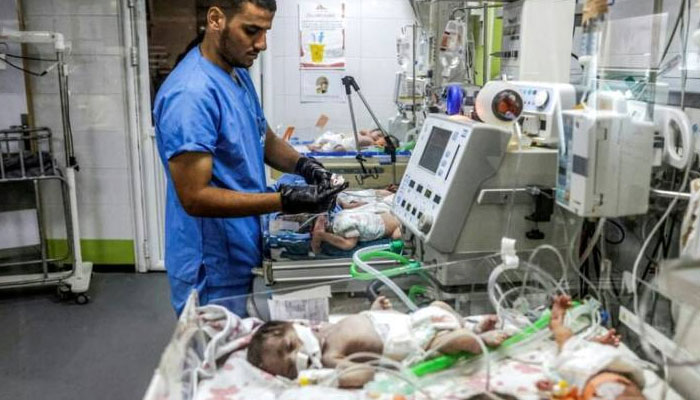
GAZA: (News Desk) – Two premature newborns lie side by side in a single incubator at Nasser Hospital in southern Gaza, as doctors struggle with a critical shortage of incubators, oxygen and other essential medical supplies.
The situation has made survival even more difficult for Gaza’s most vulnerable newborns, who are already entering the world amid a devastating humanitarian crisis caused by the prolonged war.
Hatem Dhahir, head of the neonatal department at Nasser Hospital in Khan Yunis, said there was no oxygen available for some babies and no spare incubators at the facility.
“We are trying to transfer them to other hospitals, but they are always full,” Dhahir told AFP, warning that many newborns require oxygen and are severely underweight.
Gaza’s healthcare system has suffered extensive damage during the war between Israel and Hamas, with many medical facilities either destroyed or only partially operational. Restrictions on the entry of goods have also contributed to shortages of medicines, medical equipment and specialist supplies.
Israel says it restricts the entry of items that could have military applications and accuses Hamas, which launched the October 7, 2023 attack on Israel, of planning further violence.
According to Dhahir, Nasser Hospital has recorded a significant rise in premature births in recent months, along with an increase in twin and triplet births. The shortage of incubators has forced medical staff to place two or even three newborns in a single incubator.
The UN humanitarian agency OCHA reported in March that one in three pregnancies in Gaza were considered high-risk, while around 70 percent of newborns were premature or underweight. It warned that sharing incubators significantly increases the risk of infant mortality.

The broader humanitarian crisis has also taken a heavy toll on maternal health. Almost the entire population of Gaza has been displaced at least once since the war began, while widespread destruction has severely damaged sanitation systems and access to clean water.
A UN-mandated inquiry published in June said shortages of food, medical supplies and fuel, together with the collapse of healthcare services, had severely affected maternal health. It reported increases in miscarriage, stillbirth, low birth weight and congenital defects.
Medical practitioners cited by the inquiry also reported a rise in certain congenital heart conditions.
Mona Ahmad, who accompanied a baby to Nasser Hospital in late August, said the child was diagnosed with a serious congenital condition in which the heart’s two main arteries are switched in position.
Doctors determined that the baby needed to be transferred elsewhere because the condition could not be treated at the hospital. However, Ahmad said the newborn was discharged after spending a week in the neonatal unit because there was no space available.
The UN children’s agency UNICEF has increased efforts to support Gaza’s neonatal services by supplying incubators, ventilators and monitoring equipment to hospitals.
UNICEF says it has provided 93 incubators to six facilities across Gaza, including equipment supplied before the ceasefire.
However, Toby Fricker, UNICEF Palestine’s chief of advocacy and communications, said major challenges remain.
Despite the severe shortages, he said doctors and medical workers continue to keep neonatal services functioning through their determination and resilience.
Comments are closed, but trackbacks and pingbacks are open.