
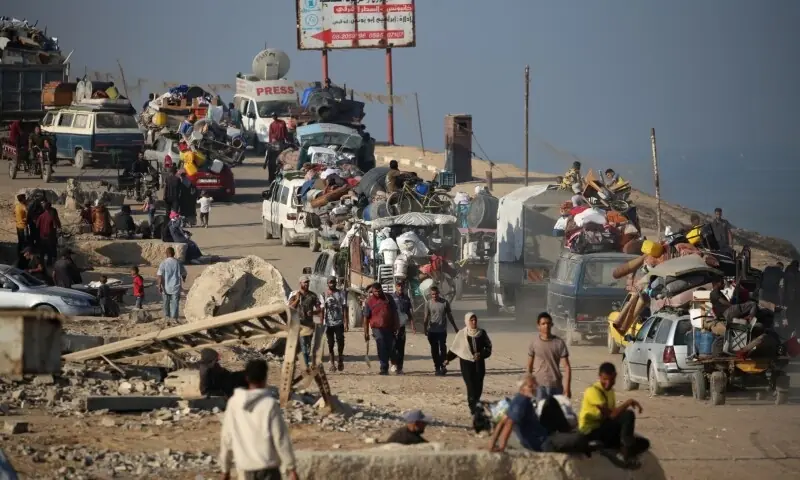

Gaza, at this grievous historical juncture, no longer merely constitutes a geographically beleaguered enclave; rather, it has assumed the form of one of those lamentable chapters in the annals of human civilisation wherein warfare is prosecuted not solely through the overt violence of artillery, missiles, and aerial devastation, but through the far more insidious instrumentation of deprivation itself. Bread, potable water, medicinal provisions, and fuel supplies have increasingly been transformed into silent yet devastating implements of coercion, rendering subsistence itself contingent upon the calculus of siege and restriction. The prevailing scarcity of flour and fuel has consequently thrust the inhabitants of Gaza into an ordeal of almost unimaginable severity, wherein even the most elementary prerequisite of human existence bread has become an object of agonising rarity. Lengthening queues before bakeries, citizens returning empty-handed after interminable hours of waiting, curtailed flour deliveries, and the relentless escalation of fuel costs collectively testify to the sombre reality that Gaza once again stands precariously upon the precipice of a profound humanitarian catastrophe.
According to various Arab media reports, Gaza requires approximately four hundred and fifty tons of flour each day merely to sustain the rudimentary nutritional demands of its population; yet under present conditions scarcely two hundred tons are reaching the territory. Such a disparity is not merely a statistical incongruity within logistical calculations; it represents the harrowing chronicle of innumerable famished stomachs, despairing mothers, and children condemned to the insecurities of chronic malnourishment. The reduction in bakery production has paralysed the ordinary rhythms of daily life. Entire families now endure exhaustive vigils from dawn until dusk in pursuit of a few loaves of bread, only to depart in deprivation and disappointment. One is compelled to confront the tragic impression that food within Gaza has ceased to function as an inalienable human entitlement and has instead become a vanishing privilege increasingly inaccessible to the majority of the population.
The most distressing dimension of this crisis lies in the fact that the prevailing scarcity is not the consequence of a natural calamity or agricultural collapse, but rather the product of an extensive and deliberate system of restrictions that has severely undermined the essential infrastructure of civilian existence. Israeli limitations have not only constricted the inflow of humanitarian aid and food supplies but have also gravely impaired fuel distribution. Consequently, bakeries are progressively losing the capacity to operate their generators, without which production becomes virtually impossible. The exorbitant rise in the prices of generator oil and fuel has amplified operational expenditures to intolerable levels, imposing yet another burden upon an already shattered economy debilitated by prolonged warfare and destruction.
The contemporary condition of Gaza compels the international conscience to confront a deeply disquieting question regarding the efficacy and sincerity of modern human rights discourse. International organisations, global powers, and self-proclaimed custodians of humanitarian values routinely issue declarations of concern and solidarity; yet the stark reality upon the ground reveals that millions of Palestinians continue to exist without reliable access to the most basic conditions of nutritional security. Even the bakeries operated under the auspices of the World Food Programme are now receiving flour in drastically limited quantities, thereby diminishing the operational capacity of humanitarian relief itself. If even the mechanisms of international assistance can be rendered impotent before the forces of blockade and political obstruction, then one must ask by what means the preservation of human life is ultimately to be guaranteed.
The economic ramifications of this calamity are equally severe and far-reaching. Gaza had already been afflicted by catastrophic levels of unemployment long before the current intensification of scarcity. Thousands of households remain deprived of stable income while the prices of essential commodities continue their relentless ascent. Under such circumstances, the increasing cost of bread ceases to be merely an economic inconvenience and instead emerges as a social tragedy of profound magnitude. When a father loses the capacity to procure even a few loaves for his children, the consequences extend far beyond hunger itself; they penetrate the psychological, moral, and social fabric of an entire community, corroding dignity, stability, and hope simultaneously.
History repeatedly demonstrates that famines do not arise solely from the absence of food; they are equally born from political indifference, economic strangulation, and the collapse of humane priorities. The developments unfolding within Gaza unmistakably point toward precisely such a trajectory. Unless immediate and substantial improvements are made in the provision of food, fuel, and medical assistance, the present crisis may evolve beyond mere scarcity into a vast humanitarian cataclysm of historic proportions. The United Nations and numerous international relief agencies have already issued repeated warnings that Gaza is approaching an extraordinarily perilous phase of nutritional devastation, yet despite these alarms no meaningful structural transformation appears forthcoming.
It is further imperative to recognise that wars are not won exclusively upon conventional battlefields; they are equally prosecuted through the systematic breaking of human endurance and collective morale. For years, the people of Gaza have endured siege, bombardment, displacement, and economic ruin, yet their struggle for survival persists with remarkable resilience. A Palestinian standing for hours within a bread line is not merely seeking sustenance; he is, in a profoundly symbolic sense, engaged in a silent act of existential resistance an affirmation of identity, continuity, and the irreducible right to exist.
Within the broader architecture of contemporary international politics, the crisis of Gaza has long ceased to be a merely regional issue; it has instead become a defining examination of the moral credibility of the global order itself. If the world genuinely aspires to uphold the principles of civilisation, human rights, and international justice, it must move beyond rhetorical declarations and undertake substantive measures capable of alleviating this immense human suffering. For the agony of hunger cannot be extinguished through diplomatic abstractions, nor can hope be restored to famine-stricken children through resolutions alone. Gaza today seeks not merely assistance from the international community, but an answer from the collective conscience of humanity itself: whether, in the so-called modern age, bread shall continue to be weaponised as an instrument of political domination and human subjugation.
Comments are closed, but trackbacks and pingbacks are open.