
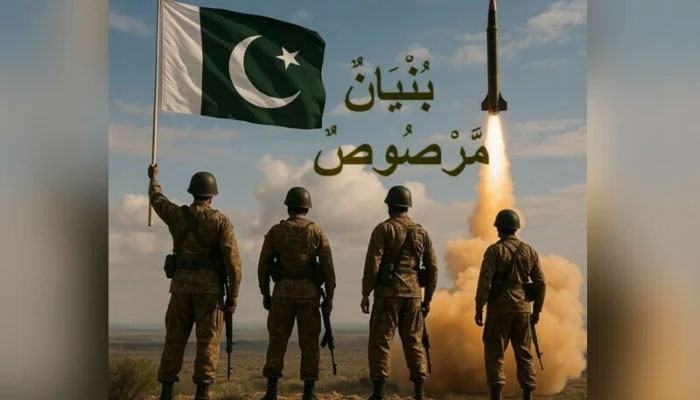

One year after the culmination of the Battle of Truth, the pronouncements emanating from Pakistan’s military and political leadership have not merely reconfigured the strategic ambience of South Asia but have also resurrected profound discourses surrounding deterrence equilibrium, psychological ascendancy, and multidimensional warfare doctrines. The recent statements delivered by Lieutenant General Ahmed Sharif Chaudhry and Interior Minister Mohsin Naqvi transcend the confines of conventional martial rhetoric or emotional nationalism; rather, they appear to constitute an intricately engineered national narrative designed to consolidate Pakistan’s defensive resolve, strategic confidence, and psychological supremacy simultaneously on both domestic and international fronts.
Perhaps the most consequential dimension of this discourse lies in the conspicuous emphasis placed upon multidomain warfare as a central pillar of Pakistan’s contemporary military doctrine. In modern strategic theory, warfare is no longer circumscribed by territorial boundaries, artillery batteries, or missile arsenals alone. Instead, it has evolved into an integrated theatre encompassing aerial dominance, maritime influence, cyberspace operations, informational confrontation, electronic warfare, artificial intelligence, cognitive manipulation, and diplomatic coercion. Consequently, when the Director General of ISPR declared that “India witnessed merely ten to fifteen percent of Pakistan’s aggregate capability,” the statement was not intended merely as an exhibition of military confidence; rather, it represented a meticulously calibrated act of strategic signalling aimed at communicating the existence of latent and undisclosed capabilities still retained within Pakistan’s military architecture.
The political and military history of South Asia demonstrates with remarkable clarity that conflicts in this region have seldom been waged solely through kinetic force. Psychological intimidation, media-driven narratives, and international diplomatic manoeuvring have consistently functioned as equally decisive instruments of confrontation. This explains why recent Pakistani statements repeatedly invoke expressions concerning the annihilation of adversarial arrogance, the transformation of the strategic geometry of warfare, and the reinforcement of deterrent stability. Pakistan seeks to project the impression that it has not only preserved its conventional defensive infrastructure but has also fundamentally disrupted India’s assumption that limited military escalation could impose unilateral pressure upon Islamabad. If Pakistan indeed succeeded in inflicting substantial damage upon Indian aerial, cyber, and electronic capabilities as asserted by officials of the Pakistan Air Force then such developments may signify a pivotal alteration in the strategic balance of the region.
The Pakistan Air Force’s assertion regarding the downing of multiple Indian aircraft, including four Dassault Rafale fighter jets, has likewise generated extraordinary attention within strategic and defence circles. Admittedly, independent verification of wartime claims remains inherently problematic during active hostilities; nevertheless, such declarations themselves constitute a crucial component of psychological warfare. In the contemporary international order, perception management frequently acquires a significance nearly equivalent to tangible battlefield achievements. This explains Pakistan’s persistent effort to reinforce the narrative that it not only neutralised hostile aggression but also subjected its adversary to strategic humiliation and psychological disorientation.
Another profoundly significant aspect of this discourse emerged when the DG ISPR characterised war between two nuclear powers as “madness.” This formulation essentially reiterates Pakistan’s longstanding strategic position that a comprehensive war in South Asia cannot ultimately serve the interests of either state. Under the shadow of nuclear deterrence, both nations remain constrained within an exceedingly fragile equilibrium wherein limited skirmishes may occur, yet a full-scale conflict could propel the entire region towards catastrophic devastation, economic collapse, and humanitarian disaster. Consequently, while Pakistan simultaneously projects military preparedness and operational confidence, it also underscores the unimaginable repercussions associated with unrestricted warfare.

Within this broader geopolitical framework, references to the role of the United States possess exceptional significance. The Interior Minister’s assertion that former American President Donald Trump prevented India from suffering “massive losses” suggests that South Asian crises can no longer be regarded as merely regional disputes. Global powers remain acutely conscious of the potentially destabilising implications of any large-scale military confrontation between Pakistan and India. The United States, China, Russia, and the Gulf monarchies fully comprehend that a comprehensive conflict in South Asia would not remain geographically confined but would inevitably disrupt global trade corridors, maritime security, energy supply chains, and broader international stability.
Similarly, Pakistan’s military leadership has sought to underscore the strategic interdependence between Pakistan and Saudi Arabia. The relationship between Pakistan and Saudi Arabia extends far beyond religious affinity or economic cooperation; it encompasses defence collaboration, geopolitical convergence, and ideological alignment accumulated over decades. By linking the protection of the Two Holy Mosques with Pakistan’s own security paradigm, Islamabad is signalling the existence of a deeply entrenched strategic partnership rooted in mutual trust and longstanding defence cooperation.
Statements concerning Afghanistan are equally laden with strategic implications. Pakistan has once again reiterated that Afghan territory must not be permitted to serve as a platform for hostile activities against Pakistan. This position reflects Islamabad’s evolving perception that internal security challenges can no longer be interpreted merely as isolated manifestations of domestic militancy but must instead be viewed within the wider context of regional security dynamics. Furthermore, the insistence that terrorism bears no association with Islam constitutes part of a broader state narrative intended to delineate a clear distinction between religious faith and violent extremism.
Amidst all these declarations, another noteworthy element is the deliberate emphasis upon internal cohesion and national confidence. Assertions such as “no force can create a divide between the military and the people” are fundamentally aimed at reinforcing a narrative of national unity at a time when informational warfare, social media propaganda, and psychological operations have become integral instruments of modern conflict.
One year after the Battle of Truth, the manner in which Pakistan continues to project its military capability, strategic self-assurance, diplomatic relevance, and psychological superiority indicates that South Asia is entering an increasingly volatile and intricate geopolitical era. Warfare is no longer confined to explosives, artillery, or missiles; it has evolved into a contest of narratives, technological sophistication, information supremacy, artificial intelligence, cognitive influence, and institutional resilience. In such an environment, true power no longer resides solely in weaponry itself, but rather in the capacity to compel an adversary into fear, hesitation, and strategic recalculation even before the commencement of war.
Comments are closed, but trackbacks and pingbacks are open.