
A Treatise on the Helvetian Conciliation: Pakistan’s Strategic Ascendancy as the Vanguard of Regional Pacification
By Muhammad Mohsin Khan (Rajput)

Correspondence: muhmmadmohsinrajput@gmail.com*
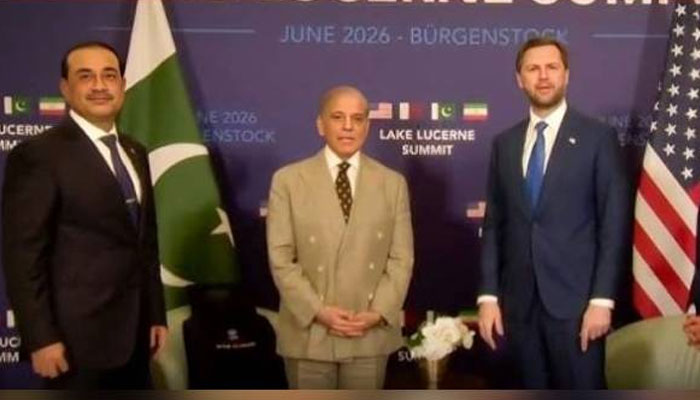
Amidst the sublime, snow-crested precipices of the Swiss Alps, within the tranquil confines of the Bürgenstock resort, there unfolds an epoch-making juncture in international statecraft a geopolitical phenomenon hitherto unvisualized by the Pakistani polity. In the labyrinthine, technical-level parleys transpirating between the United States of America and the Islamic Republic of Iran, the Islamic Republic of Pakistan does not merely assume the mantle of an intermediary; rather, its supreme civil-military diarchy, embodied by Field Marshal Asim Munir and Prime Minister Shehbaz Sharif, exercises direct auspices over this monumental pacification. This constitutes far more than a transient diplomatic triumph; it represents a profound transfiguration of Pakistan’s global identity and sovereign prestige.
This diplomatic conclave operates under the aegis of the *“Islamabad Memorandum of Understanding,”* an instrument of accord solemnized on the seventeenth of June, the year Two Thousand and Twenty-Six. This covenant bears the signatures of the American Chief Executive, Donald Trump, and the Iranian President, Masoud Pezeshkian, with Prime Minister Shehbaz Sharif appending his signature as the legitimizing mediator. Precipitated by a quadrimester of armed hostilities, this concordat delineates a structured pathway toward the unimpeded reopening of the geostrategic Strait of Hormuz to maritime commerce, the mitigation of punitive embargoes hobbling Iranian hydrocarbon exports, and the formulation of a comprehensive framework governing Iran’s nuclear apparatus through a designated sixty-day operational matrix.
The contemporary deliberations at Bürgenstock signify the inaugural, formal endeavor to codify the granular complexities of this mutual understanding. The plenipotentiaries of the United States are led by Vice President J.D. Vance, whereas the Iranian delegation is marshaled by the Speaker of the Islamic Consultative Assembly, Mohammad Bagher Ghalibaf, alongside the Minister of Foreign Affairs, Abbas Araghchi. The State of Qatar concurrently participates in these proceedings in the capacity of a co-mediator.
The preeminent role assumed by Field Marshal Asim Munir within this deliberative theater is by no means an accident of history. It was his strategic stewardship that thrust Pakistan forward as an “unanticipated diplomatic bridge” spanning the chasm of Anglo-American and Iranian antipathy. As chronicled by *The Guardian*, Field Marshal Munir, through unmediated engagements, telephonic diplomacy, and persistent conciliation, engendered a climate of mutual confidence between the adversarial heads of state. His established rapport with the high command of the Islamic Revolutionary Guard Corps, conjoined with his unsullied credibility within the corridors of Washington, empowered Pakistan to navigate this treacherous diplomatic chessboard with consummate efficacy.
Intelligence and strategic sources attest that through unalloyed sincerity, immaculate professionalism, sagacity, and divine providence, Field Marshal Asim Munir performed a cardinal function in averting a cataclysmic conflagration in the region. This achievement is singularly extraordinary a triumph realized without the mobilization of kinetic force, standing as a testament to strategic doctrine of the highest order.
The genesis of this mediation traces back to April 2026, when Islamabad hosted the inaugural exploratory dialogue between the United States and Iran. In the intervening period, Pakistan has remained indefatigably engaged in sustained diplomatic intercourse. The convening of the Bürgenstock summit stands as irrefutable verification that Islamabad enjoys the unstinting confidence of both contending sovereigns.
The dimensions of this diplomatic ascendancy are manifold:
* **Primacy of Doctrine:** It underscores a foreign policy matrix that is meticulously balanced, constructive, and anchored in immutable principles.
* **Geopolitical Pivot:** It establishes Pakistan as an indispensable arbiter of peace and equilibrium within the Eurasian rimland.
* **Macroeconomic Resilience:** It fortifies Pakistan’s economic and geostrategic leverage, particularly given that the maritime arteries of the Strait of Hormuz remain critical to the equilibrium of global commerce.
Yet, the trajectory toward absolute conciliation remains fraught with systemic perils. In response to ongoing Israeli military campaigns within the Lebanese theater, Tehran has proclaimed a potential re-closure of the Strait of Hormuz, an escalation that introduces profound complications into the negotiating matrix. Iranian authorities have characterized these military incursions as indicative of American *“mala fides”* (bad faith). Compounding this friction, the spokesperson for the Iranian foreign ministry has articulated their diplomatic posture through the strict doctrine of “reciprocal resolve” (*resolve for resolve*).
Notwithstanding these volatile impediments, Pakistan remains steadfast in its mediatory obligations. On the sidelines of this historic summit, Prime Minister Shehbaz Sharif is scheduled to engage in bilateral colloquies with the diplomatic envoys of Iran, Qatar, Switzerland, and the United States.
The transactions underway at Bürgenstock transcend the parameters of ordinary diplomatic discourse; they herald a new dawn for Pakistan. A nation once erroneously categorized as a locus of regional volatility has emerged as an indispensable architect of international concord. Under the synchronized governance of Field Marshal Asim Munir and Prime Minister Shehbaz Sharif, Pakistan has demonstrated with absolute clarity its capacity not merely to insulate its own sovereign interests, but to act as a monumental arbiter in the resolution of global schisms. This historical juncture demands a profound sense of national pride, and imposes an enduring obligation to preserve this international trust while relentlessly pursuing the institutionalization of regional peace. Pakistan stands today not as a mere bystander to diplomacy, but as the very architect of international peace.
Comments are closed, but trackbacks and pingbacks are open.