
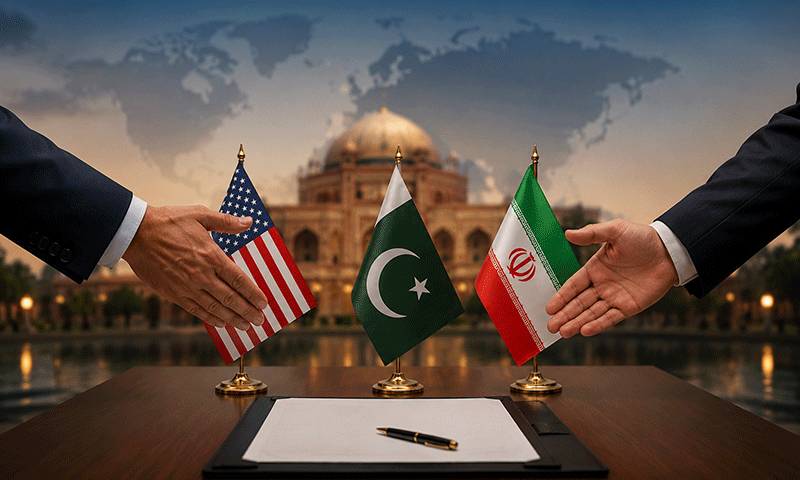

The peace deal between the United States and Iran is an unprecedented development for global peace, prosperity, and stability. Although the agreement carries significant implications for the political dynamics of the Middle East and its future challenges, a certain degree of uncertainty is likely to remain.
The good news is that on April 7, 2026, Pakistan demonstrated its diplomatic skill when the United States and Iran agreed to halt a 40-day war. The question arises: how did Pakistan achieve this remarkable diplomatic success despite numerous conspiracies and diplomatic hurdles?
Historically, this is not the first time Pakistan has demonstrated its mediation capabilities. In 1971, Pakistan used its diplomatic channels to facilitate rapprochement between the United States and China. Another milestone was achieved through Pakistan’s diplomatic efforts during the Geneva Accords, which led to the withdrawal of Soviet troops from Afghanistan after nearly eight years of occupation.
In 2014, Pakistan’s negotiations with the European Union proved successful when the EU approved the Generalized Scheme of Preferences Plus (GSP+) status for Pakistan. On the diplomatic front, Pakistan-China relations took a historic turn with the establishment of the China-Pakistan Economic Corridor (CPEC). Later, in 2020, Pakistan successfully facilitated negotiations between the United States and the Afghan Taliban, ultimately leading to the withdrawal of American forces from Afghanistan after nearly two decades of military presence.
Against this backdrop, the U.S.-Iran agreement represents another diplomatic breakthrough for Pakistan. Islamabad hopes that if the United States and other Western countries remove sanctions on Iran, bilateral relations between Islamabad and Tehran will improve significantly.
It is quite clear that this historic agreement materialized largely due to the sincere and tireless efforts of Prime Minister Shehbaz Sharif and Field Marshal Syed Asim Munir. Both leaders engaged with the U.S. and Iranian leadership patiently and firmly. Diplomatic circles rightly point out that Pakistan helped save the international community from the risk of a wider regional conflict.
It should not be overlooked that, during this crisis, Israel sought to shape the regional situation in a manner that could have intensified tensions between Iran and several Arab countries. Pakistan understood the potential dangers of such developments, which could have had disastrous consequences for many Muslim states. Consequently, the Prime Minister and Field Marshal Asim Munir remained in continuous contact with the leadership of Saudi Arabia, Türkiye, the UAE, Kuwait, Qatar, and other Muslim countries.
It is evident that Israeli Prime Minister Benjamin Netanyahu seeks to reshape the strategic landscape of the Middle East. Many analysts believe that he played a significant role in influencing President Trump’s decision to take military action against Iran. Netanyahu appears convinced that Iran serves as the centre of resistance in the Muslim world. Therefore, he has long advocated regime change in Tehran and the installation of a government more aligned with Western and Israeli interests.
On the other hand, Pakistan’s leadership believes that the collapse of the current political order in Tehran could seriously undermine regional security, including Pakistan’s own security interests. Pakistani policymakers are also mindful of emerging strategic partnerships and regional alignments that may affect Pakistan’s long-term security environment.
Pakistan shares borders with four countries. While relations along the Indian and Afghan borders have often been marked by tensions, Pakistan cannot afford hostility with another neighbour, particularly Iran, with which it shares a border of more than 900 kilometres. In this context, maintaining stability in Iran remains a vital strategic interest for Islamabad.
The ongoing conflict has also highlighted shifting power dynamics in the Middle East. The world has witnessed Iran asserting itself as a significant regional power. Tehran’s influence over the Strait of Hormuz remains substantial. Despite extensive military pressure and air strikes, Iran has maintained its strategic position around this critical maritime passage, through which a significant portion of global energy supplies passes.
However, despite the peace agreement between the United States and Iran, uncertainty persists. For example, the United Arab Emirates has begun redesigning its defence strategy in coordination with the United States and Israel. Before the U.S.-Iran conflict, the UAE promoted the slogan “Peace Through Trade.” However, following missile and drone attacks linked to regional tensions, Abu Dhabi has increasingly focused on strategic self-reliance and defence preparedness.
The UAE has also expanded its strategic relations with India, Ukraine, Greece, Cyprus, and Ethiopia, while simultaneously strengthening defence cooperation with the United States and Israel.
A crucial question remains: how durable is the peace agreement between the United States and Iran? Many observers argue that Benjamin Netanyahu and several hard-line members of his government remain committed to limiting Iran’s military capabilities. In this context, both Washington and Tehran must remain vigilant against any attempts to undermine the agreement.
Media reports also suggest that tensions continue elsewhere in the region, particularly in Lebanon. Undoubtedly, this remains a significant challenge for President Trump and the broader international community. The key question is whether the current peace momentum can be sustained and expanded to bring lasting stability to the Middle East.
The agreement between the United States and Iran offers a ray of hope. Yet decades of mistrust, geopolitical rivalry, and competing strategic interests mean that genuine and lasting peace will require patience, vigilance, and sustained diplomatic engagement from all parties involved.
Comments are closed, but trackbacks and pingbacks are open.