
Civilizational Identity and the Making of a Multipolar Order
Firdous Syed is a writer from Jammu & Kashmir, Srinagar, currently based in Istanbul.

By: Firdous Syed
“The Turkish spirit is very much alive. Western nations have come to embody largely the material form of modernity; Türkiye possesses both body and soul.”
These words sparked the reflection that I carried away from my recent meeting with Ali Şahin, a Member of Parliament (milletvekili), in his chamber at the Turkish Grand National Assembly. Fresh from his participation in the parliamentary and policy discussions surrounding the successful NATO Summit, our conversation quickly moved beyond the summit itself to the larger question of Türkiye’s place in the emerging multipolar world.
Şahin is particularly well qualified to discern Türkiye’s strategic direction. Seven years in Pakistan, where he completed bachelor’s and master’s degrees in international relations at the University of Karachi, grounded him in South Asia’s strategic dynamics and social fabric. He later served as Türkiye’s Deputy Minister for European Union Affairs and now heads its delegation to the Latin American and Caribbean Parliament.
What follows is not a verbatim account of our discussion but my understanding of its central argument. Türkiye is moving from being a factor in the calculations of other powers to becoming an actor capable of shaping the geopolitical landscape and regional security of an emerging multipolar order.
The Foundations of Strategic Resilience
This expanding international role draws strength from an internal continuity that cannot be measured in material terms alone. Türkiye’s ascent rests on more than military capability, diplomatic reach or economic capacity. Beneath the institutions of the modern Republic runs a deeper consciousness of belonging. On 15 July 2016, citizens across the political spectrum united to safeguard the Republic and assert their sovereign right to shape its destiny.
Whenever calamity strikes, whether born of human design or nature’s force, that same spirit instinctively reasserts itself, drawing the nation towards solidarity. Modernity has transformed Türkiye without uprooting it from the civilizational memory that shaped this region for centuries. It therefore possesses the body of a modern state and also the soul that binds the present to history and the individual to a shared destiny.
Against this background, the Ankara NATO Summit revealed Türkiye’s social cohesion, military strength, institutional capacity and expanding international reach at a moment of profound global uncertainty. Leaders of all thirty-two NATO members assembled as war continued across the Black Sea, confrontation with Iran unsettled the wider region, Europe assumed greater responsibility for its own defense, and questions persisted over the future direction of American strategic commitments. NATO Secretary General Mark Rutte described this transformation as “NATO 3.0”, characterized by greater European and Canadian responsibility alongside expanded defense capabilities and production.
The summit mattered as much because of where it was held as because of who attended. Türkiye occupies the intersection of Europe and Asia, the Black Sea and the Mediterranean, NATO and the Muslim world, and the established Western order and an emerging multipolar one. It possesses NATO’s second-largest army, controls the Turkish Straits, contributes increasingly to Europe’s defense industry, maintains dialogue with Russia, and extends diplomatic influence across Africa, Central Asia and the wider Muslim world.
President Donald Trump’s description of the gathering as “a very successful NATO summit”, together with his characterization of President Erdoğan as “a great leader” with “a very strong personality”, points to growing international recognition of Türkiye’s political weight. The Ankara Summit thus marked the moment when Türkiye’s geopolitical weight became a recognized reality of the emerging order.

From Geopolitical Factor to Civilizational Pole
Geography alone never guarantees influence; strategic agency lies in transforming geography into political choice. Türkiye’s defense industry has steadily reduced external dependence, while its diplomatic networks, military presence and economic outreach increasingly enable it to initiate policy rather than merely respond to decisions made elsewhere.
Strategic autonomy does not require abandoning NATO, choosing Washington over Moscow, or exchanging one alignment for another. Rather, it means engaging multiple centers of power without allowing any of them to define the limits of Turkish policy. It reflects the enduring principle that nations possess permanent interests rather than permanent friends or permanent enemies. It is this principle that underpins President Erdoğan’s description of Türkiye as a potential “pole” within the emerging multipolar order. Such a pole rests upon the ability to exercise independent strategic judgement while attracting enduring partnerships.
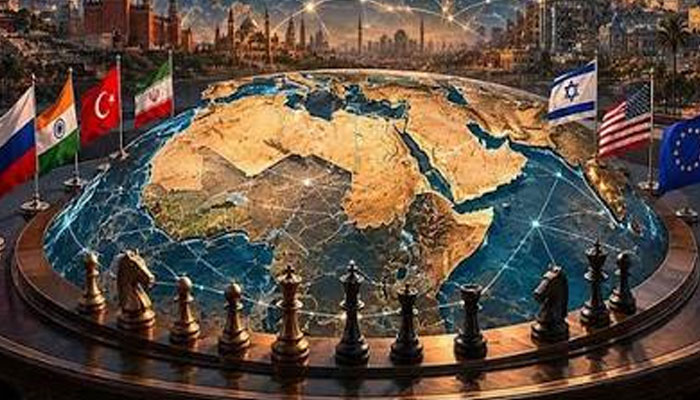
The fast-evolving consultation among Türkiye, Pakistan, Saudi Arabia and Egypt reflects this broader strategic reality. As the international order becomes increasingly fragmented and less capable of managing regional crises, states sharing convergent interests are discovering that cooperation is no longer a luxury but a necessity. Although the mechanism remains consultative rather than a formal alliance, it rests upon an increasingly compelling principle: regional challenges are best addressed through regional solutions.
Since their inaugural meeting in Riyadh in March 2026, the four foreign ministers have continued regular consultations, meeting most recently in Cairo on 21 June. The consultation is steadily acquiring the characteristics of a more durable regional framework through the gradual development of regular consultation, intelligence-sharing, defense coordination and economic cooperation.
Towards a New Regional Equilibrium
The post-Ottoman and colonial settlement left behind twenty-two sovereign states, while successive experiments in Arab nationalism proved unable to transform civilizational affinity into lasting regional cooperation. The result has been a politically and strategically fragmented order in which common challenges have too often been confronted individually rather than collectively, creating space for external powers to shape regional outcomes.
Yet the civilizational bonds that unite the Arab world have never disappeared. They continue to provide the foundation upon which a more coherent regional order may gradually emerge—one capable of safeguarding collective security, reducing external dependence and shaping solutions rooted in the region’s own interests. The significance of the present consultation therefore lies in the four states that presently constitute it, and in the possibility that it represents the beginning of a broader process through which regional responsibility may increasingly replace external management.
Within this framework, Türkiye and Pakistan help build a resilient regional order through military, technological, and diplomatic cooperation—rooted in partnership over dependency, and balance over hierarchy.
Any emerging regional architecture must counter external hegemonic designs while rejecting sectarianism as a foundation for regional politics. Rather than forming an exclusive bloc, its aim is to strengthen collective capacity to safeguard shared security, stability, strategic autonomy, and long-term prosperity.
It is through this equilibrium that regional powers can finally shape a multipolar order defined not by subordination, but by mutual respect and enduring stability.
Firdous Syed is a writer from Jammu & Kashmir, Srinagar, currently based in Istanbul.
Comments are closed, but trackbacks and pingbacks are open.