
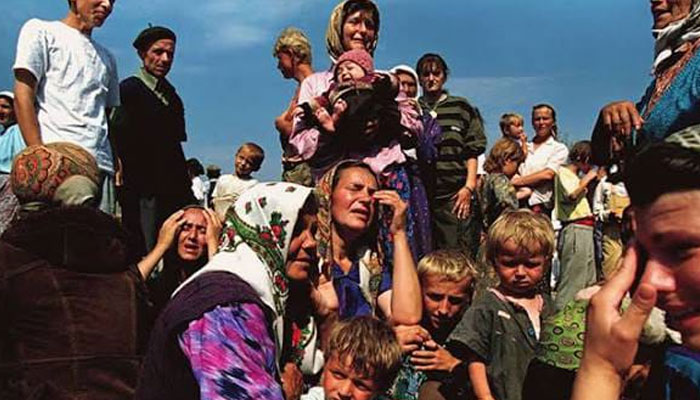
Srebrenica: When the Valleys of Europe Witnessed the Bloodshed of Humanity
The Bosnian Genocide, the Test of the World's Conscience, and the Eternal Pursuit of Peace

By: Syed Umer Gardezi, Islamabad
Some tragedies do not fade with time; instead, they grow deeper with every passing year. Srebrenica is one such wound. Nestled among the lush green valleys, crystal-clear rivers, and snow-capped mountains of Bosnia and Herzegovina, this small town was once known for its mineral wealth, breathtaking natural beauty, and peaceful coexistence. People of different ethnicities and religions shared neighborhoods, attended the same schools, traded in the same markets, and celebrated each other’s joys and sorrows. Yet, in the final decade of the twentieth century, this peaceful land was consumed by the flames of nationalism, hatred, and war, leaving a scar on humanity that can never truly heal.
Following the disintegration of the former Yugoslavia, Bosnia and Herzegovina declared its independence in 1992. A nationwide referendum overwhelmingly supported sovereignty, but Bosnian Serb political and military leaders rejected the outcome. What followed was a systematic campaign of ethnic cleansing, mass killings, forced displacement, detention camps, and the deliberate destruction of towns and villages. The capital, Sarajevo, endured one of the longest sieges in modern history, lasting nearly four years, during which thousands of civilians lost their lives to shelling and sniper fire. This was not merely a civil war; it was a calculated campaign aimed at erasing the Bosniak Muslim population from large parts of Bosnia and Herzegovina.The international community expressed concern, but its response proved painfully inadequate. In September 1991, the United Nations Security Council adopted Resolution 713, imposing an arms embargo on the former Yugoslavia. Although intended to reduce violence, the embargo effectively deprived the newly independent Bosnian government of the means to defend its civilian population, while heavily armed forces already possessed overwhelming military superiority.
As violence escalated, tens of thousands of displaced Bosniaks sought refuge in Srebrenica. Recognizing the worsening humanitarian crisis, the United Nations Security Council adopted Resolution 819 in April 1993, declaring Srebrenica a “safe area” under UN protection. This was followed by Resolution 824, which extended similar protection to other towns, and Resolution 836, authorizing UN peacekeepers to use force in defense of designated safe areas when necessary. These resolutions gave desperate civilians hope that the international community would finally protect them.
History, however, would prove otherwise. On 11 July 1995, Bosnian Serb forces commanded by General Ratko Mladić entered Srebrenica. The Dutch peacekeeping contingent, commonly known as Dutchbat, lacked sufficient manpower, military capability, and political backing to prevent the assault. Thousands of terrified civilians fled toward the UN compound at Potočari, believing the blue flag of the United Nations represented safety. Instead, they found themselves abandoned at the very place where they expected protection.
What followed became the darkest chapter in post-Second World War European history.
Women, children, and elderly civilians were separated from men and boys. Thousands of Bosniak males, including teenagers and elderly men, were transported to schools, warehouses, fields, and remote execution sites where they were systematically murdered. Others attempted to escape through forests toward Bosnian government-held territory, only to be ambushed and killed along what survivors now call the “Death March.” Within only a few days, more than 8,000 Bosniak Muslim men and boys were executed solely because of their ethnic and religious identity. Even after the killings, the perpetrators sought to erase the evidence. Mass graves were excavated and bodies were secretly transferred to secondary and tertiary burial sites in an effort to conceal the crime. As a result, the remains of many victims were scattered across multiple locations; some individuals were later identified from bones recovered from as many as five separate mass graves. Today, advanced DNA analysis continues to reunite families with the remains of their loved ones. Every year on 11 July, newly identified victims are buried at the Potočari Memorial Centre, a solemn reminder that although wars may end, grief does not. Justice eventually began to emerge through international law. The International Criminal Tribunal for the Former Yugoslavia (ICTY) ruled in multiple landmark cases that the crimes committed in Srebrenica constituted genocide under international law. Bosnian Serb political leader Radovan Karadžić and military commander Ratko Mladić were convicted of genocide, crimes against humanity, and war crimes, receiving life imprisonment sentences. In 2007, the International Court of Justice (ICJ) affirmed that genocide had indeed occurred in Srebrenica, making it the first judgment by the world’s highest court to recognize genocide in Europe since the Holocaust. These rulings became historic milestones in the development of international criminal justice.
The war formally ended with the Dayton Peace Agreement in November 1995. Although it brought an end to armed conflict, it left behind a nation devastated by destruction. Roads, bridges, schools, hospitals, industries, and places of worship lay in ruins. More than two million people had been displaced, and countless families had been permanently shattered. Rebuilding Bosnia and Herzegovina required decades of determination, international assistance, and extraordinary resilience. Physical reconstruction could be measured in years; rebuilding trust among communities would require generations.
Today, Bosnia and Herzegovina stands once again as a country striving toward peace and prosperity. Sarajevo has regained much of its vibrancy, universities educate a new generation, tourism flourishes, and economic recovery continues despite political challenges. Yet beneath this progress lies an enduring memory that refuses to fade.
Every year on 11 July, the nation falls silent. At the Potočari Memorial Centre, rows upon rows of white marble headstones stretch across the valley. Mothers who have spent decades searching for fragments of their sons’ remains finally lay them to rest, often burying only a few bones identified through DNA testing. Their grief is not confined to history books; it lives in every funeral prayer, every tear, and every unanswered question. For the people of Bosnia and Herzegovina, Srebrenica is not merely a historical event, it is a living memory. Every newly discovered grave serves as a reminder that justice is not achieved solely through courtroom verdicts. It also requires preserving historical truth, confronting genocide denial, educating future generations, and defending human dignity wherever it is threatened. During Bosnia’s darkest days, Pakistan stood beside the Bosnian people through humanitarian assistance, diplomatic support, participation in United Nations peacekeeping missions, and contributions to post-war reconstruction. These acts of solidarity remain deeply appreciated by the people of Bosnia and Herzegovina and continue to strengthen the friendship between the two nations.
In May 2024, the United Nations General Assembly adopted a resolution proclaiming 11 July as the International Day of Reflection and Commemoration of the 1995 Genocide in Srebrenica. This landmark decision represents far more than an annual remembrance; it is a global commitment to preserving historical truth and ensuring that genocide is never forgotten nor repeated. Srebrenica teaches humanity a painful lesson: genocide does not begin with bullets. It begins with hateful words, discrimination, propaganda, indifference, and silence. When the world dismisses injustice as someone else’s problem, perpetrators interpret that silence as permission. That is why Srebrenica belongs not only to Bosnia but to the conscience of humanity. At a time when many parts of the world continue to witness war, ethnic hatred, religious intolerance, and humanitarian catastrophes, the memory of Srebrenica reminds us that peace cannot survive through treaties alone. It must be built upon justice, education, tolerance, accountability, and unwavering respect for human dignity.
The endless rows of white gravestones at Potočari continue to ask the world a single haunting question:
Was “Never Again” merely a slogan, or a solemn promise? The answer cannot come from Bosnia alone. It must come from every nation, every institution, and every individual who believes that human life possesses equal value regardless of ethnicity, religion, or nationality. If humanity chooses compassion over hatred, justice over revenge, truth over denial, and courage over silence, then perhaps future generations will remember Srebrenica not only as one of history’s darkest tragedies, but also as the moment the world finally learned that peace is never guaranteed, it must be protected, defended, and renewed by every generation.That is the enduring legacy of Srebrenica.That is the resilience of Bosnia and Herzegovina and that is the enduring test of our shared humanity.
Comments are closed, but trackbacks and pingbacks are open.