
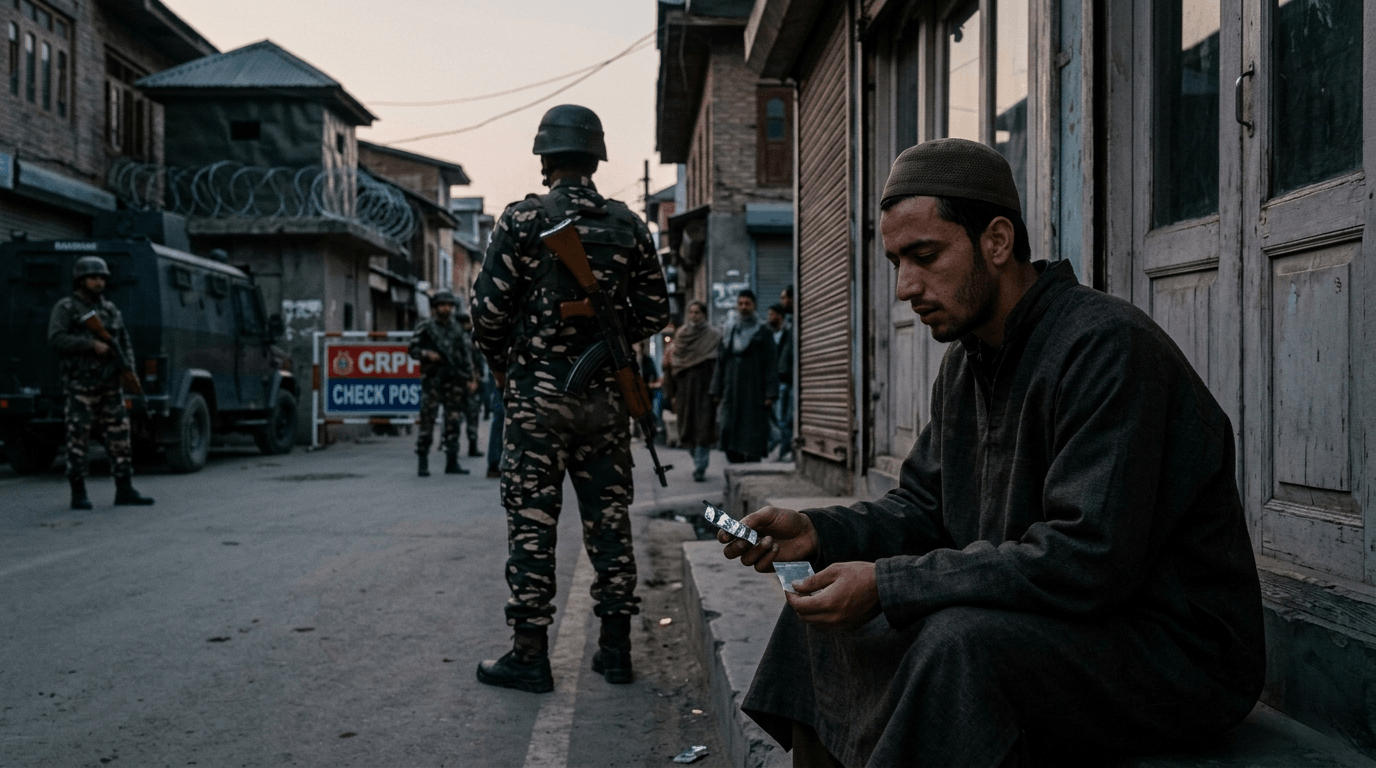

The Valley of Kashmir, once eulogized as an earthly paradise, has for the past seven decades—and particularly in the wake of 1989—been plunged into the crucible of an unrelenting military, political, and humanitarian crisis. It stands today as one of the most heavily militarized zones on earth, where approximately 700,000 to 900,000 Indian troops, paramilitary forces, and police personnel are garrisoned. Arbitrary arrests, the systemic confiscation of land and property, relentless cordon-and-search operations, and a calculated demographic engineering campaign to dilute the Muslim majority are the order of the day. The local legislature and administration have been reduced to toothless figureheads. All absolute authority is vested in a Hindutva-driven, fascist Lieutenant Governor appointed from New Delhi, operating in tandem with militarized police and armed forces.
A draconian scaffolding of state terror laws serves to institutionalize retribution against the populace, while constitutional guarantees of human rights exist merely as ink on forgotten parchment. Rampant maladministration and corruption have left the bureaucratic machinery entirely unaccountable, leaving humanity to slowly suffocate under a regime where even raising one’s voice is deemed a capital offense.
Interference in religious life has reached insidious new depths through figures like Durakhshan Mudi, under whose writ clerics and Friday orators are dragooned into delivering sermons dictated and vetted by the Bharatiya Janata Party (BJP) and the Rashtriya Swayamsevak Sangh (RSS). Not even during the darkest epochs of the Sikh and Dogra autocracies did Kashmir witness such absolute oppression; the mantle of tyranny has now been draped in the saffron hues of the BJP’s Lieutenant Governor. The stolid indifference of international institutions, coupled with complicit geopolitical entanglements with India, spells a profound and imminent peril to the soul of humanity itself.
The pages that follow marshal authoritative documentation and investigative findings to chronicle this human cost in stark, undeniable statistics.
1. Total Casualties and Extrajudicial Killings
According to research bulletins compiled by the Kashmir Media Service and international human rights monitors:
From January 1989 to June 2026: Between 96,498 and 96,507 Kashmiris have attained martyrdom. One authoritative report pegs the precise figure at 96,498, which includes 7,419 lives extinguished in custody and through staged encounters.
From 1947 to the Present: Incorporating the tribal incursions of 1947, the conflicts of 1947–48, 1965, the tumultuous decade of the 1990s, and subsequent eras, various Kashmiri sources record an aggregate death toll exceeding 100,000. A comprehensive study spanning 1989 to 2010 alone documents 93,274 fatalities.
In the Post-2019 Era: Following the revocation of Articles 370 and 35A on August 5, 2019, documented martyrdoms have claimed 1,050 lives—among them 22 women and 45 children. Of these, 287 deaths occurred either under custodial torture or in staged engagements.
2. Mass Arrests, Black Laws, and the Atmosphere of Coercion
1989 to 2020: A staggering 161,131 individuals were subjected to arbitrary arrest.
Post-August 5, 2019: Exactly 33,141 persons—comprising students, journalists, religious scholars, and human rights defenders—were detained under draconian statutes such as the Unlawful Activities Prevention Act (UAPA) and the Public Safety Act (PSA). Alternate documentation indicates that 29,490 individuals were subjected to severe custodial torture during this identical window.
The 2026 Landscape: Within the first eight months alone, 1,903 search operations netted 4,738 civilian arrests and left 52 citizens wounded. In May 2025 alone, a single month registered 481 First Information Reports (FIRs) and 518 arrests.
3. Enforced Disappearances and the Plight of “Half-Widows”
Human rights watchdogs, Amnesty International, and the United States Department of State estimate that between 8,000 and 10,000 individuals were forcibly disappeared between 1989 and 2012.
The indigenous human rights organization Association of Parents of Disappeared Persons (APDP) records approximately 8,000 citizens vanished into the abyss of state custody.
The wives left in this agonizing legal and emotional limbo are known as “Half-Widows”—a haunting designation borne by roughly 2,500 women enduring a perpetual state of neither closure nor relief.
4. Widows, Orphans, and Assaulted Women
Widows: From January 1989 to date, 22,991 women have been widowed by state violence, with parallel surveys recording figures of 22,976 and 22,962.
Orphans: Over the same timeframe, 107,351 children have been orphaned, with concurrent datasets noting totals of 108,007 and 107,805.
Sexual Violence: Documented assaults on the dignity and sanctity of women account for 11,275 instances of rape or desecration, with specific tallies listing 11,224 and 11,259 cases.
Child Fatalities: A heartbreaking sub-total of 933 children have been martyred amidst the broader carnage.
5. The Nameless Graves
This remains perhaps the most agonizing chapter in Kashmir’s tragic modern history.
A 2011 inquiry by the State Human Rights Commission (SHRC) unearthed 2,730 unmarked graves spread across Northern Kashmir, out of which a mere 574 local inhabitants could be positively identified.
A comprehensive six-year study published in 2025 by the Save Youth Save Future Foundation—encompassing a rigorous survey of 373 graveyards—cataloged 4,056 graves. Of these, 276 were categorized as entirely anonymous, 2,493 as foreign militants, 1,208 as local militants, 70 as tribal combatants from the 1947 conflict, and a mere 9 as ordinary civilians. A secondary independent report corroborates this precise distribution.
6. Destruction of Property, Confiscations, and Intimidation Campaigns
1989 to 2020: A devastating 110,374 residential structures and commercial buildings were systematically demolished or put to the torch, with individual reports citing 105,861 houses and 110,375 built structures.
Post-2019: An additional 1,168 homes were razed to the ground.
The Contemporary Campaign: Between October 2024 and February 2026, 1,425 structures—including 1,194 residential dwellings—were pulverized under the guise of removing illegal constructions. In the first nine months of 2026 alone, 293 properties, encompassing homes, land parcels, and commercial storefronts, were formally confiscated.
The weaponization of the UAPA, PSA, NDPS, and the anti-narcotics campaign Nasha Mukt Bharat serves as a convenient smokescreen for arbitrary seizures and bulldozing operations—practices universally condemned by the Kashmiri civil society as acts of collective punishment.
Conclusion
The tragedy of Kashmir is neither a mere border dispute nor a localized administrative friction; it is an enduring, bleeding humanitarian catastrophe. Over ninety-six thousand martyred souls, upwards of eight thousand enforced disappearances, twenty-three thousand widows, over a hundred thousand orphans, more than eleven thousand violated women, a hundred thousand destroyed homes, and thousands of nameless graves stand as eternal, unassailable witnesses. They testify that beneath the veneer of normalcy, the valley remains trapped in a suffocating climate defined by the terror of the midnight knock, the indiscriminate search, the arbitrary cage, and the state-sanctioned plunder of dignity and land.
Comments are closed, but trackbacks and pingbacks are open.