
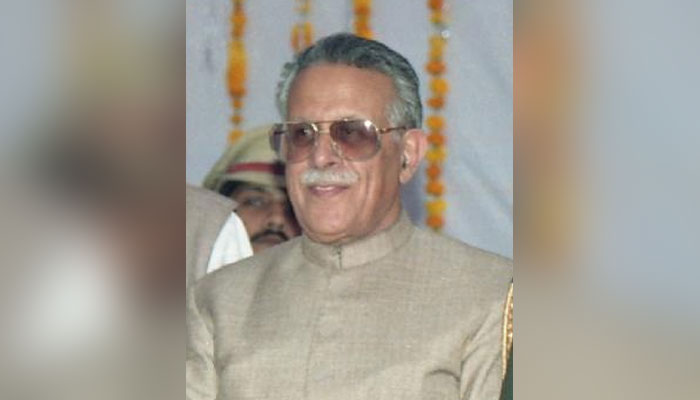

Dr. Ghulam Nabi Fai
Chairman
World Forun for Peace & Justice
August 24, 2026
I first heard the name Mohammad Shafi Qureshi long before I met him. He was a prominent politician from Srinagar and, at the time, a well-known figure in Jammu and Kashmir. I had never imagined that a brief personal encounter with him would later become part of a much larger question in my mind: Can a person be kind and courteous in private and still become part of a political system that does something deeply wrong? My answer became complicated in 1977.
I was a student at Aligarh Muslim University, which I joined in 1975. Students from Jammu and Kashmir had a useful privilege in those days: we could obtain air tickets home at half price. We would get a voucher from the Provost of our residential hall and present it to the airline office in New Delhi.
There was only one flight a day, and obtaining a seat was not always easy. Sometimes we were told that there were no seats available on the date we wanted. There was also a less formal solution that everyone seemed to understand: a little cash placed beneath the voucher could sometimes make a seat miraculously appear.
I mentioned this problem to a friend in Aligarh. He told me that the Union Deputy Minister of Railways was a Kashmiri and suggested that I visit his office in New Delhi. The staff, he said, could endorse my voucher and ensure that I got a seat.
I asked his name. “Mohammad Shafi Qureshi.” I knew the name but had never met the man.
A few weeks later, while traveling to Srinagar, I went to Mr. Qureshi’s office in New Delhi. He was not there. I explained my situation to his staff and told them that I was from Kashmir, and they immediately stamped my voucher and told me to show it to the airline. It worked. The airline saw the official stamp and confirmed my seat.
A few months later, I returned to the same office and asked Mr. Qureshi’s Personal Assistant if I could meet him. To my surprise, Mr. Qureshi called me in.
He offered me tea. We spoke for perhaps five or ten minutes. He asked what I was doing at Aligarh Muslim University and where I was from in Kashmir. Nothing extraordinary happened during that conversation. Yet I remembered it.
Here was a senior politician taking time to speak with an unknown student who had no influence, no political connections and no significance in his world. I found that admirable.
Then came the 1977 parliamentary election.
Mr. Qureshi was contesting parliamentary election from the Anantnag constituency. The Jamaat-e-Islami Jammu and Kashmir decided to oppose him and nominated Hakim Ghulam Nabi as its candidate. Since Hakim Ghulam Nabi was from Shopian, which was part of the constituency, he was considered a suitable candidate.
The Jamaat established an election office near Bijbehara, and Sheikh Ghulam Hassan who later became the Air of Jamaat, was overseeing the campaign’s election arrangements. Volunteers were needed to serve as election agents at polling stations.
Although I was from Budgam, roughly forty miles away, I volunteered. I traveled to Bijbehara the day before polling and stayed overnight at the election office.
The next morning, Sheikh Ghulam Hassan gave me a letter certifying that I was the bona fide election agent of Hakim Ghulam Nabi. A taxi took me to Bangidar village, (if I remember the name correctly) a remote location surrounded by forest.
When I arrived, there were already dozens of people near the polling station. Policemen were guarding the area. One policeman stopped me. Polling had not yet begun, he said, and I needed to wait.
I explained that I was not there to vote. I was an authorized election agent and had come to monitor the polling on behalf of the candidate. The policeman was courteous. He said he would consult his superior.
A senior police officer came out and asked to see my authorization letter. I handed it to him. He told me to wait. I waited five minutes. Then another five minutes. When polling time arrived, I asked to be allowed inside. Instead, the officer came out, put me in his car and drove away.

I was young and inexperienced in election monitoring. I did not understand what was happening. After about half an hour, he stopped at a house. He met the owner of the house and instructed him to give me breakfast and lunch until he returned in the afternoon.
I was stunned. I told him that I had not come there to eat lunch. I had come to monitor an election. He left.
The homeowner told me that the polling station was at least an hour and a half away on foot. He also explained that if he allowed me to leave, he could get into trouble. So, I stayed. His eighth-grade son was also at home because his school was closed for the election. We spent much of the day talking. And during those long hours, I kept thinking about Mohammad Shafi Qureshi.
I remembered the man I had met in New Delhi—the man who had invited an unknown student into his office, offered him tea and spent time listening to him. Now I was sitting in a house, miles from the polling station, because the election machinery had prevented me from doing the job for which I had been officially appointed. The contradiction troubled me.
How could someone who appeared so courteous and considerate as an individual be associated with a political process that was, at least in my experience, preventing an authorized election agent from observing the vote?
Eventually, I returned to Bijbehara. There I learned that I was not the only election agent who had been prevented from reaching a polling station. Similar incidents had occurred at several polling stations. Hakim Ghulam Hassan told us that Hakim Ghulam Nabi was on his way to New Delhi to protest what he regarded as the rigging of the election.
For those of us who witnessed these events, the conclusion seemed unavoidable: the machinery of the state had been used to influence the electoral outcome. But this raises a question that has stayed with me for decades.
Where does personal responsibility end and political responsibility begin?
I cannot claim to know what Mr. Qureshi personally knew about what was happening at every polling station. I cannot say that he personally ordered anyone to interfere with the election. Those are matters that require evidence, not assumption. But I do know that he was the beneficiary of the electoral outcome. And that creates a moral question that cannot simply be dismissed.
If a candidate becomes aware that the machinery of government is being used to secure his victory unfairly, what should he do? Should he remain silent because the decision was made by people above him? Or should he say: This is not the election I am willing to win?
That is where political responsibility becomes different from personal character. A person can be generous in private and still participate in, benefit from or remain silent about an unjust political system. Personal kindness is not a substitute for political integrity.
This was not unique to this particular election at Anantnag. It is a universal problem of political life in Kashmir. We often judge politicians by how they treat us personally. If they shake our hands, offer us tea, remember our names or help us with a personal problem, we are inclined to think well of them. But democracy requires a different standard.
The real test of a politician is not how he treats a student in his office. It is how he treats the rights of citizens when those rights conflict with his own political interests. That is why my brief meeting with Mohammad Shafi Qureshi remains so vivid in my memory.
I remember him as a courteous and kind man. I also remember the election of 1977 and what I experienced as an election agent. Both memories are true for me. Perhaps that is the uncomfortable lesson.
Human beings are rarely one-dimensional. Someone can possess admirable personal qualities while being part of a political system that produces unacceptable results. The existence of personal kindness does not erase political responsibility.
Mr. Qureshi has since passed away. I cannot know what he knew, what he did not know, or what he might have done had he known everything that was happening. So, I do not claim to be his judge. I can only pray that Allah forgives him for whatever shortcomings were his. But I also cannot forget what I witnessed.
For me, the lesson of 1977 was simple: an election is not democratic merely because people are standing in line to vote. It is democratic only when the voters—not the government, not the police, not the political establishment—are allowed to determine who wins. That lesson remains relevant far beyond Anantnag.
Democracy ultimately depends not only on laws and institutions, but on the willingness of those who benefit from power to ask a difficult question: Am I winning because people chose me—or because the system was made to choose me? The answer to that question is the difference between holding office and earning the legitimacy of office.
Dr. Ghulam Nabi Fai can be reached at:
WhatsApp: 1-202-607-6435
gnfai2003@yahoo.com
Comments are closed, but trackbacks and pingbacks are open.