

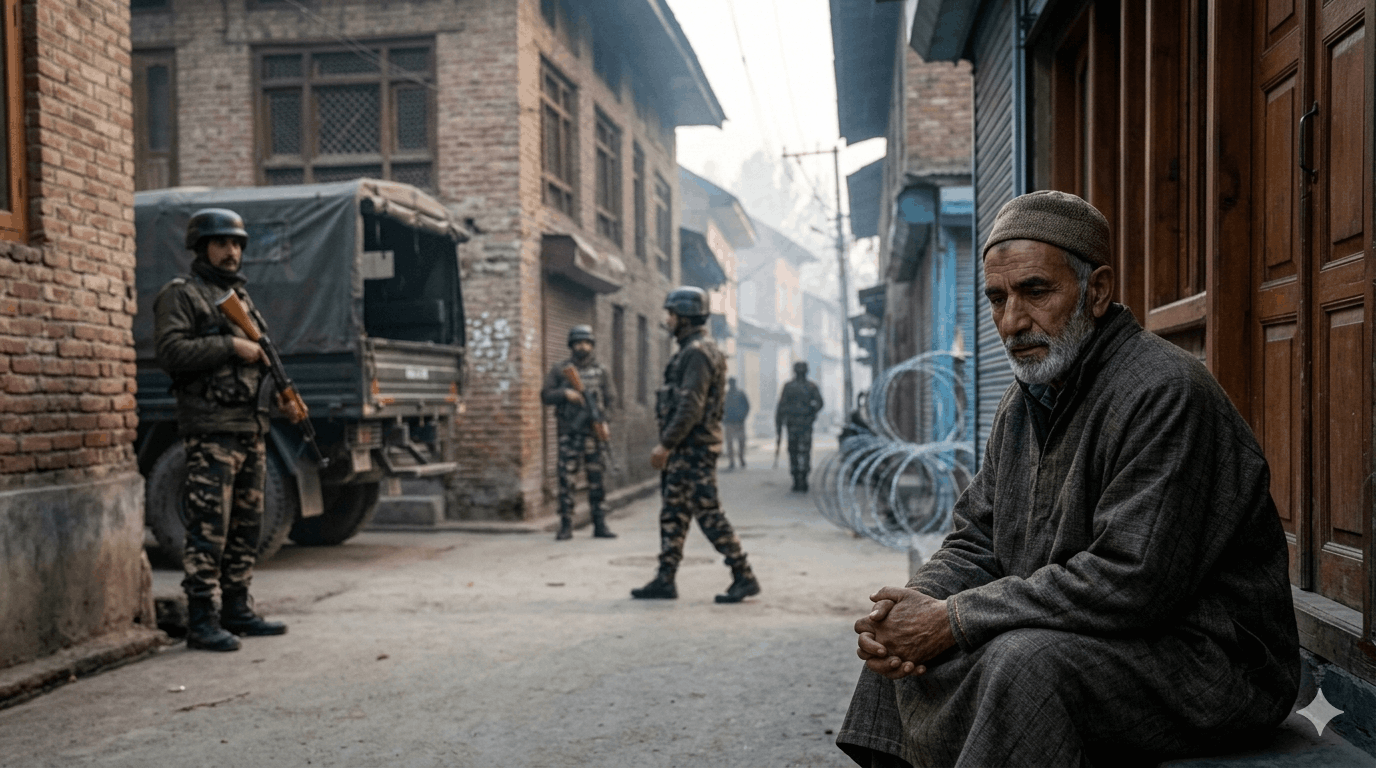
Jammu Martyrs’ Day: 237,000 Martyrs, A Silent History and Our Collective Conscience
By: Professor Imran Ismail

November 6 is not merely a date on the calendar; it is a tragic chapter in the history of Kashmir, an enduring lament whose echoes can still be heard in the deserted streets, abandoned homes, and painful memories of displacement in Jammu. It is a day of remembrance for the countless Muslims whose lives, homes, dreams, and centuries-old cultural identity became victims of the bloody events of 1947. Jammu Martyrs’ Day reminds us that alongside the celebrations of independence during the Partition of the subcontinent, an immense human tragedy was unfolding, the wounds of which have yet to heal.
In 1947, the princely state of Jammu and Kashmir was ruled by Maharaja Hari Singh. Although Muslims constituted the majority of the state’s population, political power remained concentrated in the hands of the Dogra ruling dynasty. Muslims faced various forms of political, economic, and administrative discrimination. The events of 1931 had marked a turning point in the political awakening of the Muslim population. The political struggles of leaders such as Sheikh Abdullah and Chaudhry Ghulam Abbas further highlighted the question of the state’s future. Following the end of British rule in 1947, when princely states were required to decide their political destiny, the Maharaja attempted to preserve his authority despite the aspirations of the majority population. This political conflict eventually became part of a much larger human tragedy.
Violence against Muslims in Jammu had reportedly begun as early as August 1947. During October and November, it assumed an extremely horrifying form. According to various historical accounts and research studies, Dogra state forces, armed Hindu and Sikh groups, and elements associated with extremist organisations targeted Muslim communities. Muslim villages were devastated, houses were set ablaze, properties were looted, and large numbers of people were forced to abandon their ancestral homes. The atrocities committed against women and children remain among the darkest aspects of this tragedy and deserve an honest place in historical records.
One particularly significant historical reference concerning this tragedy is a report published by The Times, London, on August 10, 1948. The report claimed that 237,000 Muslims in the eastern districts of Jammu were systematically killed or managed to escape to Pakistan. It attributed these events to the Dogra state forces under the Maharaja’s authority and the armed Hindu and Sikh elements assisting them. This figure relates to the combined tragedy of killings and displacement, rather than representing the number of deaths alone. The report was subsequently cited by Pakistan’s representative, Sir Zafrullah Khan, during a meeting of the United Nations Security Council on February 8, 1950. (The Times, London, August 10, 1948; United Nations Security Council, 464th Meeting, February 8, 1950).
Renowned researcher Christopher Snedden examined this tragedy in detail in his research paper, What Happened to Muslims in Jammu? Local Identity, “The Massacre” of 1947 and the Roots of the Kashmir Problem, published in 2001 in the South Asia: Journal of South Asian Studies. His book, Kashmir: The Unwritten History, is also an important research contribution to this subject. Snedden critically examined various historical accounts and figures, highlighting the difficulty of establishing an exact number of casualties. Nevertheless, his research draws attention to the large-scale killings, violence, and forced displacement experienced by Muslims in Jammu. (Christopher Snedden, 2001, pp. 111–134).
The magnitude of this tragedy can be understood from the fact that the demographic composition of areas where Muslims had lived for generations changed dramatically within a few weeks. Those who survived were forced to migrate towards Pakistan, leaving behind their ancestral homes. These migration caravans included mothers holding their children close to their hearts, elderly people carrying their final memories of their homes, and young men uncertain about their future. The stories of attacks, killings, and separation along the migration routes remain among the most painful accounts in human history.

A fundamental question arises here: Was the right to self-determination of the Muslims respected during Partition? Were the people of a Muslim-majority state allowed to decide their own future? Maharaja Hari Singh’s accession to India, the arrival of Indian forces on October 27, 1947, and the subsequent war transformed the Kashmir issue into an international dispute. Violence against Muslims in Jammu had already begun before the arrival of Indian forces. Subsequent military and political developments further complicated the conflict. A comprehensive and evidence-based examination of these events is essential to understand the role and responsibility of every party involved.
The tragedy was not limited to the loss of human lives; it also shattered an entire social and cultural existence. The Muslims of Jammu lost not only their homes but also their lands, businesses, educational institutions, family connections, and historical heritage. Their families were scattered across borders, and subsequent generations had to rebuild their lives in refugee settlements and unfamiliar cities. The memories of Jammu remained alive in the hearts of their elders, but the responsibility of preserving these memories for future generations remains an important challenge.
It is unfortunate that while certain human tragedies receive extensive recognition in international history, the massacre and displacement of Muslims in Jammu have not received the global attention they deserve. Our own negligence has also contributed to this silence. We have not made sufficient organised efforts to preserve the oral histories of our elders, the experiences of displaced families, and the historical documents associated with this tragedy.
Jammu Martyrs’ Day demands that we bring this history into educational institutions, universities, research journals, and international forums. We must present the position of the Kashmiri people in the light of United Nations resolutions, the right to self-determination, and international human rights principles. The foundation of our struggle must be justice, not revenge; our weapon must be reason and evidence, not hatred.
November 6 reminds us that nations are not defined merely by geographical boundaries. Their identity is shaped by their history, sacrifices, and collective memory. The blood of the martyrs of Jammu demands that we never forget their sacrifices, that we preserve the injustice suffered by them in historical records, and that we educate future generations about the truth.
For a nation that forgets the history of its martyrs loses an essential part of its identity. The martyrs of Jammu represent a chapter of our history that neither the passage of time nor the silence of the world can erase.
Comments are closed, but trackbacks and pingbacks are open.