

Pakistani Confucius Institute Teacher: The Pakistani Student Who Practiced Chinese Calligraphy Has Now ReachedSpace

Pakistani astronaut Muhammad Zishan Ali's journey from Chinese calligraphy classes in Islamabad to the Tiangong space station shows how language and cooperation are changing China-Pakistan ties

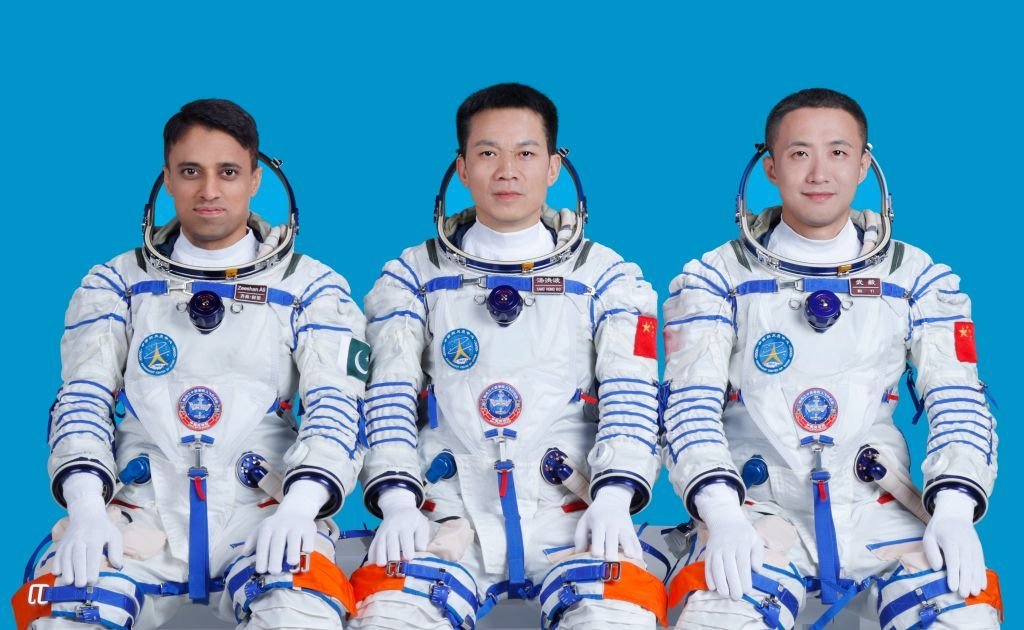
On November 25, the Shenzhou-24 manned spacecraft was successfully launched, carrying Pakistani astronaut Muhammad Zishan Ali to the Chinese space station “Tiangong,” becoming the first foreign astronaut to enter the Chinese space station. In an interview, he specifically mentioned that the most challenging part of all his training was learning Chinese. In fact, he and another astronaut candidate selected for the Chinese space station mission both studied Chinese at the Confucius Institute at Beijing Language and Culture University in Islamabad. How did they “learn” this “essential course for spaceflight”? The Sichuan International Communication Center invited Rashida Mustafa, a lecturer in the Department of Sinology at the National University of Modern Languages ​​in Pakistan, to recount the two astronauts’ experiences learning Chinese and share her observations on the growing “Chinese fever” among young people in Pakistan.

As a Chinese language teacher and coordinator at the Confucius Institute at the Islamabad campus of the National University of Modern Languages ​​(NUML) in Pakistan, I had the opportunity to speak with candidates Muhammad Zishan Ali and Hulam Daoud. I recall that both of them had a strong interest in Chinese culture, including the Chinese language, and frequently participated in Chinese calligraphy activities organized by the Confucius Institute.

During the activity, the two students didn’t simply finish writing and leave; instead, they earnestly asked me, “Teacher, why is this stroke like this? What does this character mean?” Even if they made a mistake, they would proactively ask for another sheet of paper to practice again. Their serious and engaged attitude left a deep impression on me. This showed me that beyond language learning, they were also willing to actively explore the cultural connotations behind the Chinese language. This thirst for knowledge is truly invaluable.

I was thrilled to learn that Pakistani astronaut Muhammad Zishan Ali had become the first foreign astronaut to visit the Chinese space station, and I am genuinely proud of Pakistani youth. This is not only a significant moment in the development of Pakistan’s space program, but it also means that young Pakistanis have the opportunity to participate in cutting-edge international scientific and technological cooperation through their own efforts and professional skills.

In my view, the significance of this event goes beyond simply “entering space.” It allows more young people to see how vast the opportunities science, education, and international exchange can open up for personal growth and development. For the people of Pakistan, seeing their youth have the opportunity to step onto such an international stage gives them greater confidence in the future of the next generation.

Having participated in China-Pakistan educational cooperation for many years at the Confucius Institute at the National University of Modern Languages ​​(NUML) in Pakistan, I have witnessed firsthand the evolution of the cooperation model between the two countries. The past model was more like “you watch, I do.” A decade or so ago, when we participated in international exchange activities, developing countries often could only play the role of bystanders: others conducted experiments, and we watched; others explained, and we took notes.

However, the cooperation approach embodied in the Shenzhou-24 mission was completely different; it was “we do it together.” China did not invite Pakistan to “come and see our space station,” but rather invited Pakistani aerospace professionals to “conduct experiments with us on the space station.” The Pakistani astronauts participating in the mission did not enter the space station as tourists, but as payload specialists undertaking Sino-Pakistani cooperative space science experiments, becoming equal partners.

I’ve personally experienced this shift in cooperation models in my work at the Confucius Institute. In the past, our cooperation was largely about “Chinese teachers teaching and Pakistani students learning.” Now, the forms of cooperation are increasingly diverse. We jointly organize calligraphy activities, youth exchange camps, and educational forums. Chinese teachers teach Pakistani students calligraphy, and Pakistani students introduce their own dances and culture to Chinese teachers. Both sides learn from and share with each other through these exchanges, moving beyond a one-way transmission of knowledge.

From the classrooms of the Confucius Institute to the Tiangong space station, the same principle is evident: cooperation is shifting from one-way learning to two-way exchange, from one-way instruction to joint participation. This space cooperation also shows us that collaboration in the field of science and technology requires not only professional knowledge but also communication and trust between people. Language plays a crucial role, and for the two astronauts who had the opportunity to participate in the China-Pakistan cooperation project, language and cultural knowledge can also help them better understand their partners and enhance mutual communication.

In my work at the Confucius Institute, I’ve observed many young people who initially encountered Chinese out of curiosity, but gradually deepened their understanding of China through language learning and cultural activities. This process, starting with language learning and progressing to cultural understanding and friendly exchange, is precisely the significance of people-to-people exchanges.

To the young Pakistanis learning Chinese, I say: Don’t be afraid to start from scratch. Keep learning, actively engage in conversation, and learn more about Chinese culture. You will discover that this language can bring many unexpected opportunities. I hope more Pakistani youth can use Chinese as a bridge to enhance exchanges between China and Pakistan, broaden their horizons, and create more possibilities for realizing their personal ideals.A lecturer in the Department of Chinese Studies at the National University of Modern Languages, Pakistan, with twenty years of experience in teaching Chinese and conducting Sinological research. Proficient in both Chinese and Urdu, she has long been deeply involved in Chinese language teaching, Chinese grammar, and the translation of Chinese culture, and actively participates in Sino-Pakistani cultural exchange activities.

A lecturer in the Department of Chinese at National University of Modern Languages, she has over 20 years of experience in Chinese language teaching and Sinology research. Fluent in both Chinese and Urdu, she has long been engaged in Chinese language education, Chinese grammar studies, and the translation of Chinese culture. She also actively participates in China-Pakistan cultural exchange activities.

Comments are closed, but trackbacks and pingbacks are open.