

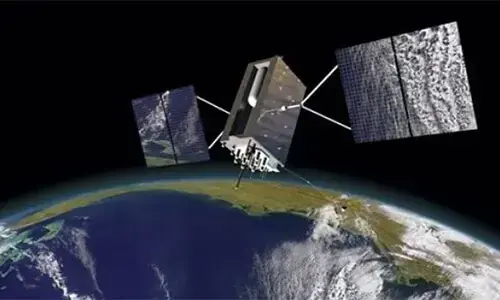

The world is rapidly entering a new era in which the progress and global standing of nations are determined not merely by economic stability, industrial production, military strength or natural resources, but also by achievements in science, technology, artificial intelligence and space exploration. Today, countries exploring the vastness of space are striving to strengthen their position in the world of tomorrow. In this context, the news that Pakistani astronaut Muhammad Zeeshan Ali is set to become the first international crew member to reach China’s Tiangong Space Station aboard the Shenzhou-24 mission carries extraordinary significance for Pakistan. This development could mark an important milestone in the country’s scientific history and become a moment of immense national pride.
Deputy Prime Minister and Foreign Minister Senator Mohammad Ishaq Dar, while congratulating the entire nation and Pakistan’s national space agency, SUPARCO, on this historic development, stated that Pakistan is preparing to make history in space exploration and joint scientific advancement. Referring to the forthcoming launch of China’s Shenzhou-24 mission and the anticipated historic participation of Pakistani astronaut Muhammad Zeeshan Ali aboard the Tiangong Space Station, he described the development as a strong reflection of the enduring and time-tested strategic partnership between Pakistan and China. His message highlights Pakistan’s efforts to create new opportunities in advanced scientific fields through its foreign policy and international cooperation.
This development is not merely a matter of Pakistani representation in a space mission; it carries broader possibilities for the country’s scientific future, national capabilities and international cooperation. The inclusion of a Pakistani astronaut in an international space crew will send a strong message to the world that Pakistan also possesses the potential to contribute to the global advancement of science and technology. It can serve as a source of inspiration and encouragement for the country’s young generation, scientists, engineers and educational institutions.
The relationship between Pakistan and China is founded on mutual trust, respect and a time-tested friendship. Over several decades, both countries have expanded cooperation across numerous sectors. Their partnership in defence, trade, energy, infrastructure, communications, education, agriculture and industrial development has become a strong example of bilateral cooperation. The China-Pakistan Economic Corridor (CPEC) has also given a new economic and commercial dimension to their relationship. Now, cooperation in space exploration and scientific advancement is creating an important opportunity to connect this longstanding friendship with the technologies of the future.
One of the most significant characteristics of Pakistan-China friendship is that both countries have continuously expanded their relationship in accordance with changing global requirements. While defence and economic cooperation traditionally remained central to their partnership, artificial intelligence, digital technology, space exploration, advanced communication systems and scientific innovation are now becoming increasingly important areas of collaboration. This transformation reflects the shared vision of Pakistan and China to build their partnership around the needs and challenges of the coming decades.
China’s space programme is currently regarded as one of the world’s leading space programmes. Over the past several years, China has achieved remarkable success in space exploration. Through human spaceflight missions, lunar exploration, Mars missions, satellite technology and the development of its own Tiangong Space Station, China has demonstrated its scientific and technological capabilities at the international level. The Tiangong Space Station represents China’s long-term scientific vision and its commitment to technological self-reliance.
A space station is essentially an advanced research facility established in Earth’s orbit, where scientists and astronauts conduct various scientific experiments. Research conducted in an environment different from Earth’s gravity provides valuable information about the human body, biology, medicine, physics, chemistry, materials science and several other disciplines. The findings of such experiments can contribute to improving human life on Earth, developing medical treatments, producing advanced industrial materials and promoting scientific innovation.
The participation of Pakistani astronaut Muhammad Zeeshan Ali in this mission is particularly important because it will provide Pakistan with an opportunity to participate directly in international scientific activities. The knowledge and practical experience gained through research in space could become a valuable asset for Pakistan’s future space programme. Such international partnerships can also provide Pakistani experts with opportunities to learn modern research techniques, develop the skills required to work in the space environment and gain exposure to international scientific standards.
It is important to recognise that the benefits of space exploration are not limited to discovering the Moon, stars and planets. In the modern world, space technology has a direct connection with the everyday lives of ordinary people. Communication satellites improve television broadcasting, internet services and global connectivity. Weather satellites help monitor changing weather patterns, rainfall and storms. Remote sensing technology enables the monitoring of natural resources, forests, rivers, agricultural land and maritime boundaries.
Pakistan is facing several serious challenges due to climate change. Floods, unusual rainfall, extreme temperatures, droughts and water shortages are among the major problems requiring modern scientific solutions. Space technology can play an important role in monitoring these challenges and improving national planning. Satellite images and information can help identify flood-affected areas, monitor river water levels, assess agricultural land and understand changing climate patterns.
Agriculture holds fundamental importance in Pakistan’s economy. A significant portion of the country’s population depends directly or indirectly on this sector for its livelihood. Integrating modern space technology with agriculture can provide accurate information about crop health, soil fertility, water consumption and weather conditions. This can help farmers make better decisions, increase agricultural productivity and reduce the wastage of resources. Similarly, monitoring water reservoirs, underground water resources and river systems can become more effective through satellite-based technologies.
Another important dimension of space exploration for Pakistan relates to national security and defence requirements. In the modern era, satellite technology plays a vital role in communications, surveillance, mapping and information exchange. Developed countries are increasingly utilising space technology to strengthen their national security capabilities. Pakistan also needs to enhance its capabilities in this field according to its defence and scientific requirements. However, achieving this objective will require sustained investment in research, education, indigenous technology development and institutional capacity-building.
In this entire journey, the role of Pakistan’s national space agency, SUPARCO, is of fundamental importance. Pakistan began its journey in space exploration several decades ago, and SUPARCO has worked on various projects involving satellite technology, remote sensing, space science and national communication requirements. To bring Pakistan’s space programme in line with modern global developments, it is essential to provide SUPARCO with additional resources, advanced research facilities, skilled professionals and greater opportunities for international cooperation.
The future of Pakistan’s scientific progress is closely linked to its younger generation. Thousands of students in our educational institutions are pursuing their ambitions in science, mathematics, physics, engineering, computer science and artificial intelligence. The need of the hour is to provide these young people with opportunities for advanced research and practical experimentation. Special programmes related to scientific activities, robotics, space science and technology should be introduced in schools, colleges and universities to promote research, innovation and creative thinking among students.
Muhammad Zeeshan Ali’s anticipated participation in this mission can become a practical example for young Pakistanis. It will reinforce the belief that Pakistani youth also possess the ability to achieve international recognition in scientific fields. With appropriate educational opportunities, advanced training and government support, Pakistani students and professionals can secure prominent positions not only in space exploration but also in other advanced scientific disciplines.
This is also an important opportunity for the government to give space exploration a prominent place among national development priorities. Increased investment in research and development, stronger cooperation between universities and scientific institutions, the establishment of modern laboratories and international educational and research partnerships are essential requirements. Similarly, talented scientists and engineers must be provided with suitable facilities and better professional opportunities within the country so that skilled human resources can contribute to Pakistan’s development rather than seeking opportunities abroad.
Space cooperation between Pakistan and China can create numerous new possibilities in the future. Joint satellite projects, scientific research, professional training, technology exchange and research partnerships between universities can further strengthen this cooperation. Pakistan should benefit from China’s experience while gradually moving towards greater self-reliance in its own space programme. Genuine scientific progress becomes possible when a country not only learns from the experiences of others but also develops its own indigenous capabilities.
It is equally important that space exploration should not remain limited to government institutions. The private sector, universities and local technology companies should also be encouraged to participate. The global space economy is expanding rapidly. Business opportunities related to satellite data, communication services, Earth observation and space technology are increasing. With appropriate planning and investment, Pakistan can create new employment opportunities and connect its national economy with advanced technological developments.
This historic development also carries an important diplomatic dimension. International scientific cooperation is an effective means of strengthening trust and relations between countries. Scientific progress increasingly depends on the exchange of knowledge and experience beyond geographical boundaries. Pakistan’s participation in China’s space programme further demonstrates the mutual confidence and shared commitment to development between the two countries. It can also help enhance Pakistan’s positive scientific image at the international level.
Deputy Prime Minister Ishaq Dar’s expression of best wishes for the successful and safe completion of the mission by all astronauts conveys an important national message. Space missions are extremely complex and sensitive undertakings. Their success requires years of training, advanced scientific expertise, sophisticated technology and comprehensive planning. Therefore, the responsibilities and capabilities of every individual participating in such missions are of exceptional importance.
Pakistan must transform this historic opportunity into a sustained national scientific movement. Celebrating participation in a single mission is not enough. This achievement should serve as a foundation for establishing clear and practical objectives for the future. Pakistan needs to expand its satellite programme, develop indigenous space technologies, establish advanced research centres and invest in the training of young scientists. At the same time, promoting scientific education and creating an environment conducive to research must remain national priorities.
It is an established reality that developed nations invest today to secure their future. Countries that prioritise education, research and technology achieve prominent positions in the global economy and scientific community in the years ahead. Pakistan possesses talented young people, intelligent scientists and hardworking engineers. What is required is a comprehensive national strategy to utilise their abilities and provide them with opportunities to contribute to the country’s progress.
Undoubtedly, Muhammad Zeeshan Ali’s participation in China’s Shenzhou-24 mission could become a historic and proud achievement for Pakistan. It represents the enduring friendship between Pakistan and China, their growing scientific cooperation and the new possibilities for shared development. This achievement will not only strengthen Pakistan’s international identity but also encourage the younger generation to dream big and work towards turning those dreams into reality.
The most important message for Pakistan today is that the future belongs to knowledge, research and advanced technology. We must prepare our young people not merely to seek employment but to become scientists, researchers, inventors and internationally recognised professionals. The journey into space reminds us that nations achieve greatness not simply through their resources but through determination, hard work, knowledge and continuous struggle.
Pakistan’s journey into space represents hope for a new scientific era. If this opportunity is pursued through sound planning, effective policies and sustained investment, Pakistan can play an increasingly significant role in global space exploration in the years ahead. This is not merely an ambition to reach space; it is a commitment to building a modern, self-reliant, developed and scientifically advanced Pakistan.
Comments are closed, but trackbacks and pingbacks are open.