

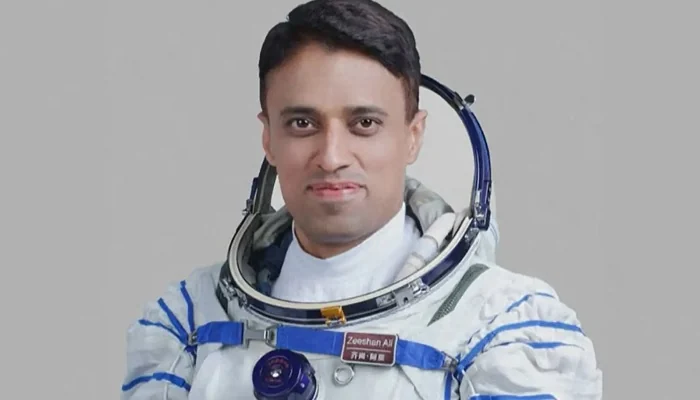
Pakistan’s First Astronaut to Travel to China’s Tiangong Space Station on Historic Mission
Muhammad Zeeshan Ali to Become First Pakistani in Space

JIUQUAN: (Web Desk) Pakistan is set to make history in space exploration as its first astronaut, Muhammad Zeeshan Ali, prepares to travel to China’s Tiangong space station aboard the Shenzhou-24 mission on Wednesday, November 25.
The mission will mark Pakistan’s first participation in a crewed spaceflight and make Ali the first Pakistani national to travel to space.
The China Manned Space Agency (CMSA) announced at a pre-launch media briefing on Tuesday that the Shenzhou-24 spacecraft is scheduled to lift off at 8:18am Beijing time (5:18am Pakistan time) from the Jiuquan Satellite Launch Centre in north-western China.
Ali will join Chinese astronauts Tang Hongbo and Wu Yi as a payload specialist. He will also become the first foreign astronaut to visit China’s Tiangong space station.
Tang Hongbo will command the mission, while Wu Yi will serve as flight engineer. Tang has previously travelled to space aboard the Shenzhou-12 and Shenzhou-17 missions and is expected to become the first astronaut to visit the Tiangong station three times. Wu, who belongs to China’s third batch of astronauts, will undertake his first spaceflight.
The Pakistani astronaut will undertake a short-duration mission, focusing primarily on scientific experiments under the Pakistan-China space research cooperation programme. His duties will include participating in routine crew activities, installing experimental samples and research equipment, and conducting scheduled experiments aboard the orbital laboratory.
The research programme builds on four Pakistani biotechnology experiments selected by Chinese institutions from more than 300 proposals submitted to the Space and Upper Atmosphere Research Commission (SUPARCO) by universities across Pakistan.
According to details previously shared by SUPARCO officials with *Reuters*, the experiments focus on research areas linked to food security and climate change.
SUPARCO has said Ali is expected to spend approximately one week aboard the Chinese space station before returning to Earth aboard the Shenzhou-23 spacecraft.
Chinese authorities provided Ali with specialised training in spacecraft and space station operations, scientific experiment procedures and emergency response ahead of the joint mission.
The crew also participated in joint exercises covering operational coordination, procedural handovers and responses to technical problems.
Language preparation was another important part of the training. Ali received instruction in Chinese commands and technical terminology to ensure effective communication and the accurate execution of mission procedures.
The Astronaut Centre of China also prepared Chinese-English operating manuals and halal space food for the Pakistani astronaut, taking into account his language and dietary requirements.
These arrangements were highlighted during the final full-system launch rehearsal at Jiuquan on November 21, according to reports from the Chinese space programme.
The mission will be the first joint crewed spaceflight involving Chinese and foreign astronauts in the history of China’s human spaceflight programme. It will also make Tiangong the first Chinese space station to host a foreign astronaut.
The historic flight follows expanding cooperation between Pakistan and China in space exploration. The two countries signed an agreement in February 2025 to select and train Pakistani astronauts for participation in Chinese space station missions, formally launching the selection process.
After three rounds of screening and assessment, Muhammad Zeeshan Ali and Khurram Dawood were selected as reserve astronaut candidates and completed their training in China. Ali has now been confirmed for the mission, while Dawood will serve as his backup.
The Shenzhou-24 mission will also introduce a change in the Chinese space station’s crew rotation. Zhu Yangzhu, a member of the outgoing Shenzhou-23 crew, will remain aboard Tiangong for a year-long in-orbit residency experiment, according to details announced alongside the crew selection.
The spacecraft and its Long March-2F carrier rocket were transferred to the launch area on November 17, while the final full-system rehearsal was successfully completed on November 21.
At Tuesday’s briefing, Chinese authorities said the spacecraft and rocket were in controlled condition, the crew was in good health and the space station complex was operating normally. Preparations were continuing ahead of the scheduled launch.
The mission is expected to create new opportunities for Pakistan’s participation in human spaceflight, scientific research and international space cooperation, taking the longstanding partnership with China beyond satellite development and other space technology projects.
Comments are closed, but trackbacks and pingbacks are open.