
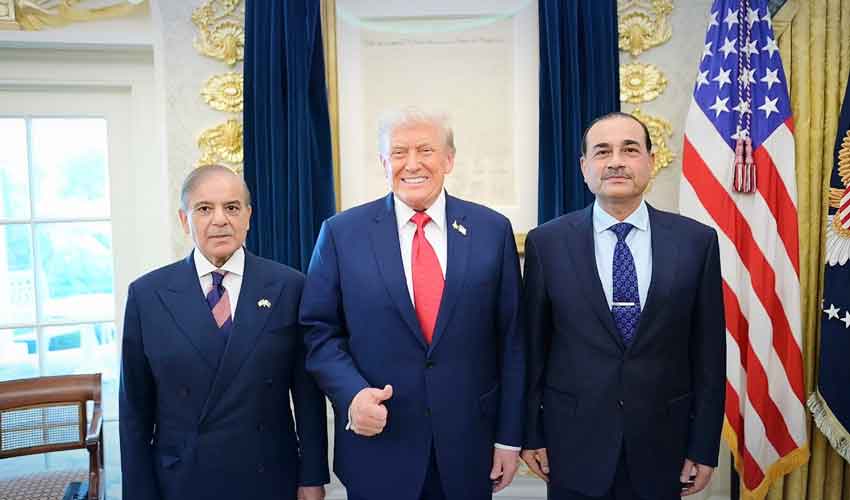
US–Iran Peace Pact Puts Field Marshal Syed Asim Munir and PM Shehbaz Sharif in Nobel Peace Spotlight
By Syed Faiz Naqshbandi

There are moments in history when humanity stands at the edge of an abyss, when a single decision can determine whether the world steps back from disaster or descends into it. The recent US Israel aggression on Iran was one such moment. In a chilling escalation, US President Donald Trump warned that “a whole civilization will die tonight, never to be brought back again.” In a nuclear age, such words are not rhetoric; they are a stark reminder of how close the world can come to annihilation. The risk of miscalculation could definitely terrifying possibility of a wider war even use of nuclear arsenal, placing all humanity under an unprecedented elimination.
The consequences of such a war would have been beyond comprehension. Cities reduced to rubble, millions of innocent lives extinguished, economies shattered, and environmental destruction lasting generations, this was not a distant scenario, but an imminent danger. The Middle East, already scarred by decades of instability, stood on the brink of becoming the epicenter of a conflict that could have engulfed global powers and triggered a catastrophic chain reaction.
At this most critical hour, when the drums of war were at their loudest, Pakistan rose as a voice of wisdom and restraint. Under the resolute and visionary leadership of Field Marshal Syed Asim Munir and PM Shehbaz Sharif, the country undertook bold, courageous, and highly effective and strategic diplomatic initiatives to defuse this devastating situation. Their leadership was defined not by hesitation, but by decisive and timely action, engaging both Washington and Tehran with credibility, urgency, and trust. Pakistan’s mediation ultimately transformed hostility into dialogue, culminating in direct negotiations in Islamabad and paving the way for a ceasefire that pulled the region back from the brink.
Pakistan’s efforts were not carried out in isolation. Its mediation was supported and encouraged by key global powers, including China, Russia, and influential European nations such as Italy and Spain, Australia, members of the European Union and other countries. These nations recognized Pakistan’s unique position as a credible and trusted bridge between adversaries. Yet it was Pakistan’s leadership that infused the process with momentum, direction, and the confidence required to bring both sides to the table.
Through relentless engagements, back-channel diplomacy, and extraordinary commitments, Syed Asim Munir landed at Tehran at the most dangerous juncture, while Shehbaz Sharif engaged key regional capitals to consolidate support for peace. Together, they helped reopen broken lines of communication and rebuild trust where it had nearly collapsed. Where the world expected escalation, Pakistan delivered de-escalation; where confrontation seemed inevitable, it made negotiation possible.

What distinguishes this leadership is not merely the outcome, but the courage to act when the stakes were highest and failure was a real possibility. It is easy to speak of peace; it is far more difficult to secure it under immense pressure and global scrutiny. Field Marshal Syed Asim Munir and Prime Minister Shehbaz Sharif demonstrated that true statesmanship lies in preventing wars, not waging war.
Their remarkable efforts have been acknowledged across the international community, recognizing Pakistan’s decisive role in steering the world away from a dangerous precipice. In doing so, Pakistan not only safeguarded regional and international peace and stability but fulfilled a higher responsibility to humanity emerging as a powerful advocate for peace through unmatched and principled diplomacy.
In recognition of these extraordinary and timely efforts, that may have averted a catastrophic nuclear conflict, it is both justified and imperative that CDF Field Marshal Syed Asim Munir and Shehbaz Sharif Prime Minister of Pakistan be awarded the Nobel Peace Prize. Their actions stand as a testament to the power of diplomacy, the courage of leadership, and the enduring hope that even in the darkest moments, peace can prevail.
The author is senior leader of All Parties Hurriyet Conference (APHC) and legal expert of international law. He can be reached at faiz.naqshbandi@gmail.com & at WhatsApp number 03335145416.
Comments are closed, but trackbacks and pingbacks are open.