
US-Iran Peace Efforts Need Patience, Trust and Steady Engagement, Says Naqvi
Interior Minister Naqvi tells the Global Security Forum that Islamabad never gave up, even when tensions rose sharply between Washington and Tehran.

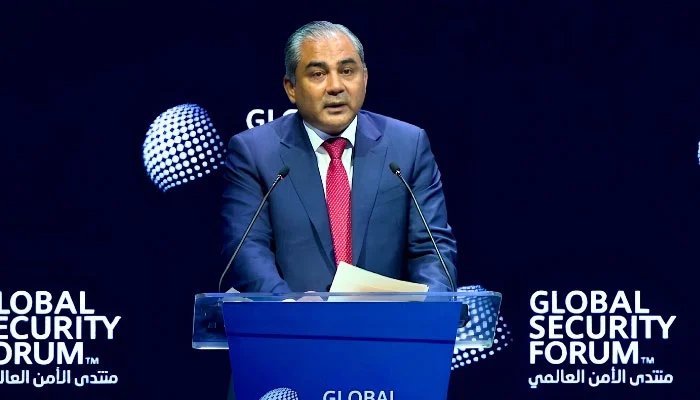
Islamabad – (Choudhry Mudassar) – Pakistan says it did everything it could to support US-Iran peace efforts. Interior Minister Naqvi shared this message on Monday while speaking at the Global Security Forum in Doha.
He said Pakistan tried hard to bring Washington and Tehran to the same table. At times, tensions rose sharply, but Islamabad did not stop trying.
Naqvi also thanked Qatar for its role as a mediator. He said Pakistan and Qatar worked side by side to stop the situation from getting worse.
“Peace cannot be achieved in a single meeting,” he said. He added that it needs patience, trust and steady effort.
“Peace if not achieved in one meeting. It requires patience, trust and continuous effort.” – H.E. Syed Mohsin Raza Naqvi, Federal Minister for Interior and Narcotics Control of the Islamic Republic of Pakistan https://t.co/QluCq8FuyP
— Global Security Forum (@GSECForum) October 19, 2026
He also spoke about the Swiss peace talks. According to Naqvi, Field Marshal Syed Asim Munir, the Chief of Defence Forces, and Qatari Prime Minister Sheikh Mohammed bin Abdulrahman bin Jassim Al Thani worked for more than 16 hours without a break.
His words come at a tense time for the region. In Yemen, government forces recognised by the world are still fighting Houthi rebels. The rebels are also hitting targets in Saudi Arabia.
Saudi Arabia said it stopped four drones on Saturday. More interceptions followed on Sunday, as the attacks kept coming.
Talks between the US and Iran have also stalled. Both sides disagree on the terms for starting the dialogue again.
Iranian Foreign Minister Abbas Araghchi spoke on Sunday. He said Iran’s offer to reopen the Strait of Hormuz within seven days is still on the table. But he said any progress depends on how Washington answers Iran’s conditions.
Iran wants the US to lift its blockade on Iranian ports. It also wants relief from sanctions on its oil exports. In addition, Tehran wants an end to fighting on all regional fronts.
Washington sees it differently. The US wants Iran’s nuclear programme to be handled first.
Naqvi also mentioned the Makkah Joint Defence Agreement, or MJDA. Pakistan, Saudi Arabia and Turkiye are the three members of this pact. He said it shows Pakistan’s wish for regional safety, and that its goal is peace, not war.
His comments came one day after Lt Gen Ahmed Sharif Chaudhry, the ISPR Director General, shared a warning. He said the pact’s shared deterrence could come into play if talks fail and the crisis turns into a military conflict.
In an interview with Independent Arabia on Sunday, he called the alliance defensive. He also said it is not aimed at any one country.
The three countries signed the MJDA on August 7 at the Makkah Al-Mukarramah Summit for Joint Defence. Under the deal, an armed attack on one member counts as an attack on all three.
For now, the road to peace looks long. Pakistan says it will keep supporting talks, and Naqvi’s message was clear: lasting peace needs time and steady work from every side.
Comments are closed, but trackbacks and pingbacks are open.