

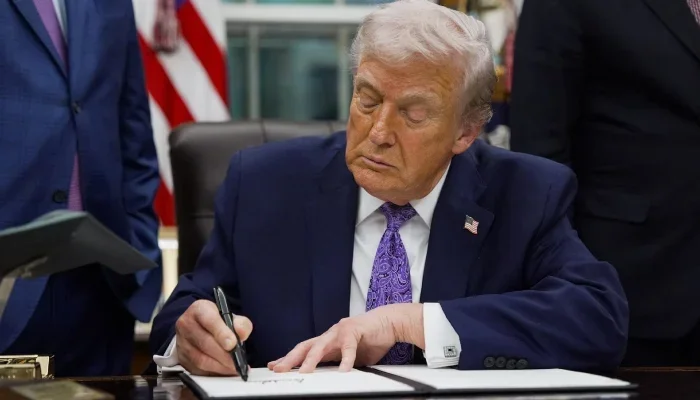

Donald Trump Sign AI Order – (Web Desk) – President Donald Trump has signed a new executive order focused on artificial intelligence. The order creates a voluntary system that gives the government early access to the most powerful AI models before they go public.
Under this new framework, major AI companies like OpenAI, Google, and Anthropic can share their advanced models with the government for up to 30 days before a planned public release. This gives officials time to review potential risks.
The order was largely triggered by concerns surrounding Anthropic’s Mythos model. The company has kept it away from the public because of its ability to expose serious security vulnerabilities in banks, hospitals, and government systems.
A Compromise Between Government and Tech Industry
The final 30-day window is a middle ground. The government originally wanted 90 days of access, while tech companies pushed for just 14 days. Both sides settled on 30 days as a workable solution.

Sam Altman of OpenAI said the order gets the balance right. Google’s Kent Walker called it an important step forward. Even Anthropic, which has had tensions with the Trump administration, welcomed the move as a step toward strengthening American leadership in AI.
The road to signing was not smooth. David Sacks, Trump’s AI and crypto adviser, reportedly called the president directly to warn that the order could slow innovation and hurt America’s position in the AI race against China. This caught many White House staff off guard.
A New AI Cybersecurity Clearinghouse Is Being Created
The order also directs the Treasury, the NSA, and the CISA cybersecurity agency to build a shared AI cybersecurity clearinghouse. This hub will work with private companies to find and fix software vulnerabilities across critical infrastructure.
Trump removed Biden’s 2023 AI oversight order on his first day back in office. Biden’s order had required AI companies to share safety test results, but critics felt it did not go far enough. The European Union, by contrast, has passed binding rules for high-risk AI systems under its AI Act.
Anthony Aguirre, CEO of the Future of Life Institute, called the order a step in the right direction. However, he stressed that voluntary frameworks are not enough and that the government must have the power to block AI systems that pose an unacceptable national security risk.
Comments are closed, but trackbacks and pingbacks are open.