
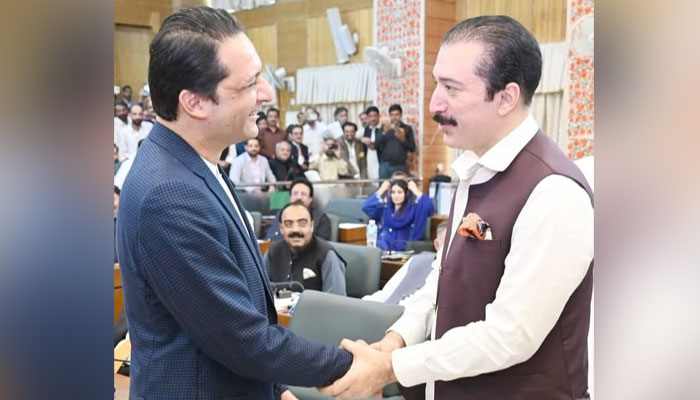

The nomination, election and assumption of office by Iftikhar Gillani as Prime Minister of Azad Jammu and Kashmir continue to remain a subject of discussion in political and journalistic circles. However, power has once again been transferred democratically from the Pakistan Peoples Party to the Pakistan Muslim League-Nawaz. Former Prime Minister Faisal Mumtaz Rathore handed over the reins of government to the newly elected young Prime Minister Iftikhar Gillani with a smile, congratulated him on assuming office and expressed his best wishes for his success.
Thus, Iftikhar Gillani became the 17th Prime Minister elected by the Legislative Assembly and took oath as Prime Minister on the same day. Leader of Pakistan and President of the Pakistan Muslim League-Nawaz Muhammad Nawaz Sharif, Prime Minister Muhammad Shehbaz Sharif, Punjab Chief Minister Maryam Nawaz Sharif, federal ministers and other PML-N leaders congratulated Iftikhar Gillani on assuming the office of Prime Minister and expressed their best wishes for his success.
Following this political transition, the biggest challenge before the new government is not merely to assume power, but to take far-sighted decisions to steer the state out of its existing difficulties and put it on the path of development. In this context, Iftikhar Gillani’s assumption of the office of Prime Minister of Azad Jammu and Kashmir, coupled with the strong confidence expressed in him by the top leadership of the Pakistan Muslim League-Nawaz, represents an important political development.The newly elected Prime Minister personally brought former Prime Minister Raja Muhammad Farooq Haider Khan from his residence to the Assembly and kept him involved in the consultation process.
The newly elected Prime Minister met PML-N Azad Kashmir President Shah Ghulam Qadir at his residence in Islamabad. Shah Ghulam Qadir expressed his best wishes for the Prime Minister’s success. Iftikhar Gillani also visited Federal Minister for Kashmir Affairs and Gilgit-Baltistan Engineer Amir Muqam to inquire about his health.
The meetings of Prime Minister Iftikhar Gillani and Speaker of the Legislative Assembly Chaudhry Tariq Farooq with PML-N President Muhammad Nawaz Sharif, Prime Minister Muhammad Shehbaz Sharif and Punjab Chief Minister Maryam Nawaz Sharif reflect the fact that expectations from the new government in Azad Kashmir are not merely political; they are equally broad in terms of governance, economic development and public welfare.
Iftikhar Gillani and Chaudhry Tariq Farooq thanked the leadership for expressing confidence in them, while the top PML-N leadership congratulated them and stressed the need for immediate resolution of the problems faced by the people of Azad Kashmir. Important matters relating to the development of Azad Kashmir, improvement in public facilities and strengthening the effectiveness of the government system were also discussed.
An important aspect of these meetings was the proposed 100-day reform plan for Azad Kashmir. PML-N President Muhammad Nawaz Sharif shared a reform plan with the Prime Minister of Azad Kashmir focusing on improvements in health, education, sanitation, infrastructure and other basic sectors. He also emphasized the need to put Azad Jammu and Kashmir on the path of modernization, development and modern governance.
This, in fact, points towards the need for a comprehensive governmental vision in which the success of the government is measured not merely by political activity but by tangible improvements in the lives of ordinary people. The people of Azad Kashmir need better healthcare facilities, quality education, a clean environment, improved roads, modern infrastructure, employment opportunities and an efficient administrative system. These are precisely the areas in which the performance of the new government will be put to the real test in the days ahead.
Prime Minister Iftikhar Gillani’s personality carries particular significance in this regard. He is an educated, serious, composed and soft-spoken politician. His temperament reflects deliberation rather than haste, seriousness rather than emotionalism, and consultation rather than confrontation. The ability to make timely decisions and move forward after carefully understanding issues is an important asset for any government, particularly at a time when the state needs political and administrative stability.
After assuming office, Prime Minister Iftikhar Gilani has expressed his determination to work day and night to live up to the confidence placed in him by the leadership of the Pakistan Muslim League-Nawaz. This is not merely a political statement; it reflects the clear responsibility before him. Having been entrusted with the responsibility, converting that confidence into practical performance is now the fundamental priority of his government.
During his meeting with Punjab Chief Minister Maryam Nawaz Sharif, the commitment to implementing the 100-day reform agenda for the development of Azad Kashmir was also reiterated. Prime Minister Iftikhar Gilani appreciated the development projects underway in Punjab and described them as a source of inspiration for Azad Kashmir. His statement that, under the guidance of Quaid Muhammad Nawaz Sharif, he wants to make Azad Kashmir a model of development reflects a broader vision of transforming the region into a modern, efficient and people-friendly state.
Certainly, the ground realities, resources and administrative requirements of Punjab and Azad Kashmir are not identical. However, Azad Kashmir can benefit from models of modern governance, digitalization, reforms in health and education, effective sanitation systems, improved infrastructure and timely delivery of public services. The real success will come when these experiences are adapted and implemented according to the local conditions and needs of Azad Kashmir.
Another important aspect of Prime Minister Iftikhar Gillani’s recent visit to Lahore was his interaction with prominent senior journalists and political analysts of Pakistan. A high tea hosted in his honour by anchorperson and senior journalist Farrukh Warraich was attended by Mujib-ur-Rehman Shami, Sohail Warraich, Hafizullah Niazi, Salman Ghani, Muneeb Farooq, Nasrullah Malik, Ajmal Jami, Mohsin Bhatti, Abdul Majeed Sajid, Member of the Azad Kashmir Legislative Assembly Chaudhry Abdul Rehman and PML-N Azad Kashmir Youth Wing Chairman Raja Fateh Mahmood, among others.
The participation of such prominent personalities indicated that the Prime Minister has begun presenting his political and development agenda before a broad range of stakeholders.
These interactions were not merely ceremonial. Azad Kashmir needs a meaningful dialogue in which the government, political leadership, media, intellectuals, experts and civil society collectively determine how the state can be brought out of its current challenges. The Prime Minister’s decision to present his development and reform agenda before journalists is significant because the media serves as an important bridge between the government and the people.
The vision of Azad Kashmir presented by Iftikhar Gillani places public service at its centre. It envisages an Azad Kashmir where government institutions facilitate citizens rather than create difficulties; where young people have access to education and employment opportunities; where healthcare facilities in hospitals are improved; where educational institutions meet modern requirements; where the development gap between urban and rural areas is reduced; and where infrastructure projects do not remain confined to announcements but become visible on the ground.
The 100-day reform agenda can serve as an important initial step in this direction. The first 100 days provide any government with an opportunity to determine its direction, define priorities and mobilize the administrative machinery. If measurable targets are established during this period, timelines are set for each sector and progress is regularly reviewed, these 100 days can lay the foundation for a new administrative culture in Azad Kashmir.
The Prime Minister has expressed his commitment to political resolve, a strong administrative team, financial discipline, merit, transparency and continuous monitoring in order to achieve these objectives.
Another positive factor for Prime Minister Iftikhar Gilani is that he enjoys the political backing of the top leadership of his party. The guidance of Muhammad Nawaz Sharif, federal-level support from Prime Minister Muhammad Shehbaz Sharif and the development experience of Punjab Chief Minister Maryam Nawaz Sharif provide the Azad Kashmir government with a strong foundation.
Iftikhar Gilani’s composed and balanced personality is an additional strength in this journey. Political differences are an integral part of a democratic system, but under the present circumstances, the need is to ensure that differences do not turn into confrontation. If the government maintains meaningful dialogue with all political forces, elected representatives, government institutions, media and the public, broader consensus can be developed around the reform process.
It is also a reality that the people of Azad Kashmir no longer want mere promises; they want results. They want a government that makes decisions, implements them and then presents its performance before the public. This is why the 100-day reform agenda is an important benchmark for Prime Minister Iftikhar Gilani. Clear targets in health, education, sanitation, infrastructure, employment, administrative reforms and public services must be established and implemented rapidly.
Prime Minister Iftikhar Gillani faces a difficult yet historic opportunity. He has assumed responsibility for Azad Kashmir at a time when the state urgently needs political stability, administrative improvement and financial discipline. The top leadership of the Pakistan Muslim League-Nawaz has placed its confidence in him, and the Prime Minister has expressed his determination to live up to that confidence.
Iftikhar Gilani intends to take forward his seriousness, composure, understanding of affairs and ability to make timely decisions through a clear reform roadmap, a strong administrative team and continuous hard work. He has expressed the confidence that his government will not only play a vital role in bringing Azad Kashmir out of its existing challenges but will also lay the foundation for a new era of development and good governance in the state.
The people of Azad Kashmir are now looking towards this new direction.
Meanwhile, a meeting of the Secretaries of the Government was held at the Prime Minister’s Secretariat under the chairmanship of Prime Minister Iftikhar Gilani. Chief Secretary Azad Kashmir Khushal Khan, Additional Chief Secretary General Zaheer-ud-Din Qureshi, Senior Member Board of Revenue Sardar Muhammad Zafar, Principal Secretary Sardar Adnan Khurshid and secretaries of various departments attended the meeting.
Speaking during the meeting, Prime Minister Iftikhar Gilani said that the foremost priority of his government was to introduce reforms in the system, create ease for ordinary citizens and open up new opportunities for them. He said that the challenges confronting the state would be addressed with the cooperation of the bureaucracy and that the performance of the government would be visible on the ground.
He said that the bureaucracy carried important responsibilities and that the government and administration would work together as a team.
Addressing the meeting, Prime Minister Iftikhar Gilani said, “We have come to work for the people.” He announced that a youth engagement programme would be introduced for young people. He said unemployment was a major challenge in the state and that a demand-based skills development programme would be launched in the social sector.
He further said that relief would be provided to ordinary citizens in terms of transportation and healthcare facilities.
The Prime Minister directed the bureaucracy to immediately begin implementation of the 100-day reform agenda. He said that the government’s agenda was the agenda of the common man and that the government would take measures on a priority basis to reduce the difficulties faced by ordinary citizens.
“We want to show the people of Azad Kashmir that we have come to serve them and improve their lives,” he said.
The Prime Minister further observed that the 100-day reform agenda demonstrated the seriousness of the central leadership of the party towards Kashmir.
Chief Secretary Khushal Khan briefed the Prime Minister on matters relating to the Services and General Administration Department. Inspector General of Police Captain (Retd.) Liaquat Ali Malik also briefed the Prime Minister. Chief Secretary Khushal Khan and Principal Secretary Adnan Khurshid were also present during the briefing.
There is every expectation that the first 100 days under the leadership of Prime Minister Iftikhar Gilani will not merely be the opening days of a new government, but will prove to be the beginning of a new journey of reform, stability, public service and development in Azad Jammu and Kashmir.

Comments are closed, but trackbacks and pingbacks are open.