
Minning Town: A Remarkable Journey from Poverty Alleviation to Rural Revitalization
By Zafar Hussain

YINCHUAN, China: From a barren stretch of land where families once struggled with water shortages, poor harvests and limited access to education and healthcare, to a thriving community with growing industries and new economic opportunities, Minning Town in northwest China’s Ningxia Hui Autonomous Region offers a remarkable example of how poverty alleviation can lay the foundation for rural revitalization.
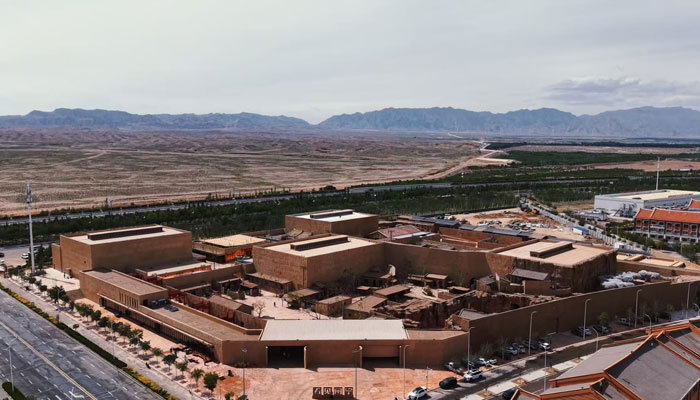
Today, this transformation is being brought to life through Seeing Minning · Theatre Village, an immersive cultural tourism project that tells the story of ecological resettlement, regional cooperation and the determination of ordinary people to build a better future.
Located in the heart of Minning Town’s new urban area, the 74-mu project officially opened on July 1, 2026. Developed around the nearly three-decade history of Fujian–Ningxia collaboration, it uses theatre, exhibitions and interactive experiences to take visitors through the different stages of the town’s development—from the hardships of life in the Xihaigu region to resettlement, poverty alleviation and today’s efforts to achieve rural revitalization.
Feng Xinxin, brand manager of Seeing Minning · Theatre Village, said the project tells the epic story of ecological resettlement by recreating the experiences of families who left their impoverished mountain homes in search of a more secure and prosperous life.
Through performances and reconstructed village settings, visitors can understand why resettlement became necessary, the challenges faced by the first generation of migrants, and how government support, regional cooperation and local people’s perseverance helped transform their lives.
The project presents ecological resettlement not simply as the relocation of people from one place to another, but as a long-term process of creating the conditions for sustainable livelihoods and development.
In Xihaigu, a mountainous area historically affected by severe poverty, drought and water scarcity, many families struggled to make a living from the land. Beginning in 1990, large numbers of residents moved to irrigated areas along the Yellow River. In April 1997, Xi Jinping, then deputy secretary of the Communist Party of China Fujian Provincial Committee, visited the region and advanced the resettlement initiative that helped lay the foundation for what became Minning Town.
The vision behind the initiative was captured in his words in 1997: Minning Village might be a barren stretch of sand at the time, but it could become a land of golden sands in the future.
That vision gradually took shape through Fujian–Ningxia collaboration, launched in 1996 as part of China’s east–west cooperation strategy. Over the past 30 years, the partnership has supported infrastructure development, industrial cooperation, education, employment and improvements in people’s livelihoods.
According to the project’s presentation materials, Fujian–Ningxia collaboration has implemented more than 4,100 assistance projects, with Fujian investing a cumulative 7.68 billion yuan in assistance to Ningxia and benefiting 2.44 million people across the region.
The Theatre Village turns this history into an experience that visitors can see and feel. Its reconstructed adobe houses, loess cave dwellings and everyday village scenes recall the difficult conditions faced by earlier generations. Dramatic performances portray families struggling to secure drinking water, children confronting barriers to education and migrants leaving their ancestral homes to begin again in unfamiliar surroundings.
These stories provide a human perspective on poverty alleviation, showing that behind development statistics are families, personal sacrifices and the determination to improve future generations’ lives.
The narrative then moves towards the achievements of regional cooperation and the development of new industries. The project highlights five major sectors that have helped raise local incomes: wine production, Juncao technology, modern facility agriculture, beef cattle and Tan sheep farming, and rural cultural tourism.
This shift from emergency assistance to sustainable economic activity is central to Minning’s experience. Rather than relying solely on external support, the town has developed industries and employment opportunities intended to strengthen its own capacity for continued growth.
The results are reflected in the town’s changing population and income levels. Project materials show that Minning Town’s population has grown from around 8,000 in the early period of resettlement to approximately 66,000 today. Annual per capita disposable income among rural residents increased from 500 yuan in 1997 to more than 20,000 yuan in 2025.
Beyond its historical and cultural role, the Theatre Village is also intended to contribute directly to the local economy. According to its project materials, it has generated employment for approximately 2,500 local people and encouraged 70 to 80 nearby restaurants, homestays and other businesses to upgrade their services. More than 1,000 standardized accommodation beds have been added in the surrounding area.
The project also incorporates traditional crafts, local cuisine and e-commerce activities, creating additional channels for local products and cultural heritage to reach consumers. Its “Minning Skillful Women” e-commerce brand, for example, is reported to generate annual sales of 10 million yuan, illustrating how local skills and products can be connected with broader markets.
Through its combination of cultural preservation, tourism and employment generation, the Theatre Village seeks to ensure that the benefits of development extend beyond the attraction itself and reach surrounding communities.
The story of Minning also has a wider significance. Ningxia’s resettlement and poverty alleviation efforts have enabled millions of people to move away from harsh living conditions, while investment in infrastructure, education, healthcare and industry has helped communities establish more secure foundations for development.
The Theatre Village offers visitors a way to explore this experience through the lives of ordinary people rather than through statistics alone. Its central message is that poverty alleviation is not the end of development, but the beginning of a longer journey towards stronger livelihoods, local industries and more sustainable rural communities.
For Pakistan, where rural development, water management, agricultural productivity and employment creation remain important policy priorities, Minning’s experience offers areas for reflection. The story highlights the importance of matching development support with local conditions, building productive industries, investing in people’s skills and ensuring that communities benefit from new economic opportunities.
Ultimately, Minning Town’s transformation is a story of people, partnership and perseverance. What began as an effort to help families escape poverty has evolved into a broader pursuit of rural revitalization, with cultural tourism providing a new platform to preserve the past, support local livelihoods and communicate the lessons of development to visitors from China and abroad.
Comments are closed, but trackbacks and pingbacks are open.