
Power Battle in Gilgit Baltistan
Power Battle in Gilgit Baltistan Heats Up as June 7 Vote Draws Near

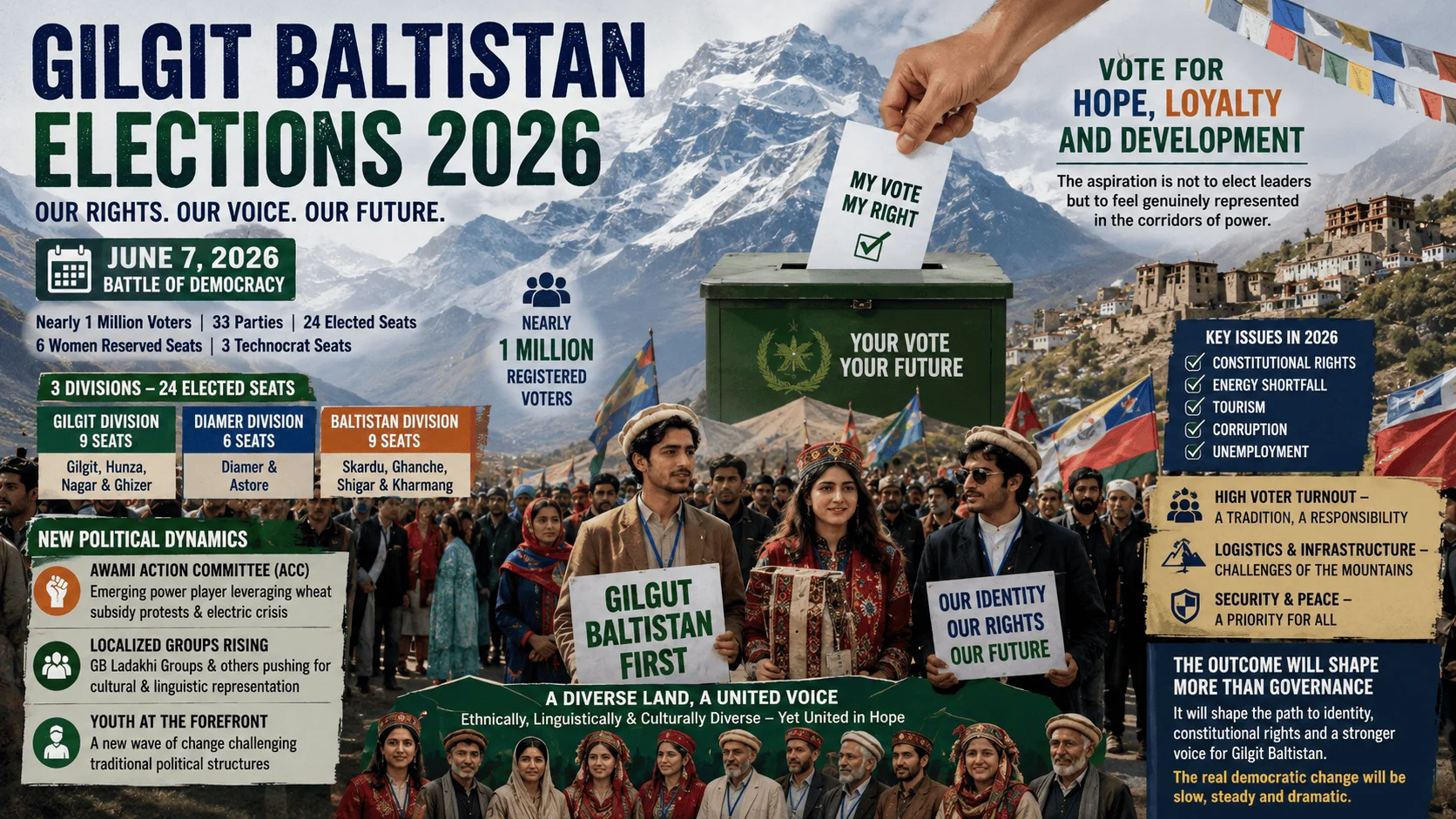
On early morning of June 7, 2026, the most ethnically and linguistically diverse people of Gilgit Baltistan will head to the battle of democracy, marking the fourth general election since a limited governance framework introduced in 2009.
Gilgit Baltistan, the mountainous region which forms a part of the erstwhile undivided Jammu & Kashmir is reviving political activity in land marked by constitutional ambiguity and strategic value. Nearly 1 million voters would exercise their rights of voting in the 2026 elections which are more significant than 2020. Political environment across Gilgit Baltistan is more politically debatable and vibrant than before. The debate among the young voters and candidates are about their constitutional rights, energy shortfall, tourism, corruption and above all unemployment.
As the elections were delayed due to winter conditions as all the main highways connecting to capital Islamabad would be blocked. If the elections had taken place in January, the peak of winter, people especially from far areas might have faced difficulties reaching polling booths eventually impacting the voting results.
Now with the revised date of elections, the regions 3 main divisions, Gilgit, Diamer and Baltistan each one carrying its own ethnic, political and sectarian dynamics. The assembly consists of 33 members out of which 24 are directly elected representatives and six are reserved seats for women and 3 for technocrats. Nine in Gilgit division (Gilgit, Hunza, Nagar, & Ghizer), six in Diamer (Diamer & Astore) and nine in Baltistan (Skardu, Ghanche, Shigar, & Kharmang) making 24 seats with 1 million registered voters.
There are 33 political parties registered with GB election commission which comprise of all the major Pakistani political parties. Historically, the GB has shifted power between Pakistan Muslim League – Nawaz, Pakistan People’s Party and Pakistan Tehreek e Insaf. Smaller parties like Muttahida Quami Movement, Majlis Wahdat e Muslimeen and some regional nationalist parties and figures like Nawaz Khan Naji had played a vital role in shaping up coalition governments.
The current mood in GB is very much vibrant. The tents of all the political parties have been erected in far flung villages and towns. This time people of GB are seeing the emergence of new political dynamics and some local pressure groups are challenging the traditional political structure. For example, Awami Action Committee (ACC) has emerged as the new power player in 2026 elections. They are leveraging the 2024-25 wheat subsidy protests and the prevailing electric crisis to back their independent candidates and influencing the voters away from the national parties contesting elections. Adding to this there is one more growing trend which is getting stronger day by day and that trend is GILGUT BALTISTAN FIRST. This trend, a sentiment which is leading to the emergence of smaller localized groups like GB Ladakhi Groups in Baltistan which is pushing for cultural and linguistic representation that most of the parties either overlook or do not have in their political agenda.
Another political theme is the pattern of alignment with the ruling party in capital of Pakistan. History says that the voters in GB has always tended to vote to the same party holding power in federal area due to their dependence on federal funding and administrative patronage. Now let’s wait and watch will this pattern holds in 2026 elections, keeping in mind the shifting of national political landscape which is marked by economic strain.
Another factor would be the voter turnout which is traditionally always high in the region. This would be key indicator which will reflect the political engagement of the main stream parties. The main factor would be the YOUTH which is now a big challenge. The younger generations around the world have changed the skeptical picture of democratic institutions and same sentiments are emerging in Gilgit Baltistan also.
Factors like logistics, limited infrastructure and disperse population would complicate polling process, often requiring the ballot materials to be transported to far flung areas under immense difficult conditions. Security, which is stable compared to other regions will also be a matter of great concern as some pockets especially in Diamer, some sectarian clashes have surface in past.
As the election date coming closer, political campaigning gathers pace. Political parties are arranging large gatherings to show their power. The voting day would be a test of their political strength and barometer of people sentiments.
Summarizing, GB elections will not only determine the composition of assembly but will also show the path to the long running debate over identity, constitutional rights. The outcome of the elections could be a cocktail of coalition government with some local groups making huge dent to the main stream parties. The answer would not emerge on election night but the real democratic change would be dramatic, particularly in mountain societies where institutions develop slowly.
June 7, 2026 the voters will vote for HOPE, LOYALTY and DEVELOPMENT. The aspiration is not to elect leaders but to feel genuinely represented in the corridors of power.
By: Malik Yasir Imtiaz AWAN
Dubai – U.A.E
Comments are closed, but trackbacks and pingbacks are open.