
New Generation, Same Rivalry: Pakistan’s Young Guns Outshine India A in Doha
Pakistan A Rule Doha! Ali Raza's Fiery Spell, Hasan Nawaz's All-Round Brilliance and Harshit Rana's Aggression Mark 48-Run Win Over India A

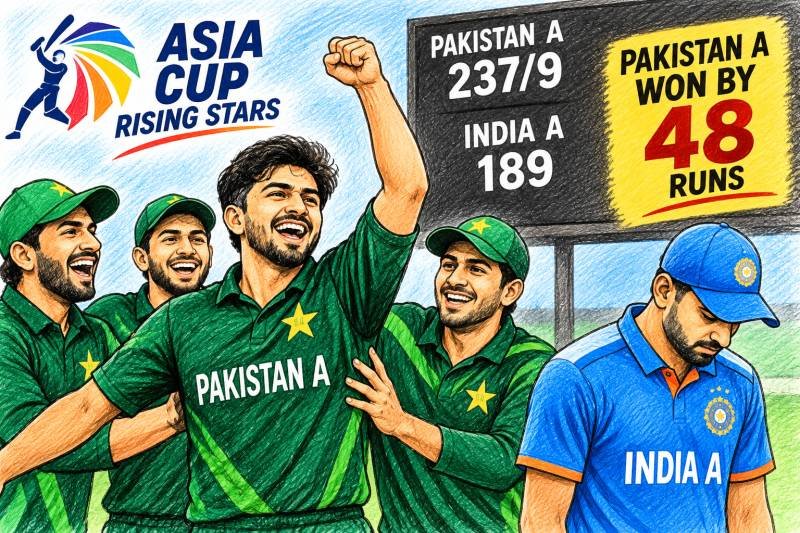
Pakistan and India – (Mudassir Iqbal/News Agency) – The cricket rivalry between Pakistan and India has always generated extraordinary excitement, emotions and anticipation among fans. Whenever these traditional rivals meet on the field, the contest goes beyond bat and ball. Every wicket, boundary and six sends emotions soaring among millions of supporters. The DP World Asia Cup Rising Stars 2026 encounter at West End Park International Cricket Stadium in Doha on November 22 was no different. Pakistan A defeated India A by 48 runs, secured a place in the semi-finals and showcased the remarkable potential of its emerging cricketing talent.
Pakistan’s victory was not merely a 48-run margin on the scoreboard; it was also an encouraging message about the future of Pakistan cricket. The toss controversy, Indian fast bowler Harshit Rana’s excessive aggression, the confidence of Pakistani batters, heated exchanges between players and Ali Raza’s decisive bowling made this an absorbing encounter.
The match began with an unusual situation at the toss. Pakistan captain Abdul Samad called heads, but the initial decision was incorrectly announced as tails. Samad immediately pointed out the mistake, and the decision was subsequently corrected in Pakistan’s favour. The incident sparked considerable discussion on social media. Some supporters criticised the handling of the toss, while others raised questions about transparency. However, there was no verified evidence of deliberate cheating or match manipulation. Nevertheless, the Pakistani captain’s insistence on getting the decision corrected was noteworthy.
Batting first, Pakistan posted an impressive 313 runs before being bowled out in 49.2 overs. Openers Shamyl Hussain and Maaz Sadaqat provided an excellent start, putting the Indian bowlers under pressure from the outset and adding 66 runs for the first wicket. Shamyl scored 33 off just 23 balls, demonstrating an attacking approach that immediately challenged India’s bowling plans. Meanwhile, Maaz Sadaqat played a responsible innings of 59 off 63 deliveries, showing that he possesses not only attacking ability but also the temperament to adapt his batting according to the situation.
Maaz’s confidence, shot selection and composure were particularly impressive. He refused to be intimidated by the Indian bowling attack and provided Pakistan with a solid foundation. His consistent performances are encouraging signs for Pakistan cricket. The young opener demonstrated that Pakistan has talented players capable of taking responsibility in high-pressure encounters.
Hasan Nawaz then showcased his class with an outstanding innings of 79 off 82 balls. His batting reflected patience, confidence and the ability to accelerate when required. He played a crucial role in stabilising the innings and taking Pakistan towards a formidable total. Farhan Yousaf also made a valuable contribution, scoring 56 off 48 deliveries. His half-century helped Pakistan cross the 300-run mark and put India under further pressure.
One aspect of the match that deserves particular attention is the conduct of Indian fast bowler Harshit Rana. His behaviour attracted almost as much attention as his bowling. His repeated verbal exchanges with Pakistani batters, aggressive send-offs after taking wickets and attempts to engage opponents in confrontations added tension to the contest. His send-off to Shamyl Hussain following his dismissal and subsequent exchanges with other Pakistani players, including Hasan Nawaz, became talking points.
There is nothing wrong with a fast bowler displaying aggression. Putting pressure on a batter, celebrating a wicket passionately and showing commitment to the team are all natural elements of competitive cricket. However, when aggression turns into unnecessary provocation and personal exchanges, it becomes a matter of concern. A talented young bowler like Harshit Rana is expected to channel his energy into disciplined bowling, rather than becoming involved in repeated confrontations that detract from the spirit of the game.
Interestingly, Rana’s aggressive approach did not translate into particularly economical bowling figures. He conceded 77 runs in his 10 overs while taking two wickets, recording an economy rate of 7.70. Although two wickets were a contribution, he proved expensive against a Pakistani batting line-up that managed to score freely. Shamyl Hussain, Maaz Sadaqat, Hasan Nawaz and Farhan Yousaf maintained their focus and responded through their batting rather than getting distracted by verbal exchanges.
This is an important lesson in professional cricket: the best response to provocation is performance, not confrontation. Rana’s aggression may have added intensity to the contest, but his bowling figures also reflected the difficulty he faced in containing Pakistan’s batters.
Chasing 314, India A suffered an early setback as Vaibhav Sooryavanshi was dismissed for 11 and Ayush Badoni returned to the pavilion without scoring. Pakistan’s bowlers had immediately put India under pressure.
Abhishek Sharma, however, attempted to change the course of the innings with an explosive display of batting. He scored 70 off just 42 deliveries, including six boundaries and six sixes. His aggressive stroke play briefly put the Pakistani bowling attack under pressure and raised hopes of an Indian comeback. However, Hasan Nawaz dismissed him at a crucial stage, giving Pakistan an important breakthrough.
India were struggling at 129 for six, and defeat appeared increasingly likely. But captain Tilak Varma refused to surrender. He joined forces with Shahbaz Ahmed to build a valuable 112-run partnership, bringing India back into contention. Shahbaz scored 56 off 49 balls, while Tilak produced a fighting century, scoring 100 off 149 deliveries.
Tilak’s century was undoubtedly a commendable individual achievement. His patience, composure and determination under pressure demonstrated his batting ability. He made a tremendous effort to keep India’s hopes alive, but Pakistan’s bowlers maintained their discipline and eventually took control of the match.
Ali Raza then delivered the decisive blow. He dismissed Shahbaz Ahmed to break the crucial partnership and followed it up by bowling Vipraj Nigam in the same over. Those breakthroughs virtually ended India’s hopes of a successful chase.
Ali Raza finished with three wickets, while Hasan Nawaz also claimed three, completing an outstanding all-round performance. India A were eventually bowled out for 265 in 49.1 overs, handing Pakistan A a convincing 48-run victory.
The match also witnessed heated exchanges between players, particularly during the closing stages. Pakistani players were seen gathering around Tilak Varma following a wicket, and the situation became tense enough for the umpires to intervene and separate the players. Such scenes demonstrate the intensity of Pakistan-India encounters, but they also underline the importance of maintaining respect and discipline on the field.
Defeating an opponent is the objective of competitive sport; humiliating or provoking individual players should never become part of the contest. Match officials also have an important responsibility to intervene promptly and impartially whenever tensions threaten to escalate.
The most encouraging aspect of this match was Pakistan’s collective performance. Shamyl Hussain provided an aggressive start, Maaz Sadaqat delivered a responsible half-century, Hasan Nawaz excelled with both bat and ball, Farhan Yousaf contributed valuable runs, and Ali Raza produced decisive bowling at a crucial stage.
These are the qualities Pakistan Cricket Board must continue to develop. Young players need consistent opportunities, quality coaching and exposure to demanding competitions if they are to become reliable members of the senior national side.
India also had its moments of brilliance. Abhishek Sharma’s explosive 70 and Tilak Varma’s fighting century deserve recognition. A balanced cricket analysis must acknowledge the achievements of both teams. Nevertheless, Pakistan’s stronger collective performance, substantial first-innings total and decisive bowling ultimately made the difference.
The Pakistan-India rivalry remains one of cricket’s biggest attractions. These encounters give emerging players an opportunity to demonstrate their abilities before a massive audience. Supporters want thrilling contests, excellent batting, fast bowling and outstanding fielding. Unnecessary arguments and provocation only distract from the beauty of the game. Harshit Rana and other young cricketers must understand that aggression is most effective when expressed through skill, discipline and performance.
Pakistan A’s victory in Doha is an encouraging sign for the future. The country has promising young talents in Shamyl Hussain, Maaz Sadaqat, Hasan Nawaz, Farhan Yousaf and Ali Raza. The challenge now is to provide them with consistent opportunities, proper development and exposure to international-standard cricket so that they can eventually become important members of Pakistan’s senior national team.
The young Shaheens have defeated their traditional rivals and secured a place in the semi-finals. Pakistani supporters have every reason to celebrate, but the real test for these emerging cricketers is still ahead. They must maintain the same commitment, discipline and determination in the matches to come.
Ultimately, the message from Doha was clear: Pakistan’s young cricketers answered their opponents with bat and ball. Ali Raza’s wickets, Hasan Nawaz’s all-round brilliance, Maaz Sadaqat’s confidence and Farhan Yousaf’s half-century formed the foundation of this memorable victory. In cricket, respect and superiority are earned through performance, not noise or confrontation. On November 22, Pakistan A demonstrated exactly that on the field in Doha.
Comments are closed, but trackbacks and pingbacks are open.