

Iran Threatens US Warships With Qassem Basir Missile, Plans Gulf Zon
Tehran threatens economic warfare and a new Gulf exclusion zone as the Qassem Basir missile targets US naval forces near the Strait of Hormuz.

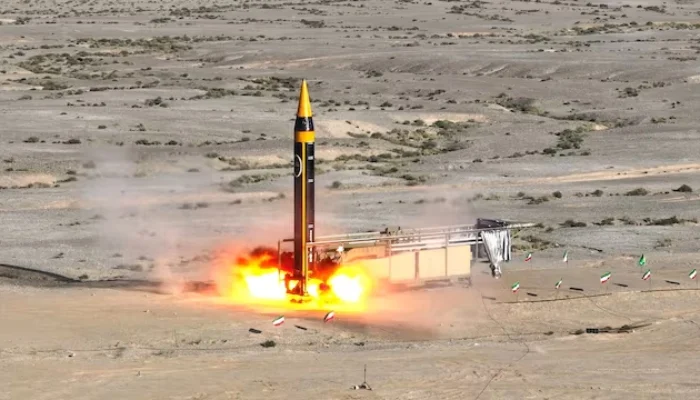
CAIRO – (Special Correpondent/Web Desk) – Iran says it launched a Qassem Basir missile at a US warship near the Strait of Hormuz, adding fresh fuel to a conflict that refuses to cool down. The claim came just days after Washington struck three Iranian oil tankers, keeping both sides locked in a tense back-and-forth that shows no sign of slowing.
American military officials pushed back on the claim. They said their warships were not hit and managed to dodge any incoming fire. Still, the message from Tehran was loud and clear: Iran wants the world to know it still has teeth, even after months of punishing attacks on its military and economy.
The missile in question, the Qassem Basir, is not a new name in Iran’s arsenal. Iranian state media describe it as a smarter, more agile weapon built to slip past modern missile defense systems. Reports say it first saw combat use back in June last year during a strike on Israel.
A Warning Wrapped In Two Threats
Iran’s Supreme National Security Council secretary, Mohsen Rezaei, didn’t stop at the missile claim. He took to social media with a pointed warning aimed straight at Washington, hinting at what he called a “recalibrated” military posture toward US ships and bases in the region.
Rezaei also raised the idea of economic retaliation, saying Iran would answer any economic pressure with a maritime exclusion zone stretching across the Persian Gulf. Any ship that dares enter this zone, he warned, would land on Iran’s sanctions blacklist.
Details of this new zone, along with maps for an alternate shipping route through Hormuz, are expected soon, though officials have stayed quiet on timing.

Oil, Sanctions, And A War Nobody Wants To Lose
This standoff carries weight far beyond military posturing. Roughly a fifth of the world’s oil and gas shipments once passed through the Strait of Hormuz before the war began. That number has dropped sharply, with shipping data showing just about ten vessels a day crossing the strait recently, the lowest count since May.
President Trump weighed in too, predicting that oil prices would eventually crash below two dollars a gallon once the war ends in America’s favor. He also repeated his long-standing promise that Iran would never be allowed to build a nuclear weapon.
Despite months of airstrikes that have worn down Iran’s conventional military and choked its economy, the country has held onto enough missile and drone power to keep threatening tankers and neighboring Gulf states hosting US troops.
A Region On Edge
The tension isn’t limited to Iran and the US. Southern Lebanon saw one of its bloodiest days in weeks after Israeli strikes killed at least a dozen people, according to local health officials. The attacks have reignited fears of a larger Israeli offensive, even with a ceasefire with Hezbollah technically still in place.
Iran has made it clear that any future deal with Washington must include an end to Israeli strikes in Lebanon, tying the Gulf standoff to a much wider regional fire that keeps spreading.
For now, there’s no real sign of a diplomatic breakthrough. Both sides seem locked into a slow, grinding pattern of strikes, threats, and brief pauses, with ordinary people across the region left waiting to see what comes next.
[…] now, all eyes remain on the Gulf. As long as the Iran-US conflict continues without a breakthrough, Brent crude looks likely to keep testing higher levels, with $100 […]