

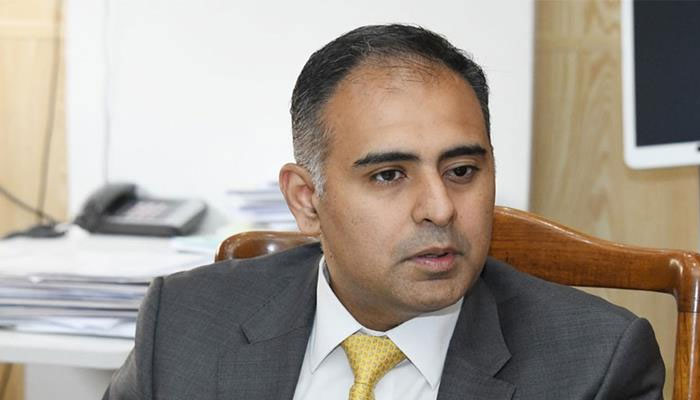

ISLAMABAD: (Finance Reporter) – Minister of State for Finance and Revenue Bilal Azhar Kayani has said the government is taking practical steps to remove business barriers, facilitate exporters and create a more supportive environment for private-sector-led economic growth.
Addressing the business community at the Sialkot Chamber of Commerce and Industry on Tuesday, Kayani said the government’s role was to eliminate hurdles faced by businesses rather than create additional obstacles.
He described Sialkot as an important contributor to Pakistan’s economy, particularly in the export sector, and said the government was working to make full use of the city’s export potential.
The minister said Prime Minister Shehbaz Sharif had instructed relevant authorities to maintain a business-friendly approach toward entrepreneurs and exporters. He noted that businesses contribute through taxes, employment generation and foreign-exchange earnings, making policy support and removal of unnecessary hurdles essential.
Kayani said the prime minister had maintained regular contact with business leaders and chambers during the past year. Working groups headed by private-sector representatives were subsequently established to examine issues relating to taxation, customs, trade, energy, railways, agriculture and information technology.
He said recommendations from these groups were taken into consideration while preparing the current fiscal year’s budget, which also included several tax measures aimed at supporting businesses and exporters.
Under the current budget, the minister said super tax had been removed for businesses with annual income between Rs150 million and Rs500 million. For businesses earning above Rs500 million, the super tax rate had been reduced from 10% to 8%.
For exporters, the combined deduction on export proceeds was also reduced. The advance income tax and minimum tax rate was brought down from 2% to 1.25%, while the 0.25% Export Development Fund surcharge was abolished, reducing the overall deduction from 2.25% last year to 1.25%.
Kayani said the budget had also provided tax relief to salaried individuals across different income brackets.
He added that the 0.25% final tax regime for the IT sector had been retained despite being scheduled to expire this year.
Export Finance Scheme Extended
The minister said the utilization period under the Export Finance Scheme had been increased from nine months to 18 months following consultations with exporters and a review of regional practices. An additional six-month extension could also be obtained, potentially taking the total period to two years.
He said the move would particularly benefit small and medium-sized exporters, whose orders are generally smaller and require less imported raw material.
Kayani also said the issue concerning the use of post-dated cheques instead of guarantees under the Export Finance Scheme had been resolved. Following clarification of the rules, exporters deriving more than 80% of their business from exports could use the facility.
Export Facilitation Committees have also been established to address exporters’ concerns more quickly. The committees will hold regular meetings with exporters and Federal Board of Revenue representatives.
He said no audit against an exporter would be initiated without first following the relevant Export Facilitation Committee process.

TDAP Reforms, Energy Costs and Privatization
Regarding the Trade Development Authority of Pakistan, Kayani said the government was pursuing reforms through a committee established by the prime minister. The objective is to transform TDAP into a one-window platform that can assist exporters and raise their trade-related concerns with domestic institutions and Pakistani missions abroad.
On industrial energy costs, the minister said cross-subsidies for the industrial sector had been eliminated and efforts were continuing to bring electricity tariffs down further. He added that industries would also be encouraged to adopt solar and other alternative energy sources wherever feasible.
Kayani said the policy rate had declined to 11.5% from around 22% when the government assumed office. He added that the State Bank had recently adjusted the rate amid inflationary pressures linked to regional tensions.
The minister also highlighted the government’s privatization programme, saying it was intended to support private-sector-led economic growth. He said the privatization of Pakistan International Airlines had been completed, while the process for three distribution companies was underway and expressions of interest had been invited.
According to Kayani, the Power Division and Privatization Commission are advancing the process while taking market feedback into account, with the aim of improving the efficiency and services of distribution companies and enabling them to provide electricity at appropriate tariffs following privatization.
Private Sector Given Greater Role in EDF
Kayani said reforms had also been introduced in the Export Development Fund’s board, giving the private sector a greater role in its management.
A private-sector representative now heads the board, while representation has been provided to major textile and non-textile exporters, chambers of commerce and other relevant sectors. He said the government’s role on the board had been limited to facilitation.
Railway Infrastructure to Support Exports
The minister emphasized the importance of transport infrastructure for boosting exports, saying financing arrangements had been finalized for the Karachi-Rohri railway section.
He said technical work was underway with assistance from the Asian Development Bank and expressed hope that practical progress on the project would become visible next year.
He added that the subsequent upgrade of the Main Line-1 railway from Karachi to Peshawar would help increase train speeds and freight-handling capacity.
Simplified Tax Scheme for Retailers
Kayani also announced that the government had introduced a simplified tax mechanism for the retail sector after consultations with shopkeepers.
Under the scheme, retailers will be able to declare their annual turnover through a simple Urdu-language form and pay a 1% final tax, with an adjustment facility available for withholding tax.
Comments are closed, but trackbacks and pingbacks are open.