
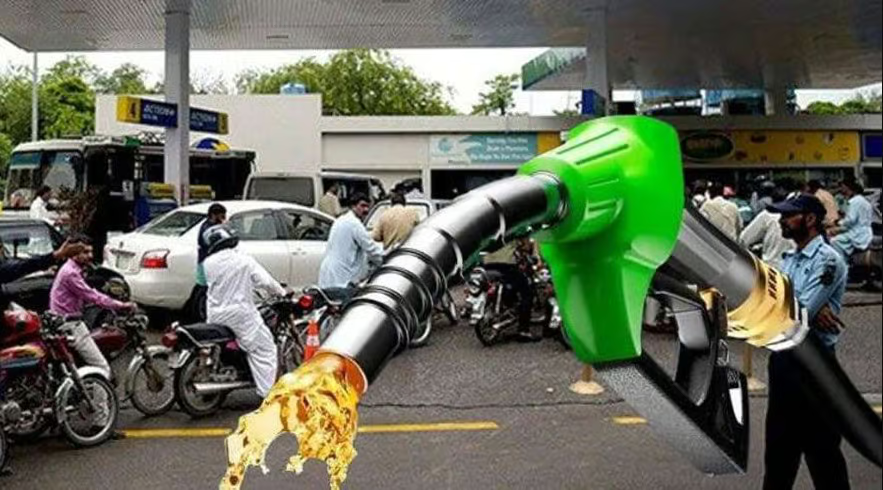

The global economy is once again passing through a period in which the effects of tensions arising in one region can quickly reach other parts of the world. The current situation in the Middle East and fluctuations in global oil prices have also added to the economic pressure on Pakistan, a country dependent on imported oil. An increase in petrol prices does not remain confined to the petrol pump; its effects extend to transportation, business activity, the prices of essential commodities and, ultimately, the household budgets of ordinary citizens.
In such circumstances, the greatest pressure falls on low- and middle-income groups whose incomes are limited while their daily expenses are already rising. For labourers, delivery riders, rickshaw and Qingqi drivers, low-paid employees and people engaged in small businesses, a motorcycle, rickshaw or small car is not merely a means of transportation; it is a means of accessing their livelihood. When petrol becomes more expensive, their transportation costs rise, their incomes can be affected, and pressure on other essential household expenses also increases.
It is against this backdrop that Prime Minister Muhammad Shehbaz Sharif has introduced the Prime Minister’s Special Relief Scheme as a targeted mechanism amid limited financial resources and international economic obligations. The basic objective of the scheme is to provide direct petrol relief to citizens who use motorcycles, rickshaws, Qingqis or cars up to 800cc for their daily economic activities. According to official information, the scheme is being implemented through a technology-based, transparent and targeted mechanism.
The significance of this initiative is not limited to an immediate reduction in fuel expenses. Low- and middle-income groups play an important role in the national economy through their labour, skills, small businesses, taxes and everyday consumption. However, during periods of economic difficulty, their household budgets are often among the first to come under pressure because of limited financial capacity. In such circumstances, the purpose of targeted relief is to reduce some of this additional pressure by lowering transportation costs.
An important feature of the Prime Minister’s Special Relief Scheme is its digital framework. The government has linked CNIC information, registered mobile SIMs, vehicle details and digital fuel tokens to create a system in which registration, token issuance and verification at petrol stations form part of an integrated process. According to the Ministry of IT and Telecommunication, the system is intended to limit duplicate registrations, unauthorised claims and the potential for misuse, while ensuring greater transparency in the delivery of relief to eligible citizens.
This digital system could also provide a foundation for a structured database that may, in the future, help identify citizens affected by economic crises and deliver targeted assistance to them in a timely manner. However, achieving this objective will require continued adherence to principles of personal-data protection, data security and responsible use of information.
Another notable aspect of the programme is Prime Minister Muhammad Shehbaz Sharif’s direct monitoring of its various stages and his instructions for immediate adjustments based on public feedback received from across the country. The effectiveness of a policy depends not only on its announcement but also on how easily ordinary citizens can access it. For this reason, attention has been given to simplifying the registration process and addressing public concerns promptly.
On the Prime Minister’s direction, the SMS registration service through 9771 has also been made completely free, so that citizens do not have to pay any additional amount to register for the relief. Under the official procedure, citizens can register by sending REG, followed by their CNIC number, vehicle registration number, the first English letter of the relevant province and the registration date to 9771. After receiving a confirmation message, a fuel token can be obtained through TOK.
Further facilitation has also been introduced into the scheme’s procedures based on public feedback. The decision to remove the mandatory requirement to purchase five litres of petrol for motorcycles, rickshaws and Qingqis is important because not every citizen with a limited income can afford to purchase a fixed quantity of fuel at one time. Following this change, eligible workers purchasing less than five litres of petrol can also receive relief under the prescribed procedure, while the mechanism provides for a discount of up to Rs. 500 against the weekly fuel token.
For cars with engine capacities of up to 800cc, the scheme provides relief on 30 litres of petrol per month. Under this mechanism, a 10-litre token is issued every ten days, resulting in three tokens per month. In this way, a specific relief mechanism has been developed according to the nature of use for different types of vehicles and the citizens who depend on them.
The digital infrastructure developed by the Ministry of IT and Telecommunication is playing a central role in the overall system. Under the leadership of Federal Minister for IT and Telecommunication Shaza Fatima Khawaja, the ministry has developed the system for registration, token generation and verification at petrol stations. According to the ministry, CNIC-linked registration and token verification have been integrated in a manner designed to maintain transparency in the relief-disbursement process and minimise the possibility of unauthorised use.
Public awareness is also fundamental to the success of the scheme. Under the leadership of Federal Minister for Information and Broadcasting Attaullah Tarar, the Ministry of Information and Broadcasting has launched an awareness campaign through television, radio, newspapers and digital media. The objective is to explain, in simple language, the eligibility criteria and the procedures for registration, obtaining fuel tokens and receiving subsidised petrol.
As part of this effort, youth teams and volunteers have also been sent to petrol stations to review the practical implementation of the system, obtain direct feedback from citizens and petrol-pump operators, and communicate emerging issues to the relevant institutions. In this way, awareness, practical assessment of the system and public feedback are being pursued as a continuous process. Recent government directions have also emphasised the involvement of youth-programme volunteers in public outreach and assistance with registration.
The implementation of a relief programme on such a large scale cannot be the responsibility of a single ministry or institution. Coordination among multiple organisations, including the Ministry of Finance, Petroleum Division, OGRA, PTA, State Bank, NADRA, NITB, district administrations and telecom operators, is a fundamental part of the system.
Under the current economic circumstances, the real test of any relief programme is how effectively it can bridge the gap between an announcement and the benefit reaching citizens. Continuous monitoring, prompt decisions based on public feedback, digital verification, nationwide awareness and institutional coordination are being used in the Prime Minister’s Special Relief Scheme with this objective in mind. Recent developments also indicate that efforts are continuing to improve petrol-pump coverage, registration and token procedures in line with conditions on the ground.
In a country like Pakistan, where millions of families manage their household expenses on limited incomes, an increase in petrol prices is not merely a matter of higher transportation costs. It can also affect a range of essential needs, including food, education, healthcare and employment.
The Prime Minister’s Special Relief Scheme has emerged as a government effort to provide direct support to these segments of society. At the present stage, its objective is to ease immediate economic pressure, while its digital framework could also provide a foundation for targeted public relief programmes in the future.
[…] the protest train pulled into the city. He asked the party to hold off on its campaign against the petroleum levy, at least until he gets back to the […]
[…] falling oil prices often bring good news. Lower crude costs can eventually lead to cheaper fuel at the pump, along with reduced costs for transportation and goods that rely on oil-based energy. […]