
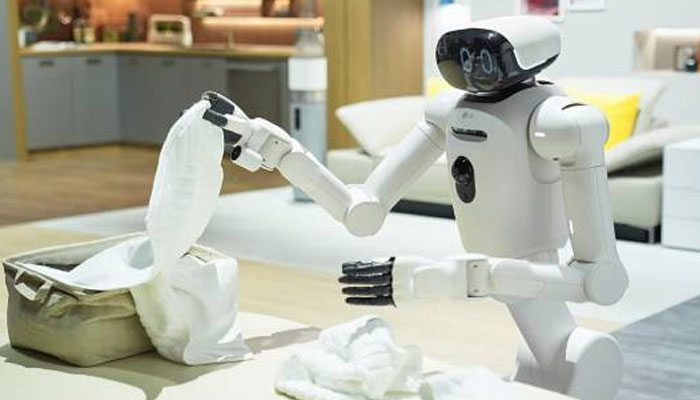
European Robot Makers Challenge China at Vivatech
European Humanoid Robot Firms Seek Edge Over Chinese Rivals

PARIS: (Web Desk) – Humanoid robots capable of performing tasks ranging from greeting visitors to harvesting grapes stole the spotlight at this year’s Vivatech technology exhibition in Paris, as European companies showcased their ambitions to compete with China’s dominant robotics industry.
Among the standout innovations was Mirokai, a social robot developed by French start-up Enchanted Tools. Featuring distinctive orange ears and expressive blue eyes, the robot is designed to interact with people in more than 50 languages and is already being tested in airports and hospitals.
The company expects to begin mass production of the robot before the end of the year. According to Enchanted Tools, a majority of Mirokai’s components are manufactured in Europe, reflecting a broader effort to strengthen local technology supply chains.
Despite Europe’s growing robotics ecosystem, China remains the global leader in humanoid robot production. Industry estimates indicate that nearly 87 percent of the world’s humanoid robots deployed in 2025 were manufactured by Chinese companies such as Unitree and Agibot.
Experts say China’s advantage stems from large-scale manufacturing capabilities and highly automated factories where robots increasingly perform production tasks with minimal human involvement.
Indian Workers Training AI Robots That Could Replace Their Jobs
However, European firms are striving to carve out their own niche. German robotics company Neura recently secured significant investment to expand its development of industrial and household humanoid robots. The company says demand is rising across multiple sectors as businesses face labour shortages linked to ageing populations.
Neura’s chief executive, David Reger, described robotics as a critical opportunity for Europe’s future economic competitiveness, arguing that advanced automation will be essential to sustaining growth and productivity.
Spanish company PAL Robotics also highlighted concerns about technological sovereignty. Its latest robots, including machines designed for logistics operations and agricultural harvesting, were showcased at the event.
Industry leaders warn that excessive dependence on foreign robotics manufacturers could create strategic risks, particularly as robots increasingly collect and process valuable operational data.
Meanwhile, French-American start-up Genesis AI announced plans to shift production of its multifunctional robots from China to Europe, aiming to better serve industrial customers across France, Germany, and Italy.
The discussions at Vivatech underscored a growing determination among European technology companies to build competitive alternatives to Asian robotics giants while maintaining greater control over innovation, manufacturing, and data security.
As demand for intelligent automation continues to rise worldwide, Europe’s robotics sector is positioning itself as a key player in the next phase of the global AI and manufacturing revolution.
Comments are closed, but trackbacks and pingbacks are open.