

Bread Shortages Leave Sudanese Families Facing Food Crisis
War and Currency Crisis Push Sudan Deeper Into Hunger

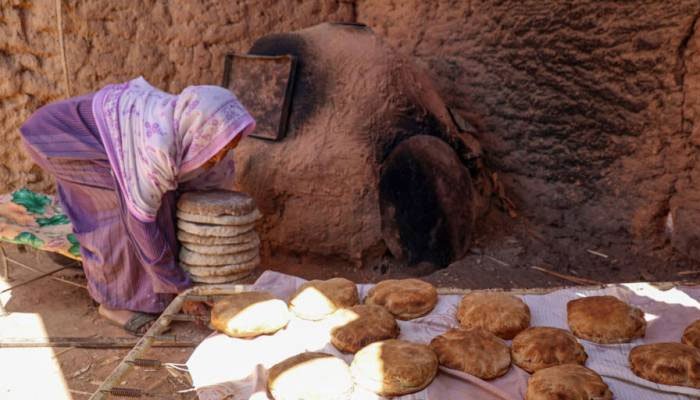
KHARTOUM: (News Desk) – Nearly three and a half years into Sudan’s devastating war, rising living costs, currency depreciation and shortages of essential supplies have made it increasingly difficult for millions of people to afford basic food items, particularly bread.
Most bakeries in the capital, Khartoum, have closed due to soaring wheat prices and fuel shortages, leaving families struggling to meet their daily food needs.
Sawsan Mahmoud, a 44-year-old mother of three, said she and her husband were now spending almost their entire combined salaries on bread.
“The situation has become unbearable,” she said, adding that her family had reduced its bread consumption and now ate it with only one meal a day.
Mahmoud said the family needed around 900,000 Sudanese pounds, equivalent to approximately $88, every month to purchase bread.
The price of a loaf in Khartoum has doubled from 250 to 500 Sudanese pounds in just one week, further increasing pressure on households already facing severe financial difficulties.
International organisations have warned of the risk of famine spreading across the country. Famine has already been declared in parts of Sudan, while around 20 million people are experiencing severe food insecurity.
Sudan relies heavily on imported wheat, making bread prices particularly vulnerable to the declining value of its currency. Over the past month, the Sudanese pound lost around 25 percent of its value against the US dollar, falling to a record low of more than 10,500 pounds before recovering slightly to approximately 10,200 on Wednesday.
When the war between the paramilitary Rapid Support Forces (RSF) and the Sudanese army began in 2023, one US dollar was worth around 500 Sudanese pounds.
Bakery owners say flour shortages and rising operating costs are threatening the survival of businesses that remain open.
Mohammed al-Fateh, who runs a bakery in Khartoum, said many bakeries had shut down because flour was no longer readily available in the market. He added that people could spend one or two days waiting at distribution centres without securing supplies.
In the southern Al-Azhari neighbourhood, bakery owner Mutawakil Ahmed Babiker said the price of flour had doubled, while frequent power cuts had forced businesses to rely on expensive generator fuel.
Babiker said he was selling bread at 500 pounds per loaf, below its production cost, because customers could not afford further price increases. He warned that he might soon be forced to close his bakery.
Khartoum and parts of eastern Sudan have also experienced widespread electricity outages following repeated drone attacks on power stations.
Meanwhile, residents have increasingly returned to public kitchens for free meals. Many community kitchens had suspended operations after the army regained control of Khartoum and expelled RSF forces in March 2025.
The Ombada Emergency Room in Omdurman, which coordinates community kitchens, has warned that growing numbers of families and displaced people are struggling to secure food. It also reported shortages of supplies and rising prices, leaving some people unable to afford even one meal a day.
According to Sudan’s Central Bureau of Statistics, poverty has risen to around 80 percent, while inflation reached 99 percent last year.
The crisis extends beyond the capital, where fuel shortages, road closures and ongoing fighting are disrupting the delivery of food and humanitarian assistance. Much of the wheat supplied outside Khartoum arrives through aid operations, but logistical difficulties are preventing regular distribution.
The conflict has divided Sudan into rival areas of control, with the army holding Khartoum and central and eastern regions, while the RSF controls much of Darfur in the west and parts of the south.
UN-backed reports indicate that more than 200,000 people in South Kordofan and North Darfur are experiencing famine. The reports have also warned that famine could spread to eight cities by 2027.
Fuel shortages have added to the country’s economic difficulties, with the government struggling to purchase imported supplies as the currency continues to weaken.
Civil servant Yasser Mohammed, speaking outside a petrol station, said he had been waiting since 6am but had still not obtained petrol by 4pm, forcing him to miss an entire working day.
The rising cost of food has also reduced the nutritional quality of meals. In an Omdurman market, shopper Al-Muradi Awad said families could no longer afford the quantities of food they previously purchased.
He said meat prices ranged between 50,000 and 70,000 Sudanese pounds per kilogram, adding that people who once bought two kilograms could now afford only 125 grams.
Comments are closed, but trackbacks and pingbacks are open.