

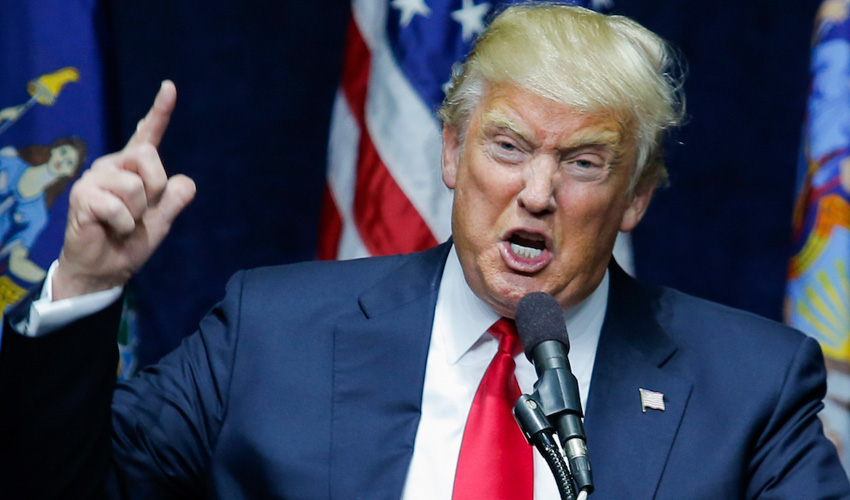
A Thesis on TRUMPOLOGY: Power, Instinct, and the Global Political Arena
OPINION by TA’ZEEM HEJAZI

Morning does not always arrive with light. At times, it arrives with a question so vast that it unsettles the architecture of thought itself. What is this phenomenon that refuses to fit within the neat compartments of political science, that bends the language of leadership, that disrupts the grammar of governance? This inquiry is not casual, nor rhetorical. It is an attempt to define, examine, and interpret a living case study in contemporary power. This is Trumpology — the study of a political method where instinct overtakes ideology, perception rivals reality, and disruption transforms into a governing principle.
There exists a Divine echo older than empires and more enduring than theories:
“And they plan, and Allah plans. And Allah is the best of planners.” (Qur’an 8:30).
Between the visible strategies of human actors and the unseen orchestration of destiny unfolds a theatre where power performs its most revealing acts. Trumpology must be situated within this theatre — not as praise, not as condemnation — but as observation of a phenomenon that belongs unmistakably to our age. It is not merely about one figure; it is about a profound shift in the very mechanics of influence.
Traditional political frameworks, whether articulated in the lecture halls of Europe or the analytical traditions of South Asia, rely on ideological consistency. Leaders are expected to stand upon defined principles — liberalism, conservatism, nationalism — each offering continuity and predictability. Yet Trumpology disrupts this expectation. The method does not operate from rigid ideological anchors. Instead, it reflects fluid instinct, adaptive positioning, and situational recalibration. Decisions emerge from opportunity rather than doctrine. Contradictions are not liabilities; they are absorbed into a broader narrative of immediacy. The guiding question shifts from what is philosophically correct to what is strategically effective in the moment. This reorientation challenges the foundational assumptions of political theory and demands a new lens of analysis — one that treats leadership as behavioral strategy rather than ideological commitment.
In this framework, attention becomes the central currency. Trumpology recognizes that in the modern media environment, visibility is power. Norm-breaking statements are not accidental; they are instruments designed to fracture routine discourse and command focus. Language is simplified, repeated, and reinforced until it embeds itself within collective consciousness. Opponents are not merely debated; they are transformed into characters within an ongoing narrative, a continuous theatre where conflict sustains engagement. The media, often positioned as an adversary, becomes simultaneously an amplifier, its outrage feeding the very visibility it seeks to critique. In this dynamic, the boundaries between communication, performance, and strategy dissolve, giving rise to a new form of political engagement.
A Western reflection holds that falsehood travels swiftly while truth struggles to keep pace. Trumpology extends this observation into a more complex terrain. It is not merely the speed of information that matters; it is the persistence of repetition. A claim, reiterated with confidence and frequency, acquires psychological legitimacy. It occupies space in public consciousness, not because it is universally accepted, but because it is continuously encountered. In this sense, perception does not replace reality; it competes with it, challenging the traditional hierarchy where facts alone define truth.
The habits underlying this method reveal a structured pattern. Communication bypasses conventional institutional filters, speaking directly to audiences in a manner that feels immediate and unmediated. Emotional resonance takes precedence over empirical detail, shaping responses that are felt before they are analyzed. The world is framed in binaries — loyalty and betrayal, strength and weakness, victory and defeat. Such framing simplifies complexity, making political engagement accessible while simultaneously intensifying polarization. This is not accidental; it is a deliberate construction of an ecosystem where belief is reinforced through emotional alignment.
Critics often describe this approach as shamelessness, yet Trumpology invites a more nuanced interpretation. What appears as disregard for conventional norms can be understood as strategic emotional immunity. By refusing to acknowledge criticism in expected ways, the method neutralizes its impact. Scandals, instead of accumulating damage, dissipate through saturation, each new controversy overshadowing the previous one. Apology, traditionally a mechanism of accountability, is replaced by counter-narrative or escalation. In this environment, the absence of visible vulnerability becomes a form of strength. A Hadith of Holy Prophet Muhammad [Peace and blessings be upon Him] reminds us:
“Modesty is part of faith.” (Sahih al-Bukhari, Book of Faith, Hadith 24).
Yet here emerges a counter current where restraint yields to momentum, raising profound questions about the evolving relationship between ethics and effectiveness in public life.
The perception of fearlessness further complicates the analysis. On the surface, Trumpology projects boldness, a willingness to confront and challenge without hesitation. Beneath this projection lies a calculated asymmetry. Risks are undertaken where others hesitate, creating moments of strategic advantage. Conflicts are escalated in ways that force opponents into reactive positions, limiting their capacity to define the narrative. Unpredictability becomes a deliberate tool, disrupting expectations and destabilizing opposition strategies. This is not randomness; it is controlled disruption, a method that leverages uncertainty as a form of power.
The handling of truth within Trumpology remains one of its most contested dimensions. It does not rely solely on fabrication; rather, it operates through selective framing, blending verifiable elements with exaggeration, and reinforcing narratives through repetition. This approach reshapes perception, creating parallel interpretations of reality. Success is not measured by universal acceptance but by the ability to sustain a sufficiently strong base of belief. In this fragmented landscape, truth becomes contested terrain, and the authority of facts is mediated by the strength of narrative.
At this juncture, analysis alone feels insufficient, as though the phenomenon demands a voice that speaks beyond structured reasoning. There emerges, from the quiet margins of thought, a subtle resonance — soft, rhythmic, almost sacred. The faint chime of small brass bells begins to echo. From this sound, a figure takes form: “BaBa Tal.” His presence belongs to neither time nor geography. His attire carries the dust of ancient caravans, and in his hands, small and medium brass bells tremble with a wisdom that predates modern discourse.
He speaks softly, yet his voice settles deeply: “Bacha… truth is light, but power often travels faster in shadow.” The bells respond — ching… ching… “People do not abandon truth easily,” he continues, “they are guided away from it — gently, repeatedly, until familiarity replaces certainty.” His gaze lingers, reflecting something older than politics itself. “The heart does not always verify; it feels, and then it believes.” The chimes soften — ching… ching… and “BaBa Tal” fades into that Sufi realm where meanings complete themselves beyond words.

Returning to structured inquiry, it becomes evident that Trumpology cannot be understood without examining its emotional core. Beneath strategies and tactics lies a structure shaped by fundamental human drives — the desire for recognition, the sensitivity to loyalty and betrayal, and the need for affirmation through audience response. These elements inform outward behavior, linking internal emotional landscapes with external manifestations of power. The performative dimension is not superficial; it is integral, reflecting continuous interaction between identity and audience.
Equally essential is the role of the support base, functioning not as a passive audience but as an active participant. This constituency values authenticity over refinement, prioritizing perceived honesty even when it challenges conventional standards. Skepticism toward institutions creates receptivity for alternative narratives, while themes of strength, identity, and grievance resonate deeply. The relationship between the method and its followers becomes reciprocal, a feedback loop in which each reinforces the other. In this dynamic, Trumpology evolves from individual behavior into a collective phenomenon.
As the analysis expands, it becomes clear that Trumpology transcends any single expression. It represents a broader transformation within the political landscape, where image accelerates beyond substance, and emotional resonance outweighs analytical rigor. Disruption, once considered deviation, becomes an instrument of governance. This shift reflects deeper societal conditions — rapid information flows, heightened polarization, and the dominance of immediacy. A Western poetic voice once lamented that the world is too much with us. In such an environment, phenomena like Trumpology do not emerge as anomalies; they emerge as symptoms.
The implications extend into democratic practice itself. If perception rivals reality, if repetition shapes belief, and if disruption sustains engagement, then accountability and deliberation undergo transformation. The role of media, the expectations of leadership, and the responsibilities of citizens are redefined. Trumpology thus becomes not only a subject of study but a lens through which to examine the evolving nature of democracy.
Yet, balance remains essential. Trumpology is neither to be embraced blindly nor dismissed arrogantly. It demands rigorous examination and intellectual honesty. It challenges assumptions about truth and power, emotion and reason, individual agency and collective response. In doing so, it invites deeper engagement with the forces shaping contemporary political life.
As this inquiry approaches its natural pause, it resists closure. Trumpology is not a concluded chapter; it is an unfolding narrative. Each statement, each reaction, each shift in perception contributes to its evolution. The questions it raises remain open. Has truth weakened, or has perception strengthened? Has leadership evolved, or fragmented? Are we witnessing deviation, or the emergence of a new paradigm?
Between mind and heart, between strategy and instinct, between voice and silence, a new grammar of power continues to be written. And perhaps, in the quiet spaces beyond analysis, the faint echo of “BaBa Tal” lingers — ching… ching… — reminding us that the age does not belong to the loudest voice, but to the one who understands what the world is ready to hear.
In precise academic terms, Trumpology may be defined as the systematic study of a contemporary political method characterized by instinct-driven decision-making, strategic use of media attention, narrative dominance through repetition, emotional mobilization of support bases, and the deliberate disruption of traditional norms of governance and communication. It is both a descriptive framework and an analytical lens, enabling scholars to examine how modern leadership can operate beyond classical ideological boundaries while reshaping democratic engagement.
This study is not complete—and perhaps it can never truly be complete. For Trumpology is a living phenomenon, one that reshapes itself with each passing day.
And when this phenomenon is examined more closely, the nature of power reveals itself in a new form. The President’s style of governance does not remain confined to traditional political maneuvers; rather, it transforms into a composite in which falsehood, intimidation, manipulation, deceit, threats, and opportunism become so intricately fused that their boundaries dissolve. These elements do not appear scattered; instead, they seem to function as parts of a deliberate strategy—as if it were a tested formula of power, refined repeatedly and presented each time in a new guise.
At this point, the mind involuntarily drifts toward former President Ronald Reagan—an accomplished Hollywood actor who journeyed from performance to politics. Yet what is striking is that President Trump, despite not being a professional actor, commands the stage like a seasoned performer. Standing far removed from objective reality, he presents his narrative with such skill that falsehood—through sheer persistence, audacity, and intensity of confidence—begins to wear the attire of truth. It ceases to be mere speech; it becomes a performance, a constructed scene in which words do not reflect reality but instead manufacture perception.
It is within this very state that a new term is born—Trumpology. All those negative traits which traditional morality once deemed weaknesses are employed by him with such clarity and boldness that they transform into instruments of strength. This is not merely behavior; it is a concept—not just a strategy, but a complete system. He weaves its webs himself and breathes motion into them as well. At times, it almost feels as though the spirit of a master of guerrilla warfare has been infused into this method—silent, unpredictable, and ever ready to strike—while the shadow of Goebbels, the infamous lieutenant of Great Adolf Hitler, looms as a guiding influence behind the craft
And it is precisely here that the faint chimes of “BaBa Tal” are heard once more—chhan… chhan… as he whispers,
“Bacha… not every war is fought with the sword; some wars are won through narrative.”
And then he dissolves into silence, as though completing the meaning requires his own disappearance.■■■
Comments are closed, but trackbacks and pingbacks are open.